Thomas Goltz - Chechnya Diary
Здесь есть возможность читать онлайн «Thomas Goltz - Chechnya Diary» весь текст электронной книги совершенно бесплатно (целиком полную версию без сокращений). В некоторых случаях можно слушать аудио, скачать через торрент в формате fb2 и присутствует краткое содержание. Город: New York, Год выпуска: 2011, ISBN: 2011, Издательство: Thomas Dunne Books, Жанр: Биографии и Мемуары, military_history, Публицистика, на английском языке. Описание произведения, (предисловие) а так же отзывы посетителей доступны на портале библиотеки ЛибКат.
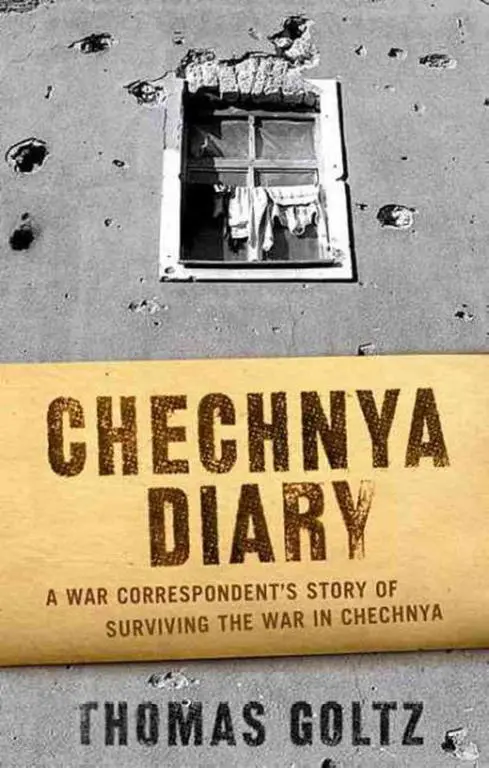
- Название:Chechnya Diary
- Автор:
- Издательство:Thomas Dunne Books
- Жанр:
- Год:2011
- Город:New York
- ISBN:0-312-26874-2
- Рейтинг книги:3 / 5. Голосов: 1
-
Избранное:Добавить в избранное
- Отзывы:
-
Ваша оценка:
Chechnya Diary: краткое содержание, описание и аннотация
Предлагаем к чтению аннотацию, описание, краткое содержание или предисловие (зависит от того, что написал сам автор книги «Chechnya Diary»). Если вы не нашли необходимую информацию о книге — напишите в комментариях, мы постараемся отыскать её.
is part of a larger exploration of the role (and impact) of the media in conflict areas. And at its heart,
is the story of Hussein, the leader of the local resistance in the small town that bears the brunt of the massacre as it is drawn into war.
This is a deeply personal book, a first person narrative that reads like an adventure but addresses larger theoretical issues ranging from the history of ethnic/nationalities in the USSR and the Russian Federation to journalistic responsibility in crisis zones.
is a crossover work that offers both the historical context and a ground-level view of a complex and brutal war.
Chechnya Diary — читать онлайн бесплатно полную книгу (весь текст) целиком
Ниже представлен текст книги, разбитый по страницам. Система сохранения места последней прочитанной страницы, позволяет с удобством читать онлайн бесплатно книгу «Chechnya Diary», без необходимости каждый раз заново искать на чём Вы остановились. Поставьте закладку, и сможете в любой момент перейти на страницу, на которой закончили чтение.
Интервал:
Закладка:
“Come and watch how we make the Russian Bear tremble!” said the former Soviet Strategic Air Command General, inviting me to the self-styled Republic of Ichkeria, which is what the Chechens called their unrecognized state.
The occasion that provided itself for my own illegal flight into the Chechen capital was yet another presidential funeral, namely the last rites of Zviad Gamsakhurdia, the deposed president of Georgia, who was to be interred in the garden of his residence-in-exile on February 24, 1994.
Although we had never met, Gamsakhurdia and I had a deeply personal connection. It was Zviad who had inadvertently introduced me to the complicated ethnic mess that was post-Soviet Georgia, and by extension and extrapolation, to the larger and more complicated ethnic mess of the post-Soviet Caucasus as a whole. In early 1992 I had been called upon to travel to the town of Sukhumi, capital of the western Georgian province of Abkhazia on the shores of the Black Sea, to find the just-putsched president and exclusively interview him about how it felt to be the first post-Soviet leader to be driven from power. Zviad’s supporters blamed his demise on a deep, dark collusion between the Russian military and Mikhail Gorbachev’s former Foreign Minister and James Baker III’s fly-fishing friend, Eduard Shevardnadze. Sadly, Zviad was not available to comment on any of this. He had not been hiding out in Sukhumi, Zugdidi, Poti or anywhere else in western Georgia. Rather, he had fled to Grozny and set up a government-in-exile there with the blessing of his host, Djohar Dudayev. And there he remained until September 1993, when an unholy alliance of Abkhaz separatists, backed by Chechen and other North Caucasian volunteers, Russian cossack freebooters, and rogue elements of the Russian military (such as the Air Force) drove Shevardnadze and the ragtag bunch of gunmen that tried to pass for an army from Sukhumi—a little episode many took to calling “Shevy’s Last Stand.”
Yes, it was a sad and confusing time, but on a personal and professional level very useful to me for the opportunity it provided to become acquainted with Caucasus-style chaos theory and to be introduced to my dear and lifetime friends, including a certain S. Lawrence Sheets.
As chaos and trauma descended on Georgia, Zviad Gamsakhurdia decided the moment had come to return home, oust Shevardnadze and restore his own government to power. Sadly for Zviad, he overplayed his hand. Shevardnadze loyalists, now backed by Russian armor, ran Gamsakhurdia to the ground in the mountains of Svanetia, where he was either killed by supporters (some say by his wife), committed suicide, or died of some illness and lay buried in an unmarked grave. There was never an autopsy.
The Gamaskhurdia revolt (or attempted restoration) collapsed, and in an attempt to start the process of inter-Georgian reconciliation, Shevardnadze allowed Zviad’s body to be exhumed and transported to Grozny for reburial in the garden of the villa that had served as Zviad’s headquarters-in-exile. It seemed poetically appropriate for me to meet in death the man I had pursued but never met alive. I thus vowed to attend his state funeral in the Chechen capital, which would give me the opportunity to poke around town and make my own assessment of what was usually described as the “bandit” state of the Caucasus.
The problem was getting there. Since its declaration of independence in the fall of 1991, Chechnya had been a belligerent island in a Russian sea, and the Russian Foreign Ministry did not issue visas to casual visitors because of a declared state of emergency in Chechnya. The one effort to reassert control over the breakaway state in December of 1991 had ended in an utter fiasco: A planeload of Spesnatz paratroopers had flown in, but were disarmed by the airport guards, put on buses and sent back to “mainland” Russia, their collective tail between their legs. After that, Moscow slapped a quasi-blockade around the renegade state. “Quasi” because it was in the interests of many in Moscow to maintain a black hole in the Russian economy, a sort of tax-free haven for commodities ranging from weapons to human beings.
My own approach vehicle was a blockade-busting Tupolov 154 death-trap jet, flying from Baku to Grozny on its way to Dubai via Istanbul. It was flying empty on the first leg of its journey to pick up a couple hundred Chechen “suitcase” businessmen on a shopping trip for cut-rate electronic goods in the Gulf, who would then flog their new Sony VCRs, television sets, and refrigerators in the Grozny market to middlemen who always seemed able to get such items to other markets in the farthest corners of the Russian Federation. With the aid of fifty dollars, the Tupolov blockade-buster became my private aircraft, at least on the Baku-Grozny leg. To this day, some people say I hijacked the plane, but that’s just not true. Ask ace American photographer Stanley Greene or Le Monde correspondent Natalie Nougayrede, whom I invited along for the ride.
As the only passengers on board we enjoyed VIP treatment from the staff. In addition to as many warm bottles of green-tinted mineral water as we wanted, the cabin crew was kind enough to supply shots of vodka in brown plastic cups. Our takeoff was of course delayed, but this allowed us to inspect our aircraft.
We found it wanting. The ashtrays in the armrests, for example, had all been removed; so we flicked our cigarettes on the floor and ground the butts into the carpet, as had many others before us, judging by burn marks. I refrain from describing the condition of the toilets.
“This plane is in pretty good shape, compared to some I have flown on these biznessman junkets to the Gulf,” said the pilot, a former Soviet Air Force comrade of Dudayev’s, who was named Othello, I believe. “Usually, the seats are stripped out to make room for refrigerators, and the passengers have to sit on the floor.”
Finally, after some four hours on the ground we received clearance to fly. Acting on the general principle of violating as many laws as possible, we stood up for takeoff, a cigarette in one hand and shot of vodka in the other. Then, after an hour or so in the air, the T-154 began its descent through the leaden sky, the no-smoking sign clicked on, followed by the fasten-seat-belt warning. We three regarded neither. The flaps came down and then the wheels, and the pilot guided the plane into Grozny’s Khankala airport for landing. The T-154 rumbled to a halt and Stanley nudged me in the ribs and pointed out the window. An airplane was parked not a wingspan from ours, although it was not going any place soon: it was another T-154, its back broken and the guts burnt out.
Last week’s unreported crash landing? we wondered. Who knew… The staircase was trundled out and we three passengers disembarked with the crew. No sooner were we on the ground than we were sprawled on our butts. There was a layer of ice everywhere, from the plane to the terminal and presumably all across the runway.
Welcome to Grozny . It was my first step in Chechnya, and it was slippery.
So was the next—namely, entering the country. The Khankale Airport lounge—to abuse the word—was filled with hard-eyed men and women in furry caps and great coats, clutching plastic bags filled with bottles of vodka and tins of caviar to trade for goods in the gleaming shopping-mall nirvana of Dubai, and all looked mean. Stanley and Natalie had Russian visas but I was, strictly speaking, an illegal alien and obliged to approach the customs man with deference and apprehension. The plan was to explain how President Dudayev himself had invited me to Chechnya, and that the officer should call the president and ask, if he doubted my word….
But the official, squatting behind a cardboard box and stamping the papers of black-marketeer Chechens out of Russia, was uninterested in my arrival, visa or not. When he had stamped out the last merchant, he just kicked the box aside and walked away. I had just entered Chechnya, a place famous for its disregard for the law.
Читать дальшеИнтервал:
Закладка:
Похожие книги на «Chechnya Diary»
Представляем Вашему вниманию похожие книги на «Chechnya Diary» списком для выбора. Мы отобрали схожую по названию и смыслу литературу в надежде предоставить читателям больше вариантов отыскать новые, интересные, ещё непрочитанные произведения.






Обсуждение, отзывы о книге «Chechnya Diary» и просто собственные мнения читателей. Оставьте ваши комментарии, напишите, что Вы думаете о произведении, его смысле или главных героях. Укажите что конкретно понравилось, а что нет, и почему Вы так считаете.