Shakespeare
Здесь есть возможность читать онлайн «Shakespeare» весь текст электронной книги совершенно бесплатно (целиком полную версию без сокращений). В некоторых случаях можно слушать аудио, скачать через торрент в формате fb2 и присутствует краткое содержание. Год выпуска: 2005, ISBN: 2005, Жанр: Биографии и Мемуары, на английском языке. Описание произведения, (предисловие) а так же отзывы посетителей доступны на портале библиотеки ЛибКат.
- Название:Shakespeare
- Автор:
- Жанр:
- Год:2005
- ISBN:978-0-307-49082-7
- Рейтинг книги:5 / 5. Голосов: 1
-
Избранное:Добавить в избранное
- Отзывы:
-
Ваша оценка:
Shakespeare: краткое содержание, описание и аннотация
Предлагаем к чтению аннотацию, описание, краткое содержание или предисловие (зависит от того, что написал сам автор книги «Shakespeare»). Если вы не нашли необходимую информацию о книге — напишите в комментариях, мы постараемся отыскать её.
Shakespeare — читать онлайн бесплатно полную книгу (весь текст) целиком
Ниже представлен текст книги, разбитый по страницам. Система сохранения места последней прочитанной страницы, позволяет с удобством читать онлайн бесплатно книгу «Shakespeare», без необходимости каждый раз заново искать на чём Вы остановились. Поставьте закладку, и сможете в любой момент перейти на страницу, на которой закончили чтение.
Интервал:
Закладка:
At the very beginning of 1598 the bailiff of Stratford, Abraham Sturley, was ready to approach Shakespeare with news of a likely investment. He had informed a close relative, Richard Quiney, alderman, “that our countriman mr Shaksper is willinge to disburse some monei vpon some od yardeland or other att Shottri or neare about vs; he thinketh it a veri fitt patterne to move him to deale in the matter of our tithes.” Sturley went on to say that “Bi the instruccions you can geve him theareof, we thinke it a faire mark for him to shoote att, and not unpossible to hitt. It obtained would advance him in deede, and would do vs muche good.” 4
So the new owner of New Place was already a gentleman of financial consequence in Stratford. It seems likely that he was being asked to consider the purchase of the house and land of his wife’s stepmother, Joan Hathaway, in Shottery; the old woman died in the following year, leaving 21/2 yardlands (a yardland being approximately 30 acres) as well as the farmhouse now known as “Anne Hathaway’s Cottage.” He was also considered to be in the market for the purchase of “tithes,” money in lieu of a percentage of crops or farm-stock on land possessed by tithe-holders; it had once been a religious obligation which had become a matter of lay ownership.
It is not clear which particular tithes Quiney and Sturley had in mind- although they were the “farmers” of the “Clopton tithe-hay”-but the essential point is that Shakespeare did not take up their offer. He did not in fact purchase tithes until 1605, which suggests a measure of prudence on his part. In the 1590s, Stratford was in a condition of economic and social depression. In the same letter Abraham Sturley notes that “our neighbours are grown, with the wants they feel through the dearness of corn, malcontent.” The succession of bad harvests had weakened the financial strength of the town, and there had been two recent widespread and devastating fires that had further depressed the price of property. It was one of the reasons why Shakespeare had been able to purchase New Place so cheaply. Richard Quiney was in fact in London on pressing local business when he received the letter from Abraham Sturley. As alderman he had been charged with the responsibility of pleading Stratford’s case with the national administration. The town asked to be made exempt from certain taxes, and wished to be given more ample provision from a fire-relief fund.
And then later in the year Richard Quiney decided to approach Shakespeare on another matter. He needed a loan on behalf of the Stratford Corporation. Who else to ask but the man who was arguably now the wealthiest householder in Stratford? So in October 1598, from his London lodgings at the Bell Inn in Carter Lane, he wrote a letter to his “Loveinge Countreyman” declaring that “I am bolde of yowe as of a ffrende, craveing yowre helpe with xxx li [£30] … Yowe shall ffrende me muche in helpeinge me out of all the debettes I owe in London, I thancke god, amp; muche quiet my mynde.” He then noted that he had gone to “Cowrte” at Richmond over Stratford affairs and pledged that Shakespeare “shall neither loase creddytt nor monney by me, the Lord wyllinge … amp; yf we Bargaine farther yowe shalbe the paiemaster yowre self.” It seems likely that Richard Quiney needed the money to sustain his advocacy of Stratford’s business in the capital. News of his attempts to borrow money from Shakespeare reached Stratford itself, and eleven days later (the speed of the post was not great) Abraham Sturley wrote to him saying that he had heard “our countriman Mr. Wm Shak, would procure vs monei, which I will like of as I shall heare when, and wheare, and howe.” 5It does not take an over-sensitive ear to detect a note of scepticism or caution on Sturley’s part. Did Shakespeare have a reputation for meanness or avariciousness? It is not an impossible assumption. He took small debtors to court. Yet it is more likely that his financial reputation, if such it was, was that of canniness rather than avarice. The idea that Shakespeare would “procure” the requisite sum suggests that Shakespeare may have been ready to deal with a money-lender on Quiney’s behalf. There have even been suggestions that, like his father, Shakespeare himself acted as a part-time moneylender. In the conditions of the time, and in the absence of banks, this was not an unusual activity for a wealthy man. It will seem inappropriate only to those who hold an excessively romantic opinion of eminent writers.
The letter to Shakespeare was in fact never sent, and was later found among Quiney’s papers. Perhaps the alderman had decided to pay a call on his countryman. But where was he to find him? In November 1597 the dramatist had failed to pay 5 shillings in property tax to the collectors of St. Helen’s Bishopsgate. He was one of those who were “dead, departed, and gone out of the said ward.” It may be that he had already removed to Southwark, out of the reach of the Bishopsgate collectors. In the following year, 1598, he was listed again by the parish authorities for non-payment of 13 s 4 d . He had certainly moved to Southwark by 1600, for in that year he is reported to the officers of the Bishop of Winchester for having still failed to pay his property tax. The Bishop of Winchester had jurisdiction over that area of Southwark known as the Clink. It was a common enough offence but it is still difficult to understand why the wealthy Shakespeare seems deliberately to have withheld payment of a standard tax. Was it laziness or meanness? Or did he feel that he had discharged his obligations by paying taxes in Stratford? Did he not consider himself to be thoroughly “settled” in London? Did he feel that he owed London nothing or, perhaps more likely, that he owed the world nothing?
Part VII. The Globe
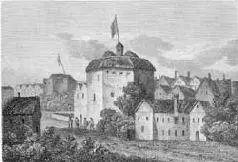
The Globe Theatre on Bankside.
CHAPTER 59. A Pretty Plot. Well Chosen to Build Vpon
In the summer of 1598 there were still demands from the civic authorities and indeed from the members of the Privy Council that the theatres should be “plucked down” as a result of the “lewd matters that are handled on the stages.” 1This had become something of an occupational hazard, and the playhouses simply ignored the injunctions. Given the undoubted popularity of plays and playhouses there was also going to be competition, official or unofficial, springing up to challenge the two established companies. The Earl of Pembroke’s Men had put on The Isle of Dogs at the Swan, as we have seen, before being disbanded.
New theatres were about to be erected in the city and northern suburbs, also, among them the Fortune and the newly refurbished Boar’s Head. In addition, the boys’ companies were soon to be in operation again. In the following year an indoor playhouse was opened in the precincts of St. Paul’s grammar school, where the children of St. Paul’s performed two plays by a new writer, who referred to himself as the “barking satirist,” John Marston. The competition demonstrated the vitality of theatrical life in London, but it was an annoyance to the already established players. Nevertheless the Lord Chamberlain’s Men were still at the Curtain, and the Admiral’s Men across the river at the Rose. There is no record of the players touring in this year, so it can be supposed that Shakespeare and the rest of the company were playing in the capital. We know that they were performing Ben Jonson’s new play, Every Man in His Humour , in the autumn of 1598. So Shakespeare acted in a drama written by one whom posterity has declared to be his “rival.” Reports of such rivalry are always greatly exaggerated by various partisans. We may place them against the testimony that Shakespeare became godfather to one of Jonson’s children.
Читать дальшеИнтервал:
Закладка:
Похожие книги на «Shakespeare»
Представляем Вашему вниманию похожие книги на «Shakespeare» списком для выбора. Мы отобрали схожую по названию и смыслу литературу в надежде предоставить читателям больше вариантов отыскать новые, интересные, ещё непрочитанные произведения.








Обсуждение, отзывы о книге «Shakespeare» и просто собственные мнения читателей. Оставьте ваши комментарии, напишите, что Вы думаете о произведении, его смысле или главных героях. Укажите что конкретно понравилось, а что нет, и почему Вы так считаете.