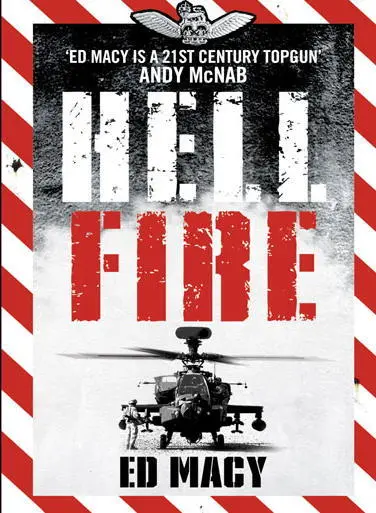
Ed Macy - Hellfire
Здесь есть возможность читать онлайн «Ed Macy - Hellfire» — ознакомительный отрывок электронной книги совершенно бесплатно, а после прочтения отрывка купить полную версию. В некоторых случаях можно слушать аудио, скачать через торрент в формате fb2 и присутствует краткое содержание. Город: London, Год выпуска: 2009, ISBN: 2009, Издательство: HarperPress, Жанр: Биографии и Мемуары, nonf_military, на английском языке. Описание произведения, (предисловие) а так же отзывы посетителей доступны на портале библиотеки ЛибКат.
- Название:Hellfire
- Автор:
- Издательство:HarperPress
- Жанр:
- Год:2009
- Город:London
- ISBN:978-0-007-34292-1
- Рейтинг книги:3 / 5. Голосов: 1
-
Избранное:Добавить в избранное
- Отзывы:
-
Ваша оценка:
Hellfire: краткое содержание, описание и аннотация
Предлагаем к чтению аннотацию, описание, краткое содержание или предисловие (зависит от того, что написал сам автор книги «Hellfire»). Если вы не нашли необходимую информацию о книге — напишите в комментариях, мы постараемся отыскать её.
Ed Macy bent every rule in the book to get to where he wanted to be: on Ops in the stinking heat of the Afghan summer, with the world’s greatest weapons system at his fingertips. It’s 2006 and he is part of an elite group of pilots assigned to the controversial Apache AH Mk1 gunship programme. So far, though, the monstrously expensive Apache has done little to disprove its detractors. For the first month ‘in action’ Ed sees little more from his cockpit than the back end of a Chinook.
But everything changes in the skies over Now Zad. Under fire and out of options, Ed has one chance to save his own skin and those of the men on the ground. Though the Apache bristles with awesome weaponry, its fearsome Hellfire missile has never been fired in combat. Then, in the blistering heat of the firefight, the trigger is pulled.
It’s a split-second decision that forever changes the course of the Afghan war, as overnight the gunship is transformed from being an expensive liability to the British Army’s greatest asset. From that moment on, Ed and his squadron mates will face the steepest learning curve of their lives – fighting an endless series of high-octane missions against a cunning and constantly evolving enemy. Ed himself will have to risk everything to fly, fight and survive in the most hostile place on earth.
http://www.youtube.com/watch?v=LNP1lbLNKqA
Hellfire — читать онлайн ознакомительный отрывок
Ниже представлен текст книги, разбитый по страницам. Система сохранения места последней прочитанной страницы, позволяет с удобством читать онлайн бесплатно книгу «Hellfire», без необходимости каждый раз заново искать на чём Вы остановились. Поставьте закладку, и сможете в любой момент перейти на страницу, на которой закончили чтение.
Интервал:
Закладка:
Some of the peak temperatures still pushed us extremely close to our limits. The Apache was initially cleared not to exceed forty degrees. On most days, we’d seen the needle creep closer to fifty. We were in uncharted territory. It would be bad enough to lose an aircraft due to enemy action; it would be criminal if we lost one because we’d just not paid enough attention to the climatic conditions.
Getting the weapons aligned was a slow, methodical operation. I’d devised the method myself after the IPT gave us a no-show on a solution. In one particular Apache, the left launcher was found to be one and a half degrees low, which would have resulted in its rockets falling almost 700 metres short of their target. The right launcher, on the other hand, would have dispatched its ordnance more than 300 metres long; the total dispersal area would have been a kilometre wide. We would have been inviting catastrophe every time we fired: a blue-on-blue of headline-grabbing proportions.
The technicians were losing weight fast and getting blacker by the day as they struggled to push out as many hours as possible. I joined them in the sweltering bays, working side by side to ready the gunships. Getting the weapons sorted was no picnic in this heat and I eventually took a break in the groundies’ tent beside the flight line. Sheltered by a Hesco Bastion wall, it was a twelve foot square affair with no ends, a table and a few well-carved benches.
‘All right Taff? Mind if I grab some warm water?’
‘Get it quick,’ he said. ‘There’ll be none left when this lot finish.’
Four of the team were stuffing multiple king-size muffins into their mouths.
‘What on earth are they up to?’
‘Ah…’ His eyes gleamed. ‘That would be the Spunk-muffin Challenge, sir.’
Taff saved me the embarrassment of inquiring.
‘The boys get free Otis Spunkmeyer muffins from the MWR, don’t they? And bring them back here by the truckload. They were about to hit their best before date, so I’m making them eat ’em, see, for being greedy. That’ll learn ‘em.’
The challenge was to eat five as fast as they could. The winner dropped out and the remainder had to do the challenge again. The numbers worked out perfectly.
‘When I was at a Navy Seals base in the States they had something called the Subway Challenge.’
‘What’s that?’ Gifted asked.
A blond lad with boyish good looks, he was the youngest member of the team; every mother’s dream. Fresh from school he turned up on his first day in the army wearing a T-shirt with ‘GIFTED’ emblazoned across it. The name stuck because he wasn’t.
I began to regret opening my mouth, but they pushed me for an explanation. Little did I know I’d just inspired them…
Lieutenant Colonel Richard Felton stood at the far end of the bird table and sucked thoughtfully on a cigarette. How anyone could smoke in this heat was beyond me, but it was the way the CO did it that cracked me up. He pinched the tab between the very tips of the index and middle fingers of his right hand, keeping it as far as possible from his lips until the moment he seemed to force himself to take a drag, face contorted, as if it was a freshly lit fuse that might detonate at any moment.
‘The Rules of Engagement, gentlemen…’ Legs crossed, left hand on his hip, he started to outline, in that soft, well-spoken way of his, exactly what we could and could not do while we were in-theatre. If it wasn’t for the seriousness of the brief and the fact that Felton was one of the youngest, toughest, no-nonsense colonels on the circuit, we’d have been forgiven for thinking we’d walked into a sketch for Comic Relief .
The ROE briefing was always going to be a bitch; I’d need to keep my wits about me. So far, our enemy were armed with little more than small arms and RPGs. But we already knew they weren’t afraid of the Apache, the weapon system that had been billed as a quantum leap in the way the British Army would fight future wars. The Taliban were medieval in their fighting methods – but also in their brutality. The boffins called it asymmetric warfare. All we knew was that with a handful of rudimentary weapons the bad guys had levelled the playing field.
Lieutenant Colonel Felton took a last drag of his cigarette before dropping it into the dregs of his coffee. I checked the battery level on my digital voice-recorder and placed it on the edge of the bird table, next to the map that depicted our area of operations. The temperature in the long metal tube that housed the CO’s HQ was unbelievable. I glanced at the blokes propped around the table. Simon, Billy, Pat, Tony, Carl, Nick and the others seemed to be taking it in their stride. If I was the only one suffering, I didn’t want them to know.
‘I know how much you’ve been looking forward to this,’ Felton said. There was a groan from the floor. ‘There are basically two different scenarios in which the ROE apply. The first is where we’re told to go and destroy a target deliberately – a known Taliban HQ, for example. Deliberate Attacks are covered under a document called the Targeting Directive. It’s for pre-planned targets only and will have been cleared by government, with signatures all the way to the top. So, if the Intelligence community find a Taliban set-up at a particular location and we confirm it’s definitely there, and the authority is given from Whitehall, then that is a legitimate target under the current guidelines. Is that clear?’
Billy nudged me and muttered in my ear: ‘They’re giving with one hand and taking away with the other.’
Yup, I thought. Legitimate, maybe, but once all those checks and balances had been attended to, it wouldn’t be us who’d be inflicting the damage, it would be fast air in their Harriers, B-1Bs and A-10s.
But the fun and games had only just begun.
‘Fast air don’t have it all their own way,’ Felton continued, ‘because the target set also has to conform to the collateral damage matrix. Each of the nations out here has different ideas over what constitutes collateral damage.’
Someone opened the door behind us and a blast of air from the furnace outside blew through the HQ, scattering the ROE sheets across the bird table. Beads of sweat dripped from one lad’s nose. I forced myself to focus on what the CO was saying.
‘The second scenario and the rules that affect you basically fall into two categories: self-defence and when you want to take specific action against a target for a reason other than self-defence.’ The second category was obviously the hot potato.
If, for example, the enemy below was about to lob a mortar round at our boys on the ground – we would be allowed to engage without consulting the chain of command, as long as we had ‘reasonable belief’ that the person in our sights was the enemy.
Somebody next to me made a choking sound. If the CO heard he didn’t show it, but the civilian in the chair behind him clearly did; I saw him glance up sharply from his notepad like an eagle-eyed schoolteacher. We were never told who this individual was, but in his conspicuously smart clothes, God bless him, he might as well have had ‘Whitehall’ stamped across his forehead. He was probably a lawyer of some description; maybe the pen-pusher who’d drafted this nonsense in the first place.
How the hell were we meant to know who had hostile intent when just about every male in Afghanistan carried a weapon. In the middle of the Green Zone a primitive house and a few livestock was all that most could afford, but they were never without an AK47 and a moped. How were we to know the difference between a farmer out patrolling his crop or the Taliban out patrolling? With a distinct lack of uniforms it was impossible to distinguish the enemy from the Afghan Army, Afghan Police, Afghan Security Forces and some other discreet security forces.
Читать дальшеИнтервал:
Закладка:
Похожие книги на «Hellfire»
Представляем Вашему вниманию похожие книги на «Hellfire» списком для выбора. Мы отобрали схожую по названию и смыслу литературу в надежде предоставить читателям больше вариантов отыскать новые, интересные, ещё непрочитанные произведения.



Обсуждение, отзывы о книге «Hellfire» и просто собственные мнения читателей. Оставьте ваши комментарии, напишите, что Вы думаете о произведении, его смысле или главных героях. Укажите что конкретно понравилось, а что нет, и почему Вы так считаете.