Ed Macy - Hellfire
Здесь есть возможность читать онлайн «Ed Macy - Hellfire» — ознакомительный отрывок электронной книги совершенно бесплатно, а после прочтения отрывка купить полную версию. В некоторых случаях можно слушать аудио, скачать через торрент в формате fb2 и присутствует краткое содержание. Город: London, Год выпуска: 2009, ISBN: 2009, Издательство: HarperPress, Жанр: Биографии и Мемуары, nonf_military, на английском языке. Описание произведения, (предисловие) а так же отзывы посетителей доступны на портале библиотеки ЛибКат.
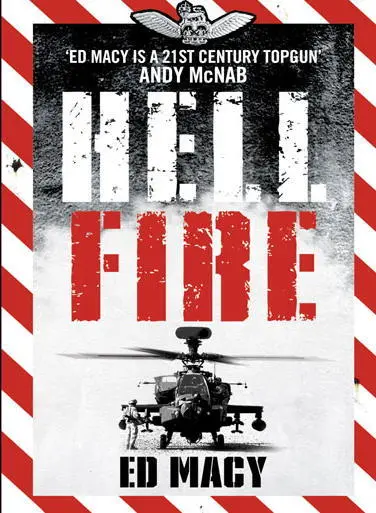
- Название:Hellfire
- Автор:
- Издательство:HarperPress
- Жанр:
- Год:2009
- Город:London
- ISBN:978-0-007-34292-1
- Рейтинг книги:3 / 5. Голосов: 1
-
Избранное:Добавить в избранное
- Отзывы:
-
Ваша оценка:
Hellfire: краткое содержание, описание и аннотация
Предлагаем к чтению аннотацию, описание, краткое содержание или предисловие (зависит от того, что написал сам автор книги «Hellfire»). Если вы не нашли необходимую информацию о книге — напишите в комментариях, мы постараемся отыскать её.
Ed Macy bent every rule in the book to get to where he wanted to be: on Ops in the stinking heat of the Afghan summer, with the world’s greatest weapons system at his fingertips. It’s 2006 and he is part of an elite group of pilots assigned to the controversial Apache AH Mk1 gunship programme. So far, though, the monstrously expensive Apache has done little to disprove its detractors. For the first month ‘in action’ Ed sees little more from his cockpit than the back end of a Chinook.
But everything changes in the skies over Now Zad. Under fire and out of options, Ed has one chance to save his own skin and those of the men on the ground. Though the Apache bristles with awesome weaponry, its fearsome Hellfire missile has never been fired in combat. Then, in the blistering heat of the firefight, the trigger is pulled.
It’s a split-second decision that forever changes the course of the Afghan war, as overnight the gunship is transformed from being an expensive liability to the British Army’s greatest asset. From that moment on, Ed and his squadron mates will face the steepest learning curve of their lives – fighting an endless series of high-octane missions against a cunning and constantly evolving enemy. Ed himself will have to risk everything to fly, fight and survive in the most hostile place on earth.
http://www.youtube.com/watch?v=LNP1lbLNKqA
Hellfire — читать онлайн ознакомительный отрывок
Ниже представлен текст книги, разбитый по страницам. Система сохранения места последней прочитанной страницы, позволяет с удобством читать онлайн бесплатно книгу «Hellfire», без необходимости каждый раз заново искать на чём Вы остановились. Поставьте закладку, и сможете в любой момент перейти на страницу, на которой закончили чтение.
Интервал:
Закладка:
‘Twelve o’clock, fifteen kilometres, Camp Bastion,’ Billy said.
I peered out of the cockpit and saw nothing except for tyre-tracks criss-crossing the barren wastes below us. Billy still had the TADS set to DTV zoom and I could see Bastion starting to take shape in black and white on the screen. First some tunnel-type tents in the south-east corner of the base, then other features sprang into view: the berm bulldozed up around the perimeter, the sangars with their tin roofs and sandbag fortifications and numerous vehicle parks brimming with Land Rovers and various types of APCs. A Chinook sat at the northern edge, blades milling, on one of two square pads that marked out the HLS.
There were two stationary Apaches on the other pad. The HLS was tiny compared to the luxurious concrete-lined complex we’d become used to at KAF. Technically, we were supposed to be able to fit four Apaches at a pinch on one pad, but I wondered, from up here how that would be possible. I didn’t have time to dwell on it, because Hardwood Two One, the second Chinook, lifted off its square. When it popped out of its own dust cloud, I could see its underslung load: a bunch of crates in a low-hanging net. The Chinook hugged the ground for several hundred metres then rose to meet us in a zoom climb.
As soon as we RV’d, we set course to the north and our next destination: Now Zad.
The two Chinooks flew in formation about a thousand metres apart. Billy and I took up station above and around two kilometres behind and to the left of them; Jon and Simon did the same to their right.
We could see the Chinooks from our vantage point, and more importantly the ground beneath and behind them. Our primary concern was a SAM launch. Unlike us, the Chinooks didn’t always have an integrated defensive aids suite. If the Taliban did fire on them, they’d have to rely on the good old Mark 1 Eyeball – ours as well as theirs – to spot the launch plume. After that, it would be down to good judgement and their ‘pippers’, hand-held controllers like the ones I’d seen on the C-130 flight from Kabul to KAF, to launch flares to seduce the missile away from the aircraft.
The only place where the threat was deemed at all likely on this segment of our journey was the point at which we crossed Highway Zero One, which looped around most of Afghanistan. You never quite knew who was going to be on the road as you roared across it – on this occasion we were fortunate; it was empty – and we always treated it with respect.
Shortly afterwards I saw a pockmarked town, smaller than Lashkar Gah. Surrounded by hills and mountains Now Zad sat in a basin, with a rough road running north-south for around 500 metres through its centre.
Houses spread back for 300 metres on either side of this road, with smaller streets and alleyways running east-west. The place looked medieval in its chaos. The houses were ramshackle and built to no discernible pattern, the majority constructed on one or two levels, with access to the flat roofs via a staircase from within. The roofs of the handful of three-storey buildings gave the Taliban some excellent fields of fire direct into the District Centre.
The DC was located to the west of the potholed main street. It had been a police station and its compound had recently come under some very heavy fire. Surrounded by a high wall that was still remarkably intact, it had a big metal gate at the front and a sandbagged watchtower turret at each corner, manned by sentries round the clock.
Billy told me that forty-one Paras were stationed there and that the threat level was judged to be so high that they were in ‘lockdown’ – they went nowhere except to collect ammo and provisions from their Chinook replen flights using their quad-bikes and WMIK all-terrain vehicles – stripped down Land Rovers fitted with a Weapons Mounted Installation Kit that allowed a GPMG and a .50 cal to hang from its frame.
All the inhabitants to the west of the road were friendly towards the Brits and had a good relationship with us. Everyone to the east had taken to their heels as the Taliban moved in.
A few hundred metres to the south-west, just outside and a couple of hundred feet above the town perimeter, was a hill, easily identifiable from the air, occupied by the ANP and known to us as ‘the Shrine’ because the slope facing Now Zad was a burial ground, full of fluttering flags and streamers.
If the Shrine went down, Now Zad would too. From here, the ANP and a few British troops kept a watchful eye on the area and directed fire out of the DC onto the Taliban. The DC was too small to accept a Chinook within its compound, so flights landed to the south-west of the Shrine, under its garrison’s protective gaze but out of sight of the town.
The landing site (LS) was approached across flat desert and through a wide opening in the mountains. The town extended for a further 500 metres north-west of the DC, and was occupied mainly by Afghans intent on living a normal life.
‘They bring no bother to this area,’ Billy said, ‘so we try to patrol out that far to reassure them we’re friends.’
The town stopped abruptly at the western edge of the built-up area and turned to desert. Two kilometres further on, steep hills rose to form the edge of the Now Zad basin.
The dodgy area of town stretched a few hundred metres east of the main road before entering a small wadi, used as a route out through the Green Zone, filled with orchards, crop-fields and tree-lined groves and bordered by a huge mountain ridge, only a few hundred metres wide, but climbing a thousand feet above Now Zad and stretching north as far as the eye could see.
The so-called Green Zones were christened by the Russians in the late seventies. Southern Afghanistan was not naturally fertile but the mountains were so high they generated their own microclimates. Clouds often obscured the tops of the ranges and produced rivers that meandered during the summer months and thundered down in winter. The Helmand was the largest of these, stretching for hundreds of miles through the southern deserts.
The Afghans had mastered irrigation, and the river banks were lined by fields that spread back from ten metres to a couple of kilometres on each side.
The Taliban lived in and where possible fought from the Green Zones. They didn’t have the numbers, equipment, weapons, logistics or support with which to do so in the open.
The richly fertile area provided a latticework of concealed approaches and escape routes. It was so dense in some areas that you could barely see thirty metres. They built hides and underground tunnels, disguising the entrances so they couldn’t be seen from the ground or air, and the irrigation system, channelling water from field to field, made their movements virtually impossible to detect. In many places, the only way through was on foot. The soft-earthed labyrinth was often inaccessible to tanks, APCs and vehicles of any description.
The Taliban didn’t want us anywhere near Now Zad, and saw the DC as a big threat. The Paras had come under intense fire, morning, noon and night the entire time they had occupied it. In the recent upsurge of violence the town had been mortared by what the threat-briefers called a ‘hard core’ of Taliban. The Green Zone on the eastern edge of the town was the place to watch; it was where they’d mounted their last attack-principally with rockets and mortars.
Simon’s voice came over the radio. ‘Widow Seven Three, Widow Seven Three, this is Wildman Five Zero, how do you read?’
Widow Seven Three was the JTAC who coordinated all air-to-ground activity in this area.
With no acknowledgement from him, Simon tried again. I suddenly spotted blue smoke below. I checked Billy’s TADS image. It was coming from the grid-reference we’d been given for the LS. Billy increased the zoom and I was able to make out a couple of vehicles at the base of the Shrine – a quad-bike and a WMIK. Blue smoke meant that the LS was secure.
Читать дальшеИнтервал:
Закладка:
Похожие книги на «Hellfire»
Представляем Вашему вниманию похожие книги на «Hellfire» списком для выбора. Мы отобрали схожую по названию и смыслу литературу в надежде предоставить читателям больше вариантов отыскать новые, интересные, ещё непрочитанные произведения.



Обсуждение, отзывы о книге «Hellfire» и просто собственные мнения читателей. Оставьте ваши комментарии, напишите, что Вы думаете о произведении, его смысле или главных героях. Укажите что конкретно понравилось, а что нет, и почему Вы так считаете.