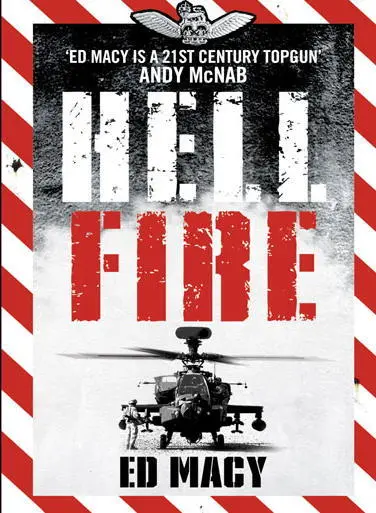
Ed Macy - Hellfire
Здесь есть возможность читать онлайн «Ed Macy - Hellfire» — ознакомительный отрывок электронной книги совершенно бесплатно, а после прочтения отрывка купить полную версию. В некоторых случаях можно слушать аудио, скачать через торрент в формате fb2 и присутствует краткое содержание. Город: London, Год выпуска: 2009, ISBN: 2009, Издательство: HarperPress, Жанр: Биографии и Мемуары, nonf_military, на английском языке. Описание произведения, (предисловие) а так же отзывы посетителей доступны на портале библиотеки ЛибКат.
- Название:Hellfire
- Автор:
- Издательство:HarperPress
- Жанр:
- Год:2009
- Город:London
- ISBN:978-0-007-34292-1
- Рейтинг книги:3 / 5. Голосов: 1
-
Избранное:Добавить в избранное
- Отзывы:
-
Ваша оценка:
Hellfire: краткое содержание, описание и аннотация
Предлагаем к чтению аннотацию, описание, краткое содержание или предисловие (зависит от того, что написал сам автор книги «Hellfire»). Если вы не нашли необходимую информацию о книге — напишите в комментариях, мы постараемся отыскать её.
Ed Macy bent every rule in the book to get to where he wanted to be: on Ops in the stinking heat of the Afghan summer, with the world’s greatest weapons system at his fingertips. It’s 2006 and he is part of an elite group of pilots assigned to the controversial Apache AH Mk1 gunship programme. So far, though, the monstrously expensive Apache has done little to disprove its detractors. For the first month ‘in action’ Ed sees little more from his cockpit than the back end of a Chinook.
But everything changes in the skies over Now Zad. Under fire and out of options, Ed has one chance to save his own skin and those of the men on the ground. Though the Apache bristles with awesome weaponry, its fearsome Hellfire missile has never been fired in combat. Then, in the blistering heat of the firefight, the trigger is pulled.
It’s a split-second decision that forever changes the course of the Afghan war, as overnight the gunship is transformed from being an expensive liability to the British Army’s greatest asset. From that moment on, Ed and his squadron mates will face the steepest learning curve of their lives – fighting an endless series of high-octane missions against a cunning and constantly evolving enemy. Ed himself will have to risk everything to fly, fight and survive in the most hostile place on earth.
http://www.youtube.com/watch?v=LNP1lbLNKqA
Hellfire — читать онлайн ознакомительный отрывок
Ниже представлен текст книги, разбитый по страницам. Система сохранения места последней прочитанной страницы, позволяет с удобством читать онлайн бесплатно книгу «Hellfire», без необходимости каждый раз заново искать на чём Вы остановились. Поставьте закладку, и сможете в любой момент перейти на страницу, на которой закончили чтение.
Интервал:
Закладка:
At the squadron, I found out that Jon and I had fallen foul of the rules governing the number of fighting personnel each nation was allowed to have in-country at any given time. The UK had exceeded its quota; even though Jon was the SupFAC and I was the Squadron Weapons Officer we had to wait until some Brits shipped home.
To keep ourselves busy, we flew the simulator and practised our weapons drills; then, when there was still no call to head for Brize Norton, we nipped over to 664 Squadron and asked if we could borrow one of their Apaches so we could stay current. Very obligingly, they said yes.
On 5 May there was still no sign our departure was imminent. I decided to head for Catterick Camp; 664 Squadron were doing their Annual Personal Weapons Test – something everyone in the armed forces had to go through to ensure that we knew the pointy end of a gun from the butt. I decided to take the opportunity to test out an idea I’d been toying with for a while.
We carried a personal weapon in addition to our sidearm in case we were shot down on operations. The short-barrelled SA-80 carbine was the only rifle allowed in an Apache, but because its handle jutted into the cockpit, restricting our escape route in an emergency, we had to remove it and screw it back on if things went pear-shaped. This had always struck me as certifiable. If I were lucky enough to survive a crash, the last thing I’d want to do was fumble around with my carbine handle while the Taliban were launching an action replay of Rorke’s Drift.
My idea was simple – fire the weapon without it. And today was the first chance I’d had to put it to the test.
I arrived at the range and was immediately confronted by a huge staff sergeant with a shaved head, straight out of Central Casting. Listen in, you facking lot! Watch and shoot, watch and shoot! Bring me my facking brew …
I unscrewed the handle of my SA-80 and dropped to the ground, facing the pop-up targets in Lane 6. A long shadow fell across me. I squinted against the sun to see Staff Sergeant Tank, hands on hips, looming over me.
‘You can’t fire your weapon without a handle,’ he boomed for all to hear, adding ‘Sir’ as an afterthought.
Patience, Macy. ‘Staff, this is how I’m going to have to fire in-theatre,’ I replied as courteously as I could manage.
‘The rules clearly state that you are not allowed to fire it without a handle.’
‘I know what the rules say, Tanky, I’m a Skill at Arms Instructor too,’ I said, marginally less diplomatically. ‘Do you know why you’re not allowed to fire it without a handle?’
He looked as if he’d just been asked to solve differential calculus on University Challenge .
He mumbled something incomprehensible.
‘So, you’re telling me not to do something but have no idea why…’
Staff Sergeant Tank stood there grappling for an answer.
‘The reason they insist that you fire this thing with a handle is because it has a short barrel, so, as there’s nothing to grip, you might end up shooting your fingers off. Let me assure you, however, that it’s not going to happen to me. Take a look at this…’
Ten minutes later, I’d done the business. The handle made no difference at all. I’d rested the rifle in the crook of my left arm, taken aim and fired. I tested the method on targets at 50, 100, 200 and 300 metres, in the prone, kneeling and standing positions. I placed the bullets squarely where they were supposed to go and listened for the tannoy.
‘Lane 4. Fail.’
‘Lane 5. Pass.’
‘Lane 6. One Hundred Per Cent Awarded Marksman.’
‘Lane 7. Pass.’
I’d not dropped a single round. Tanky had his back to me now, but I didn’t need to rub it in. The important thing was that I knew I could fly minus the handle and, if the shit did hit the fan, count on taking some of the fuckers down if I found myself in my own private version of Zulu Dawn . I’d broken a few rules, but so what, I figured the rules were supposed to be there to protect me.
A few days later, on 9 May, we got our first message back from the boys via MSN-Messenger. They were still at Kandahar Airfield, which I now knew as KAF.
Bastion isn’t ready. No one is doing any tasking.
We don’t expect to do any for a while. Everyone is ground running the aircraft. Then we’ll airtest them.
It was all routine stuff, but it did nothing to ease my frustration. There was still no word on when Jon and I’d be leaving. I felt as if we were participating in our very own Phoney War-lolling around in a deckchair waiting for the Hun to attack.
It wasn’t long before he did.
On 17 May, there was a newsflash on Sky. Fighting had broken out in southern Afghanistan and British and NATO troops had been involved. The details only came through the following day. Ninety insurgents were reported dead in Helmand. There was no news of any British casualties. Jon and I felt like a couple of caged tigers.
It wasn’t until later in the day, when a message came through on MSN from Chris, a member of 3 Flight, that we learned Apaches had been involved.
I’ve used up two of my nine lives!!!
Canadian soldiers went out today and hit the hornets’ nest with a baseball bat. They encountered RPGs and small arms.
My TADS was u/s. We went, but couldn’t fight.
Hornet not afraid of AH. ROE didn’t support firing.
Did a show of force at 125 feet. Heard RPG miss the cockpit. Black smoke trail. Couldn’t return fire.
Pat didn’t see the RPG, so he couldn’t shoot back.
Another RPG passed between our aircraft. I couldn’t ID which man fired it, so I couldn’t return fire. Climbed back up.
Fight died down. RTB.
There was a lot of information to absorb here. The guys had seen action. Serious action. A ‘show of force’ normally meant a fast jet streaking over a bunch of troublemakers at low level as an implicit warning: next time, it would be a bomb. Low level for a jet was low enough to be seen but still above the SA band. A show of force by an Apache at 125 feet – no wonder he’d been fucking shot at, I thought. What happened to high level?
I couldn’t understand why they were in Panjwai either; it was in Kandahar province, thirteen miles west of Kandahar City, well short of the eighty miles to Helmand. Chris was a small bloke with a big sense of humour. This was no joke, though. I could read his excitement between the lines as well as the relief. RTB. Return to base. We’d been lucky – on the squadron’s first outing, I’d nearly lost a couple of mates and we’d damn near lost a helicopter.
As I reread Chris’s message, one line in particular filled me with a combination of excitement and trepidation. ‘Hornet not afraid of AH (Attack Helicopter).’
So, the Taliban wanted to mix it with us. Then bring it on. But please let me be a part of it. It sounded mad, irrational, even to me, but I had been twenty-one and a half years in the armed forces, with half a year left to go, and this was what I’d trained for.
Later that day, I read that a Canadian JTAC had not been so lucky. She’d been killed in an RPG attack when the Taliban launched an assault on their position after the Apaches, low on fuel, had been forced to fly back to KAF. She had been the first female NATO soldier to be killed in Afghanistan.
Within a few hours, the news channels reported the crowing response of Mullah Omar, leader of the Taliban. ‘The Taliban consider themselves at war with British troops in Afghanistan,’ the Mad One trumpeted. ‘There will be a wave of suicide attacks as we step up our fight against the government and its allies.’
According to Mullah Omar, there were people queuing around the block to don explosive vests and pick up Kalashnikovs, he had twenty-five mid-level commanders in southern Afghanistan, and his forces there were armed with anti-aircraft weapons.
Читать дальшеИнтервал:
Закладка:
Похожие книги на «Hellfire»
Представляем Вашему вниманию похожие книги на «Hellfire» списком для выбора. Мы отобрали схожую по названию и смыслу литературу в надежде предоставить читателям больше вариантов отыскать новые, интересные, ещё непрочитанные произведения.




Обсуждение, отзывы о книге «Hellfire» и просто собственные мнения читателей. Оставьте ваши комментарии, напишите, что Вы думаете о произведении, его смысле или главных героях. Укажите что конкретно понравилось, а что нет, и почему Вы так считаете.