Ed Macy - Hellfire
Здесь есть возможность читать онлайн «Ed Macy - Hellfire» — ознакомительный отрывок электронной книги совершенно бесплатно, а после прочтения отрывка купить полную версию. В некоторых случаях можно слушать аудио, скачать через торрент в формате fb2 и присутствует краткое содержание. Город: London, Год выпуска: 2009, ISBN: 2009, Издательство: HarperPress, Жанр: Биографии и Мемуары, nonf_military, на английском языке. Описание произведения, (предисловие) а так же отзывы посетителей доступны на портале библиотеки ЛибКат.
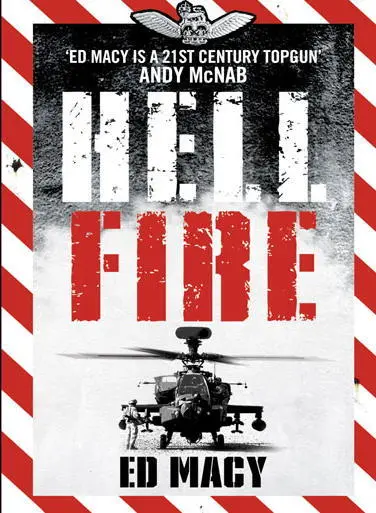
- Название:Hellfire
- Автор:
- Издательство:HarperPress
- Жанр:
- Год:2009
- Город:London
- ISBN:978-0-007-34292-1
- Рейтинг книги:3 / 5. Голосов: 1
-
Избранное:Добавить в избранное
- Отзывы:
-
Ваша оценка:
Hellfire: краткое содержание, описание и аннотация
Предлагаем к чтению аннотацию, описание, краткое содержание или предисловие (зависит от того, что написал сам автор книги «Hellfire»). Если вы не нашли необходимую информацию о книге — напишите в комментариях, мы постараемся отыскать её.
Ed Macy bent every rule in the book to get to where he wanted to be: on Ops in the stinking heat of the Afghan summer, with the world’s greatest weapons system at his fingertips. It’s 2006 and he is part of an elite group of pilots assigned to the controversial Apache AH Mk1 gunship programme. So far, though, the monstrously expensive Apache has done little to disprove its detractors. For the first month ‘in action’ Ed sees little more from his cockpit than the back end of a Chinook.
But everything changes in the skies over Now Zad. Under fire and out of options, Ed has one chance to save his own skin and those of the men on the ground. Though the Apache bristles with awesome weaponry, its fearsome Hellfire missile has never been fired in combat. Then, in the blistering heat of the firefight, the trigger is pulled.
It’s a split-second decision that forever changes the course of the Afghan war, as overnight the gunship is transformed from being an expensive liability to the British Army’s greatest asset. From that moment on, Ed and his squadron mates will face the steepest learning curve of their lives – fighting an endless series of high-octane missions against a cunning and constantly evolving enemy. Ed himself will have to risk everything to fly, fight and survive in the most hostile place on earth.
http://www.youtube.com/watch?v=LNP1lbLNKqA
Hellfire — читать онлайн ознакомительный отрывок
Ниже представлен текст книги, разбитый по страницам. Система сохранения места последней прочитанной страницы, позволяет с удобством читать онлайн бесплатно книгу «Hellfire», без необходимости каждый раз заново искать на чём Вы остановились. Поставьте закладку, и сможете в любой момент перейти на страницу, на которой закончили чтение.
Интервал:
Закладка:
Well, this was shaping up to be a ding-dong tour.
Several thoughts popped into my head. I wondered what John Reid was making of all this. What about our reconstruction mission? The Mujahideen tactics I’d read about in Egypt seemed to be alive and well. And when the fuck were Jon and I going to get our marching orders?
I got the answer to the last question later that day. Jon and I were due to leave on 20 May, in two days’ time. Whatever the ins and outs, we were on our way at last – and not a moment too soon. The Brits were engaged in heavy fighting down south and the Americans were doing their bit by sending the bombers in – big heavy B-1Bs armed with 2,000-lb GPS-guided JDAMs; bombs would do a whole lot more than rattle the bars of the Taliban cages.
The night before I left, Emily was on night-shift at the hospital again, hoping to deliver Jake’s baby, and I was at my desk doing some cheerful last-minute admin-signing my tax forms, upping my military life insurance and checking the details of my will – when the phone rang. I raised it to my ear.
‘Andy…’ I said cautiously.
‘Just checking that everything’s okay for tomorrow and wishing you well for the tour, Ed. Remember, if Emily needs anything, she only needs to pick up the phone.’
Transport had been laid on from the base to Brize Norton, a journey of around six hours. From Brize, we’d fly to Kabul. It was going to be a long day.
I went to bed early and slept so soundly that I never heard Emily return from her shift.
The next morning we got up, ate breakfast and drove straight to Dishforth. Neither of us said much and the weather wasn’t helping – it was tipping it down.
The car that would take us to Brize was already waiting.
I chucked my bags in the boot and turned to say goodbye to my girl. She was sitting at the wheel of her car, window down. The wipers were doing their best against the rain and I could see that Em was struggling too. God, I hated this. We both did.
I leaned in and gave her a kiss. ‘Love you,’ I said.
‘Love you too. I suppose there isn’t any point asking you not to do anything stupid…’
I kissed her again. ‘See you in three months.’
I watched her go until I lost sight of the tail-lights in the rain.
As we started our final descent, the loudspeaker told us to get our helmet and body armour ready. Ready for what? Nobody told us and it didn’t seem to matter much because somehow the threat – whatever it was – seemed a long way away.
As we banked I got my first real look at Afghanistan. The mountains looked majestic beneath us. Kabul itself looked dusty and exotic as it swam in and out of the heat haze. Smoke from a number of fires hung listlessly at the edge of the city. I thought for a moment that it might have been the result of some kind of attack, but an old RAF hand behind me said that it was always like that. Carbon emissions legislation wasn’t high on Hammid Karzai’s agenda; the ‘Mayor of Kabul’, as he was known, had more pressing problems to solve.
We landed in Kabul at 0615 Local – 0245 in the UK – and joined the queue to get processed into theatre. Jon and I joshed about the place we now found ourselves in; the airport was a cross between a junkyard and a high-tech arms fair, with rusting Soviet-era transport aircraft mixing it with gleaming F-16s and NATO and UN helicopters. Neither of us could believe how hot it was, or the smells that assaulted our nostrils.
When we got to the head of the queue we were ushered into a tent and, after showing our ID cards, were pointed towards a cargo trolley where our bags from the UK flight awaited us. From here we’d board a C-130 Hercules to Kandahar, where the rest of the squadron was assembled.
We took our seats in the Herc and waited for it to take off. The rear ramp remained open to allow what little ambient air there was onto the aircraft.
We weren’t the first on board. To our right was the fattest bloke I’d ever seen in the armed forces, a Territorial Army captain, awash with sweat. Next to him were two other members of the TA: a skinny major – Little to his Large – and a female sergeant major unenviably close to a small open urinal that was bolted onto the bulkhead that separated the flight-deck from the cargo area.
A loadmaster appeared and handed out ‘white death’ boxes containing our rations for the flight.
The big bloke was eating out of it almost before the box had left the loadie’s hand. Jon and I watched in amazement as he stuffed two whole muffins into his mouth, holding his helmet beneath them to catch the crumbs. He then fell asleep.
Upon being woken by the loadie a short time later and told the plane was about to take off, the captain slapped on his helmet and ended up with so many crumbs clinging to his sweat-soaked skin that he looked like he’d suffered an outbreak of scabies.
A moment or two after we were in the cruise, a Para corporal celebrated the fact that the train had left the station by climbing over everyone to get to the urinal. He beamed at the female sergeant major as he vigorously relieved himself. This, I imagined, was not contained in any in-theatre threat brief she’d ever attended. A few hours in Afghanistan, poor thing, and she looked like she was ready to go home.
The rest of the flight was relatively normal, except for the fact that the two loadies stood by the side doors during takeoff and landing, watching for missile launches. In their hands was a ‘pipper’ connected by a bungee cable to a box that controlled the flare launchers on the Herc’s fuselage. It was all very Heath Robinson.
Unlike Kabul, Kandahar was flat. The first thing that assailed us on landing wasn’t the heat – although it was like a furnace – but the stench. The smell of excrement in the air was unbelievable and it forced its way into the aircraft even before the ramp opened.
As we made our way onto the concrete, a bus drew up. It was painted in garish greens, reds and yellows and was festooned on the outside and inside with chains, from which a bizarre assortment of pendants dangled and jangled.
As we took our places, the bus seemed as if it might collapse under our weight as the driver, an Afghan with very few teeth, revved the engine noisily to signal his impatience. An RAF warrant officer, the guy who’d told me about Kabul’s fires on the earlier flight, noticed my expression and told me to relax. The bus had no first or second gear, but he promised it would get us there.
I was about to ask where ‘there’ was when I saw a huge tented city through the windscreen.
We pulled up by a marquee-like structure alongside a sign that said, ‘Cambridge Lines’. We went in, got processed again – ‘Had we had the mine-threat brief, the medical brief and several other kinds of brief?’ We had, thank God, back in the UK – before finally being released through a flap on the opposite side.
There, we were greeted by the cheery sight of Pat, the 3 Flight Commander, lolling behind the wheel of a Land Rover. He was brushing flies away with his cap, but fighting a losing battle.
We piled into the vehicle and set off towards our accommodation. As we wove in and out of the tents, the smell that had greeted us on landing seemed to be getting worse and worse.
‘What is that?’ I asked eventually, as Pat ground through the gears.
‘What’s what?’ he said.
‘That smell.’
‘It’s shit, Ed. What else can I say?’
‘Where’s it coming from?’
‘You’ll find out soon enough.’
Five minutes later, we screeched up in front of a white, semipermanent, single-storey structure, approximately twenty metres wide and sixty long. As aircrew, Pat said, we were fortunate to be given ‘hardened accommodation’ – ours was one of the 200 identical tin hutches lined up in this part of KAF.
Читать дальшеИнтервал:
Закладка:
Похожие книги на «Hellfire»
Представляем Вашему вниманию похожие книги на «Hellfire» списком для выбора. Мы отобрали схожую по названию и смыслу литературу в надежде предоставить читателям больше вариантов отыскать новые, интересные, ещё непрочитанные произведения.


Обсуждение, отзывы о книге «Hellfire» и просто собственные мнения читателей. Оставьте ваши комментарии, напишите, что Вы думаете о произведении, его смысле или главных героях. Укажите что конкретно понравилось, а что нет, и почему Вы так считаете.