Dan Hampton - Viper Pilot
Здесь есть возможность читать онлайн «Dan Hampton - Viper Pilot» весь текст электронной книги совершенно бесплатно (целиком полную версию без сокращений). В некоторых случаях можно слушать аудио, скачать через торрент в формате fb2 и присутствует краткое содержание. Город: New York, Год выпуска: 2012, ISBN: 2012, Издательство: William Morrow, Жанр: Биографии и Мемуары, nonf_military, на английском языке. Описание произведения, (предисловие) а так же отзывы посетителей доступны на портале библиотеки ЛибКат.
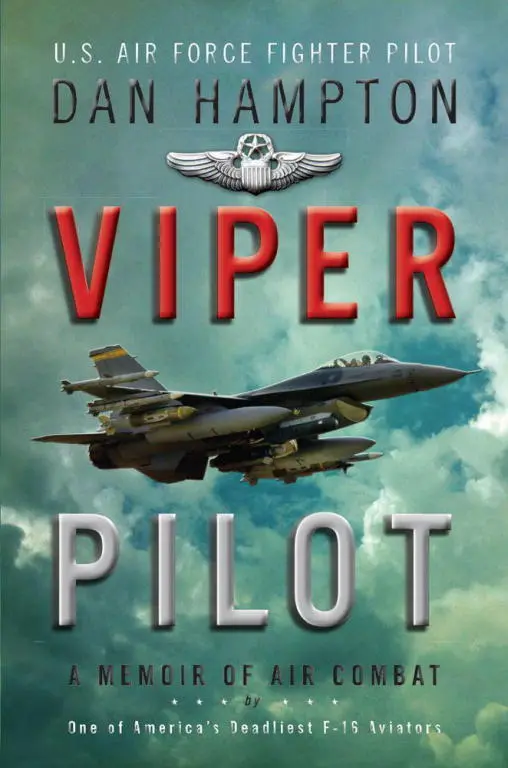
- Название:Viper Pilot
- Автор:
- Издательство:William Morrow
- Жанр:
- Год:2012
- Город:New York
- ISBN:978-0-06-213035-8
- Рейтинг книги:4 / 5. Голосов: 1
-
Избранное:Добавить в избранное
- Отзывы:
-
Ваша оценка:
Viper Pilot: краткое содержание, описание и аннотация
Предлагаем к чтению аннотацию, описание, краткое содержание или предисловие (зависит от того, что написал сам автор книги «Viper Pilot»). Если вы не нашли необходимую информацию о книге — напишите в комментариях, мы постараемся отыскать её.
is the electrifying memoir of one of the most decorated F-16 pilots in American history: U.S. Air Force Lieutenant Colonel Dan Hampton, who served for twenty years, flying missions in the Iraq War, the Kosovo conflict, and the first Gulf War.
Both a rare look into the elite world of fighter pilots and a thrilling first-person account of contemporary air combat,
soars—a true story of courage, skill, and commitment that will thrill U.S. Special Forces buffs, aviation and military history aficionados, and fans of the novels of Tom Clancy and Dale Brown.
Viper Pilot — читать онлайн бесплатно полную книгу (весь текст) целиком
Ниже представлен текст книги, разбитый по страницам. Система сохранения места последней прочитанной страницы, позволяет с удобством читать онлайн бесплатно книгу «Viper Pilot», без необходимости каждый раз заново искать на чём Вы остановились. Поставьте закладку, и сможете в любой момент перейти на страницу, на которой закончили чтение.
Интервал:
Закладка:
What?
Actually, the way I heard it was “What the fuuuck is going on down there? Get those pinheads over here on the double .” Or something like that. In the end, my grounding lasted about ten hours which was okay because I was asleep anyway. By the time I stepped out to fly the next combat mission, the in vogue expression at PeeSab was to “take an OG” instead of taking a shit. Everyone was saying it. Fighter pilots don’t cut much slack when there’s shooting going on.
I didn’t see the OG again. He remained at PeeSab but stayed safe in his office with his computer and coffeemaker. Must be a little embarrassing to get a first-class ass chewing by a four-star general and manage to be wrong, too. He also received the following official email that used small enough words so he’d understand, telling him what an important mission ROMAN 75 had flown.
From: MCGEE, MICHAEL B. LCOL
Sent: 5/25/2003 12:32 PM
Subject: Roman 75
Sir,
I wanted to pass some information regarding a Roman 75 flight that did some pretty incredible work for the MEF on 24 MAR. His actions stropped an enemy reinforcement that was about to overrun some Marines separated from their main unit.
On 24 MAR 03 at approximately 1345Z, Warhawk (V Corps ASOC) received a request for emergency CSA from Chieftan (MEF). 3rd BTN/2nd Marines had a unit that was stranded North of An Nasiriyah, and Iraq reinforcements were coming toward their position from the North along Highway 7, ivo 38RPV17525557. A flight of F-15Es was sent to engage the enemy threat. The F-15Es were unable to find or engage the target due to the very poor weather in the target area. The MEF then sent a flight of A-10s that again were unable to find or engage the target due to worsening weather. Ceilings were estimated at 8000' and visibility was down to a couple miles. Since it was an emergency situation as passed by Cyclops (controller), we then sent Roman 75, flight of F-16CJs. The flight of F-16CJs was able to find and destroy the target. Due to the poor weather, Roman 75 had to execute a low altitude strafe against the target, the only way at the time to destroy the target.
Two other flights were unable to find or engage the target after many attempts under these very difficult wartime conditions. The flexibility, tactical expertise, and calm under intense pressure demonstrated by Roman 75’s flight was above and beyond the call. This professional action of the flight lead under very poor weather conditions and in direct contact with the enemy ground forces saved 3rd Battalion from the reinforcing enemy forces.
Lt Col Mike McGee V Corps EASOC Airboss Dep Cmdr for Joint Integration 4 EASOGThis guy didn’t even have the balls to come see our squadron depart for home after the war ended. Fortunately, these types of people were rare and a marked contrast to officers like Kanga, Storm’n, and Ops Group Commander at Ali-al Salem. True professionals, they focused on combat missions and using their positions to actually help those doing the fighting. I’d love to see that colonel from Kuwait again, to shake his hand and buy him a drink.
But the war didn’t stop for the weather. This was a reality the Iraqis were slow in grasping, and it cost them dearly. They hoped to use the dust to obscure their movements and move into position for coordinated counterattacks. It’s a good thought, and worked in 1944 for the Germans, but it wasn’t going to stop a military that could see through bad weather and had satellite tracking.
In the end, after marching bravely out of their fortified positions with flags waving, the so-called elite Iraqi troops got the hell beaten out of them.
I believe that the sight of the arrogant, goose-stepping Republican Guards limping back into Baghdad convinced other military units, and, above all, the civilians, that Saddam’s grip on Iraq was loosening. Consequently, there would be no mass uprising of the people to throw the hated invaders (that’s us) into the sea. The military, however, did stay, and dug in tightly to fight the coalition forces as we approached the capital.
And approach it we did. The Army’s V Corp moved up from the south, and the Marines, mad as hell about Nasiriyah, were blitzing northwest from al-Kut. The SAMs and Triple-A around Baghdad were warmed up now and waiting for the attack helicopters and close air-support aircraft that would support the attack on their capital.
But they wouldn’t have to wait for long—the Wild Weasels were coming to get them.
9
The Valley of the Shadow
March 26, 2003
THE WINGMAN CAME OFF THE TANKER’S BOOM AND SLID BACKWARD away from the big KC-10. I zippered the mike and pulled up and away, toward the north. I saw the flash of WICKED 24’s wings as he turned with me out of the Twitch air-refueling track. Eyes out now, we transited the other tanker tracks, looking for pods of big jets surrounded by little jets. I lit the burner momentarily and climbed up above 25,000 as we headed north across the Iraqi border.
The tankers usually refueled at 25,000 or below, and the surveillance jets, like AWACS and JSTARS, were normally above 30,000 feet. So 27,000 to 28,000 feet was generally a safe haven as we crossed into Iraq. It always amazed me how, with such a big sky, jets gravitated toward each other. Of course, up here, really only F-16s and F-15s roamed about. The Navy F-18s were much farther to the east, and the A-10s couldn’t get this high. Even so, we kept our eyes out until well north of the border.
Twenty miles farther we FENCEd in. FENCE was originally a mnemonic of things to complete prior to combat: F (flares) E (electronic countermeasures) N (navigation aids—off) C (camera—on) E (emergency beacon—off).
We’d added to it over the years. Seat straps got tightened, exterior lights came off, weapons systems were set up, etc. I also ran my seat up a bit higher to better see any SAMs farther over the canopy rail, and turned the threat-warning volumes up as high as I could stand. I usually also removed my gloves so I could manipulate switches better, and almost always flew with my helmet visor up. Each pilot had his own system and it didn’t matter as long as everything was done prior to getting too deep into Indian Country.
“You’ve gotta be shitting me…” I muttered and looked at the mess below me. My flight of two CeeJays was roaming around Killbox 88 Alpha Sierra just south of Baghdad. This is what was left after the Mother of All Sandstorms had passed through. The winds may have died down, but the visibility was still terrible and Iraq was completely covered by a nasty mixture of fuzzy brown dust and low gray clouds.
“WICKED 23, this is RAMROD.” The orbiting AWACS had been unusually quiet today, which was a welcome change. Unfortunately, I wasn’t far enough north to pretend I couldn’t hear him.
“Go ahead.”
“JEREMIAH directs… repeat… JEREMIAH directs armed reconnaissance of the area around North three, three, oh, three, point five… West four, four, one, one, point three… how copy?”
Now right there I should’ve experienced inexplicable radio difficulties. JEREMIAH was the daily call sign of the general commanding all coalition air forces. He was sitting 700 miles away in an air-conditioned, carpeted tactical operations center, probably eating a doughnut. This duty rotated among senior officers, who got to sit back and watch the war on the big screens.
Since Operation Desert Storm, our command and control technology had improved—and I use that word sarcastically—to the point where all our aircraft could be tracked electronically. This was then projected on a movie-theater screen in the TOC. There were ascending rows of amphitheater seats, which wrapped around the room. Computer stations were interspersed around, manned by majors and lieutenant colonels whose main function at the moment was to be there and breathe. They had little paper name-cards on their cubicles that said things like FLTOPSMAIN, MPCFIDO, and AARDETCO. Alphabet soup to anyone other than one of them. Anyway, the general got to sit at the very top, in a little glassed-in room, like the bridge of a ship.
Читать дальшеИнтервал:
Закладка:
Похожие книги на «Viper Pilot»
Представляем Вашему вниманию похожие книги на «Viper Pilot» списком для выбора. Мы отобрали схожую по названию и смыслу литературу в надежде предоставить читателям больше вариантов отыскать новые, интересные, ещё непрочитанные произведения.







Обсуждение, отзывы о книге «Viper Pilot» и просто собственные мнения читателей. Оставьте ваши комментарии, напишите, что Вы думаете о произведении, его смысле или главных героях. Укажите что конкретно понравилось, а что нет, и почему Вы так считаете.