Dan Hampton - Viper Pilot
Здесь есть возможность читать онлайн «Dan Hampton - Viper Pilot» весь текст электронной книги совершенно бесплатно (целиком полную версию без сокращений). В некоторых случаях можно слушать аудио, скачать через торрент в формате fb2 и присутствует краткое содержание. Город: New York, Год выпуска: 2012, ISBN: 2012, Издательство: William Morrow, Жанр: Биографии и Мемуары, nonf_military, на английском языке. Описание произведения, (предисловие) а так же отзывы посетителей доступны на портале библиотеки ЛибКат.
- Название:Viper Pilot
- Автор:
- Издательство:William Morrow
- Жанр:
- Год:2012
- Город:New York
- ISBN:978-0-06-213035-8
- Рейтинг книги:4 / 5. Голосов: 1
-
Избранное:Добавить в избранное
- Отзывы:
-
Ваша оценка:
Viper Pilot: краткое содержание, описание и аннотация
Предлагаем к чтению аннотацию, описание, краткое содержание или предисловие (зависит от того, что написал сам автор книги «Viper Pilot»). Если вы не нашли необходимую информацию о книге — напишите в комментариях, мы постараемся отыскать её.
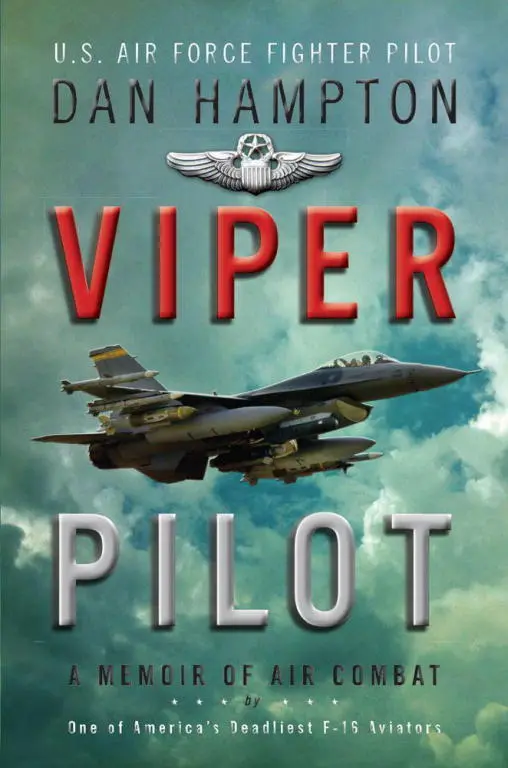
is the electrifying memoir of one of the most decorated F-16 pilots in American history: U.S. Air Force Lieutenant Colonel Dan Hampton, who served for twenty years, flying missions in the Iraq War, the Kosovo conflict, and the first Gulf War.
Both a rare look into the elite world of fighter pilots and a thrilling first-person account of contemporary air combat,
soars—a true story of courage, skill, and commitment that will thrill U.S. Special Forces buffs, aviation and military history aficionados, and fans of the novels of Tom Clancy and Dale Brown.
Viper Pilot — читать онлайн бесплатно полную книгу (весь текст) целиком
Ниже представлен текст книги, разбитый по страницам. Система сохранения места последней прочитанной страницы, позволяет с удобством читать онлайн бесплатно книгу «Viper Pilot», без необходимости каждый раз заново искать на чём Вы остановились. Поставьте закладку, и сможете в любой момент перейти на страницу, на которой закончили чтение.
Интервал:
Закладка:
“LOCK… LOCK…”
To my astonishment, the radar actually grabbed a contact. I stared, wide-eyed, at a dark speck coming straight down the “snot locker”—between us—at over 500 knots. It was eight miles away and charging up at us from below.
I snapped the master arm back to ARM and strained forward against my straps to see over the F-16’s nose. The Target Designator (TD) box was there, sliding over the mountaintops as the strange jet raced toward us.
“CONAN One is visual… bogey… ten o’clock low!”
“CONAN… CHAINSAW… say again?”
AWACS was doing its normal bang-up job. Out of the corner of my eye, I caught a flash of sunlight on something shiny and saw the Eagles, about four miles in front of me, sweeping down from the north. The F-4 and I were split apart by about five miles but now beginning to turn in. This unknown fighter was sandwiched in three dimensions. It was the perfect intercept.
He was screwed, whoever he was. It was just a matter of who would kill him first.
I grinned and uncaged my AIM-9 Sidewinder. This let the missile’s infrared seeker to try to track whatever target I was locked to. It just growled at me though, unable to tell jet from earth, so I’d have to get closer. That wasn’t a problem at these speeds, since we’d close the eight miles to shooting range in about fifteen seconds.
There! In the TD box, I could see an aircraft. It was tiny and its exhaust left a smoke trail. With the exception of the Phantom, no U.S. aircraft smoked. And this was no Phantom. I kept trying to lock the Sidewinder but it wouldn’t.
Shit.
If an Eagle killed this MiG in front of me, I’d never forgive myself. Probably spend all my money in therapy.
I’d descended a few thousand feet when we broke apart so I wouldn’t give this asshole a nice, look-up shot at me. I’d also been able to pull my power back as I’d glided down, and this cooled my engine off so any infrared missile shot against me would have a tough time. I didn’t put out any preemptive flares, because if he hadn’t seen me yet, flares would certainly give away my position. It was risky though, because if he shot, I’d have only a second or two to pop the flares. I didn’t like thinking defensively.
Fuck it. Shoving the throttle up to mil power, I pulled back and up toward the oncoming jet.
He was about four miles in front of me and slightly high, so I uncaged the Sidewinder and the clear, steady tone said it finally liked what it saw. With a good firing solution and a visual on the bogey, this was almost perfect. Squinting against the sun and the Gs, I still couldn’t tell what it was except that it was painted brown. I grunted and moved my right thumb just over the pickle button. That about clinched it. We didn’t have any brown aircraft.
For a long count of two, I waited. Waited for a smoke trail coming off his jet. Waited for the Eagles to identify it.
“CONAN One… ID Friendly! Repeat… ID Friendly.” The Eagle pilot sounded disappointed.
What in the hell…
My thumb came away from the pickle like it was hot. But I continued pulling into the other jet, carefully avoiding the two F-15s that had settled in behind the thing. As they all flashed past me, barely a mile away, I caught sight of a brown cylinder with incredibly stubby wings.
MiG-21! my brain screamed.
“It’s a fucking MiG-21,” I yelled into my mask, and my thumb came back down above the pickle. My first shocked thought was that the Eagles had made a colossal blunder. The Iraqi Air Force had MiG 21s, and this was exactly where you’d expect to find one. Close to its home base and hiding in the mountains.
Then I saw the red flag with the white crescent and star on the tail, and my thumb again came quickly away from the pickle button.
Unbelievable. Un. Fucking. Believable.
Türk Hava Kuvvetleri. Turkish Air Force. My brain clicked on again and I remembered why the jet was familiar. It was an American-made F-104 Starfighter, and I’d seen one in a museum once. Shaking my head as the thing zipped by, I very carefully moved the master arm to SAFE. What kind of idiot would be out trolling the border today in front of a hundred armed fighter pilots? I shrugged my shoulders against the seat straps and took a deep breath. A Turkish idiot, that’s who. As we continued north, the F-15s stayed with the F-104 and were voicing the same sentiments to the still bewildered AWACS.
Air-refueling was always satisfying. Every time was different and yet each instance required absolute precision to bring it off. In peacetime, in normal airspace, air-to-air refueling was tedious and very rigid. But combat refueling was more straightforward. Each track usually had a cell of three KC-10 or KC-135 tankers flying in trail of each other. They were about three miles apart and stacked at different altitudes, so we creatively named them the High, Medium, and Low tankers. The Low tanker was usually leading the cell. This was done for several reasons. The other tankers, which had no air-to-air radars, could fly off him visually during the day or night if the weather was clear. If it wasn’t, then they were de-conflicted by altitude and wouldn’t hit each other. Lastly, with the Low tanker in the lead, his jet wash, which could be considerable, didn’t affect the aircraft behind him. Flying through invisible turbulence while you’re impaled on a boom twenty feet from a jet filled with jet fuel isn’t much fun.
You had to find the tanker on your air-to-air radar and talk to him. You had to run a three-dimensional intercept to wherever he was, watching out for the remaining tankers and dozens of other fighters. It doesn’t matter how many times you’ve done it; slowly sliding up behind the big plane and watching the boom come down was always a thrill. Unless it was nighttime, or the weather was bad, and you were running out of gas—then it was a sweaty nightmare, like a monkey fucking a skunk.
But not this morning. This was a bright, clear day over an exotic corner of the world that seemed even more beautiful because I’d survived my first combat mission. After getting our gas, we slid back and pulled away low to the southwest. Our home base was about 200 miles away on the Gulf of Iskenderun.
A half-hour later, we were overhead Incirlik Air Base. Normally, there were well-established procedures for getting into and out of an air base, like overhead patterns and instrument approaches for bad weather. There were also “minimum risk” procedures, designed to get as many jets as possible off the ground or down to land without exposing them to ground fire. In retrospect, it was fairly silly to worry about shoulder-launched SAMs and small-arms fire. This being the first day of the war, no one knew what to expect and, until sanity prevailed, we could do whatever we wanted. Besides, it was fun to fly up the runway at 500 knots or do the “Stack.”
The Stack was basically a long glide in idle power down from 20,000 feet to the overhead landing pattern. You could see everything below, and it kept your engine cool to thwart an infrared threat. Besides, as I said, it was fun. Orca and I were almost the last aircraft at the top of the stack. The two F-15s that had followed us out of Iraq were somewhere behind us, and two KC-135 tankers were orbiting at 25,000 feet until all the fighters landed.
“TORCH One… High Stack.”
He made the call and went into a sharp, descending turn. I was supposed to wait until he called “mid-stack,” and then I’d start down. Dropping the mask again, I loosened my seat straps, wiped my face, and actually relaxed a bit. And why not? What else could happen?
Under normal circumstances, that’s a risky thought to have. Under these circumstances, it was downright cocky. And stupid.
Читать дальшеИнтервал:
Закладка:
Похожие книги на «Viper Pilot»
Представляем Вашему вниманию похожие книги на «Viper Pilot» списком для выбора. Мы отобрали схожую по названию и смыслу литературу в надежде предоставить читателям больше вариантов отыскать новые, интересные, ещё непрочитанные произведения.








Обсуждение, отзывы о книге «Viper Pilot» и просто собственные мнения читателей. Оставьте ваши комментарии, напишите, что Вы думаете о произведении, его смысле или главных героях. Укажите что конкретно понравилось, а что нет, и почему Вы так считаете.