Ed Macy - Apache
Здесь есть возможность читать онлайн «Ed Macy - Apache» — ознакомительный отрывок электронной книги совершенно бесплатно, а после прочтения отрывка купить полную версию. В некоторых случаях можно слушать аудио, скачать через торрент в формате fb2 и присутствует краткое содержание. Город: London, Год выпуска: 2008, ISBN: 2008, Издательство: HarperPress, Жанр: Биографии и Мемуары, nonf_military, на английском языке. Описание произведения, (предисловие) а так же отзывы посетителей доступны на портале библиотеки ЛибКат.
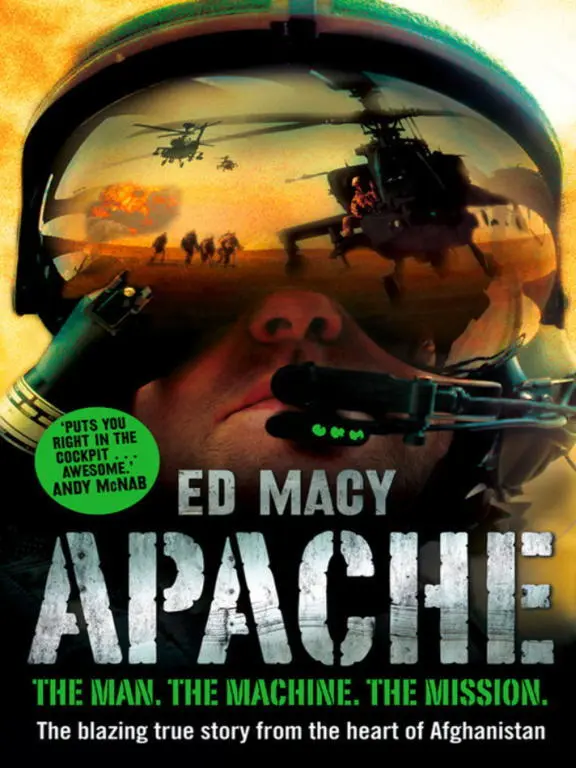
- Название:Apache
- Автор:
- Издательство:HarperPress
- Жанр:
- Год:2008
- Город:London
- ISBN:978-0007307470
- Рейтинг книги:5 / 5. Голосов: 1
-
Избранное:Добавить в избранное
- Отзывы:
-
Ваша оценка:
Apache: краткое содержание, описание и аннотация
Предлагаем к чтению аннотацию, описание, краткое содержание или предисловие (зависит от того, что написал сам автор книги «Apache»). Если вы не нашли необходимую информацию о книге — напишите в комментариях, мы постараемся отыскать её.
http://www.harperplus.com/apache
Apache — читать онлайн ознакомительный отрывок
Ниже представлен текст книги, разбитый по страницам. Система сохранения места последней прочитанной страницы, позволяет с удобством читать онлайн бесплатно книгу «Apache», без необходимости каждый раз заново искать на чём Вы остановились. Поставьте закладку, и сможете в любой момент перейти на страницу, на которой закончили чтение.
Интервал:
Закладка:
They christened me Elton. ‘Rocket Man’, after my disaster at Gereshk – I was never going to be allowed to live that down.
The tactical callsigns were so good that some became immediate nicknames. From that night onwards, Trigger, Darwin and FOG were seldom known as anything else.
By week two, our period of grace was over. While the Garmsir skirmishes continued, 3 Commando Brigade began to ramp up their operations all over the province and we were back into the hard routine. It was gruelling and rewarding work in equal measure. Every day followed a similar pattern.
My alarm clock went off at 6.45am – unless we’d had to fly a mission overnight and were already up and about. I’m a good riser, but Billy’s shaggy arse was not a sight I looked forward to at any time of day. One particularly gruesome morning I was greeted by one of his bollocks wedged between the backs of his legs. It could put a man off his food.
A trip to the cookhouse followed a shit, shower and shave, but Billy and I never fancied breakfast, so instead we strolled the 200 metres from the accommodation tents down to the JHF together for the 7.30am brief.
On the way down, we played the temperature game.
‘Okay, I reckon its 24.5 degrees celsius today.’
‘It’s warmer than that buddy. I’m going for 26.’
On arrival, we checked the digital thermometer on the weather terminal. Whoever was furthest away made a fresh pot of filter coffee. It was usually me.
After the Boss’s morning brief we got stuck into whatever our shift pattern dictated. The squadron’s four flights took it in turns to do the four tasks required of the Apache force. Each shift lasted three days. The cycle began with ‘Duty Ops’. We became four extra pairs of hands in the JHF, helping the Ops Officer and his team run the show from the ground. The pilots often did flight following: tracking the progress of ongoing missions over the radios. Being on Duty Ops also gave us time to read up thoroughly on the minutiae of the operational landscape. If it was quiet, we got a chance to plan the next shift, ‘Deliberate Tasking’.
Deliberate Tasking comprised any pre-planned sortie, from escorting a Chinook on an ‘ass and trash’ flight to prosecuting a deliberate attack. Most ops were planned days in advance, but some came as fastballs, giving us only a few hours to prepare.
As attack pilots, we lived for these moments. Creeping up on the enemy and smacking them hard was exactly what the Apache was built to do and why most of us wanted to fly it. Our resources were scarce, so sadly they were rare. Most of the time, the deliberate taskings were mundane. We spent long hours shadowing Chinooks around Helmand while they collected and dropped off bombs, beans, bullets and bayonets. The Green Zone was considered too dangerous for a highly vulnerable Chinook to land in – or even fly over – without us providing top cover.
The third shift was ‘IRT / HRF’ – the emergency scramble – the most important of the four, and the biggest adrenalin rush. Two Apaches were under starter’s orders 24 / 7, to lift immediately for any location in the province. We scrambled to bail out troops in a contact, cover reinforcements, or protect a medivac Chinook flight. It was proper seat-of-your-pants, World-War-Two-fighter-pilot stuff that always involved a mad dash to the flight line. We had thirty minutes to be off the ground once the call came in during daylight hours and sixty at night to wake up properly and allow our eyes to adjust to night vision.
There were two types of scramble. If we were going to a location that wasn’t under fire, a vehicle accident in the desert perhaps, only one aircraft – the Incident Response Team – would escort the Chinook. Two Apaches – the Helmand Reaction Force – would lift for medivacs in the Green Zone and other dangerous locations, and in support of troops in contact.
After three days of flying deliberate taskings and three more on IRT / HRF call-outs we were ball-bagged, so the fourth shift, ‘Testing and Maintenance’, provided a welcome break.
We had a total of eight aircraft in theatre. Four had to be fully serviceable in Camp Bastion at all times. That wasn’t easy. The technicians needed pilots to make sure that the parts they had replaced or repaired functioned correctly.
Aircraft were flown back to Kandahar for repairs or routine servicing. Only minor servicing was conducted at Bastion – so much of the shift was spent yo-yoing between the two bases. We’d test fly them around Kandahar Airfield and the makeshift shooting range next to it, returning the serviceable ones to Bastion.
An average three-hour sortie in the cockpit meant never less than six hours’ hard work on the ground: an hour’s planning and preparation, a twenty-minute crew brief, thirty minutes to start-up and taxi, forty minutes to refuel, rearm and shutdown, thirty to complete the aircraft paperwork and post-mission report, and a three-hour debrief – both gun tapes had to be viewed in their entirety and the average time at the pointy end was ninety minutes.
If you knew the time between sorties was going to be less than two hours, it was more efficient to keep the aircraft powered up, so we had to stay in the cockpit. We couldn’t even get out for a pee. Early in the first tour Nick had to fly three sorties in one day, one after the other. He was in the cockpit for fifteen hours on the trot, then each sortie had to be fully debriefed, adding a further nine. By the end of the summer we’d all been there.
In training, we found that our reactions started to slip after more than six or seven hours a day in the air. The aircraft sapped concentration levels and shredded energy reserves. Man simply couldn’t keep up with machine.
To avert disaster in Afghanistan, a strict eight-hour daily flying limit was imposed for each pilot. It didn’t include time spent preparing or even taxiing – just wheels off the ground. In emergencies, this could be extended to ten hours, but only with the signed permission of the CO of the aviation regiment.
Each pilot had to get eight hours’ undisturbed rest a day, of which six had to be sleep. In a squadron of workaholics, the Boss enforced the Crew Rest Periods as best he could.
‘Mr Macy, I know what time you were up this morning. Off you go to bed, please.’
‘Boss, I’ve got to finish this report–’
‘Bed, Macy. Now.’
I’d sneak the work out of the JHF and finish it on my cot with the aid of a head torch.
The odd half-hour of free time was catered for by the TV room at the tents (showing a couple of British Forces Broadcasting Service channels, Sky News and MTV via satellite), a NAAFI where you could get a really bad cup of coffee, and a Spar shop that sold cigarettes, toiletries and a few motoring magazines. The Groundies had also built their own makeshift gym.
If I fancied shooting the breeze, I headed to the ten foot by twelve communal area we’d partitioned off at the end of the JHF tent. It was a less formal place for pilots to work in, with brew making facilities, Sky News showing 24 / 7 on a TV in the corner and an Internet terminal with a time sheet divided into twenty-minute slots. FOG booked about seven of them a day, and he’d stand over us tapping his watch a full five minutes before his next stint was due to begin.
I spent much of my Crew Rest Periods tapping away on my laptop, keeping up with weapons reports, or I phoned home. We got thirty minutes’ call time a week free, but I always paid out for more.
‘Are you okay, sweetie?’ Emily would always begin. ‘You’re taking care aren’t you? Have you still got my angel?’
Some of us called home all the time; others used to do it as little as possible – not because they didn’t love their wives or children, but because they hated not being able to tell them anything about what we were up to. Sometimes it was better not to talk at all.
Читать дальшеИнтервал:
Закладка:
Похожие книги на «Apache»
Представляем Вашему вниманию похожие книги на «Apache» списком для выбора. Мы отобрали схожую по названию и смыслу литературу в надежде предоставить читателям больше вариантов отыскать новые, интересные, ещё непрочитанные произведения.









Обсуждение, отзывы о книге «Apache» и просто собственные мнения читателей. Оставьте ваши комментарии, напишите, что Вы думаете о произведении, его смысле или главных героях. Укажите что конкретно понравилось, а что нет, и почему Вы так считаете.