Benjamin Black - Holy Orders
Здесь есть возможность читать онлайн «Benjamin Black - Holy Orders» весь текст электронной книги совершенно бесплатно (целиком полную версию без сокращений). В некоторых случаях можно слушать аудио, скачать через торрент в формате fb2 и присутствует краткое содержание. Год выпуска: 2013, Издательство: Henry Holt and Co., Жанр: Триллер, на английском языке. Описание произведения, (предисловие) а так же отзывы посетителей доступны на портале библиотеки ЛибКат.
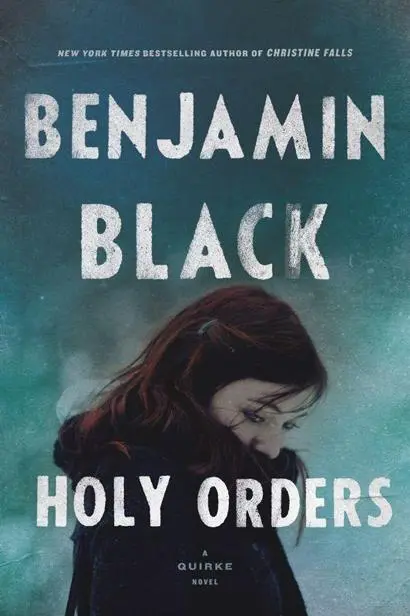
- Название:Holy Orders
- Автор:
- Издательство:Henry Holt and Co.
- Жанр:
- Год:2013
- ISBN:нет данных
- Рейтинг книги:5 / 5. Голосов: 1
-
Избранное:Добавить в избранное
- Отзывы:
-
Ваша оценка:
Holy Orders: краткое содержание, описание и аннотация
Предлагаем к чтению аннотацию, описание, краткое содержание или предисловие (зависит от того, что написал сам автор книги «Holy Orders»). Если вы не нашли необходимую информацию о книге — напишите в комментариях, мы постараемся отыскать её.
Holy Orders — читать онлайн бесплатно полную книгу (весь текст) целиком
Ниже представлен текст книги, разбитый по страницам. Система сохранения места последней прочитанной страницы, позволяет с удобством читать онлайн бесплатно книгу «Holy Orders», без необходимости каждый раз заново искать на чём Вы остановились. Поставьте закладку, и сможете в любой момент перейти на страницу, на которой закончили чтение.
Интервал:
Закладка:
What seemed to be an electric bell was dinning somewhere nearby; he could not decide if it was in his head or if a telephone was ringing. Here, around a corner, was another hallway, or corridor, with heavy-framed paintings on the walls, large, muddy, and very bad portraits of venerable clerics interspersed with martyred saints writhing in picturesque agony. His heart, still hammering, now seemed to be swelling and rising slowly up through his chest, pressing from beneath against his esophagus, robbing him of breath. He stopped and stood still and shut his eyes, pressing the lids together tightly. He told himself he must stay calm. This would pass. It was a seizure of some kind, but he was sure now it would not kill him. In the darkness inside his head great whorls of multicolored light formed and burst, like fireworks going off in silent slow motion. He opened his eyes and stumbled on. Was there no one to help him? Then suddenly there was the front door, at last. Panting, he dragged it open and almost fell through it, onto the stone step outside, gulping mouthfuls of air.
The sky was overcast now, yet the light was as intense as a magnesium flare, and he had to shut his eyes again for a moment. He felt exhausted, as if he had all at once become very old and infirm, and he sat down on the step, slowly and carefully. The granite was comfortingly cool to the touch. Through slitted eyelids — the light was searing still — he peered this way and that about the grounds. The yellow-green grass now had an even more unnaturally acid cast, and the stark branches of the trees looked like so many arms flung upwards in surprise or horror or both. He put a hand to his heart; it was still struggling behind his ribs like a big heavy bird in a too-small cage. Yet he was aware of a calm descending on him, as if a veil of some transparent, gossamer stuff were being laid gently over him from head to foot. Was he dying, after all? Was this how it would be, not violence and terror but a calm, slow sinking into oblivion?
A blackbird alighted on the lawn just beyond the ring of gravel and began busily stabbing at the turf with its orange beak, its rounded gleaming blue-black head moving jerkily, like the head of a clockwork toy. He watched it at its delving. The bird seemed to mean something, to be something, something beyond itself. He had a sense of dawning wonderment, as if he had never really looked at the world before, had never before seen it in all its raw vividness.
The door opened and he heard a step behind him. It was the old man with the crooked back. “Ah, Lord, sir, what ails you at all?” he said.
The blackbird flew off, sounding a shrilly urgent, repeated note.
Quirke tried to scramble to his feet but his knees refused to work. They felt as if they were made not of bone but metal, as if they were two hinged metal boxes that the rivets had fallen out of, and he was afraid the loose flanges would tear the skin covering them and break through and bleed and begin to rust in the harsh April air. The old man was bent so far forward that although he was on his feet his face was at the same level as Quirke’s where he sat. The eyes were a whitish-blue color — cataracts, Quirke thought distractedly.
“Felt a bit queer,” Quirke said, his voice sounding unnaturally loud. “Just having a rest here for a minute.”
He tried again to get his legs to work, flexing the muscles gingerly, afraid that those hinges in his knees would come asunder if he put pressure on them. It was a novel sensation — comical, yes — sitting here in a heap on the stone step with the old man’s face in front of him on a horizontal and so close up to his own that he could see the gray stubble on the other’s ancient, wrinkled chin.
“Will I give you a hand?” the old fellow said, speaking with measured distinctness, as if he were addressing a child. Quirke had an image of himself being hauled to his feet and of the two of them tottering together down the steps hand in hand, both of them bent over, with limbs akimbo, like a pair of chimps, the old one leading the younger and hooting soft encouragements. “No no,” he said, “no, I’m fine.”
At last he got himself up and stood swaying. His knees seemed to be all right, after all. The old man squinted up at him, that tawny side tooth bared again. “Come inside and we’ll get you a cup of tea,” he said.
They made their way through the house again, the old man going ahead, hobbling along crablike at a surprisingly rapid pace, paddling the air beside him as before with a long and seemingly boneless hand. The pounding in Quirke’s chest had subsided, though he was weak all over, as if he had come to the end of some extended and inhumanly demanding task. Yet he was certain now that he would survive. This knowledge afforded him curiously little comfort. On the contrary, he had a vexed sense of having been let down, by someone, or something. There had been a moment, out there on the front step, while he had watched the questing blackbird, when everything had seemed on the point of a grand, final resolution. It was not death he had been cheated of, he thought, for even death was incidental to whatever it was that had been coming and had not come, that had been withheld from him, at the last instant.
“How are you doing there?” the old man asked, twisting round and glancing back at him. “Are you all right?”
“Yes,” Quirke said, “yes, I am, I’m all right.”
It came to him suddenly: Nike. It was Nike, the memory of him, that had sent him stumbling in a panic out of Father Dangerfield’s room. Nike, with his thin smile, an eyebrow permanently cocked, a cigarette smoldering in his slender fingers. Nike the Inevitable.
The kitchen to which the old man led him was an enormous room with grayish-white tiled walls and a long refectory table of scrubbed deal, and two big twin stone sinks with old-fashioned copper taps stained with verdigris. There was a mighty stove, too, the top of it black and the sides the color of porridge, and there were ranks of pots and pans, venerable and battered, hanging on hooks about the walls. A big metal-framed window looked out on a concrete yard where dustbins loitered, their lids askew, like mendicants waiting in hope of scraps. All this was somehow familiar.
“Sit yourself down there now,” the old man said, and went to fill a kettle at one of the sinks.
Quirke sat. It seemed to him that he was suspended inside himself, intricate and frail, like a ship in a bottle.
The dissecting room, that was what this kitchen looked like. The light was the same, stark white and shadowless, and there was a sense of chill numbness, as if the very air had been anesthetised.
The old man, still holding the kettle under the running tap, gave him a sly, backwards glance. “Or maybe you’d prefer something a bit stronger?” he said, and winked.
Quirke said nothing, but the old man nodded knowingly and put the kettle aside. He went out through a narrow door into what must have been the scullery, whence there came a clink of glass, and he reappeared cradling in both hands, like a baby, a bottle of Powers Gold Label. “Would you ever,” he said, “get yourself down one of them tumblers off of that shelf.”
Nike, at Carricklea. Dean of Discipline; the title had always struck Quirke as absurdly grand. His name was Gallagher, Father Aloysius Gallagher. No one knew why he had been called after a Greek goddess, for the nickname had been conferred on him immemorially. He was tall and thin, like Father Dangerfield, had the same scraped-looking dry jaw, and wore the same kind of wire-framed spectacles. He had sour breath and his soutane always smelled of stale tobacco. He chain-smoked, holding the cigarette in a curious fashion, not between the first and middle but between the middle and third fingers of his left hand, even though he was right-handed. Sitting at his desk, with his bony knees crossed under his soutane and that hand held upright with the fag in it, like the hand of the Sacred Heart statue lifted in benediction, he had indeed the look of some celestial figure seated in judgment. Or no, no, what he was like was someone pretending, pretending to be a judge, playing the part of one, for a joke, but a joke that no one would dare laugh at, and that would end with whoever it was who was on trial being found guilty, and sent away red-faced and sobbing, with bruised and swollen palms clamped under his armpits and his bare knees knocking. Nike affected a little cough, it was hardly more than a dry clearing of the throat, which in the corridors of Carricklea the boys had learned to listen out for, since it was the only warning they would have of his approach, for he moved with wraithlike quiet, seeming not to walk but glide, on soundless soles.
Читать дальшеИнтервал:
Закладка:
Похожие книги на «Holy Orders»
Представляем Вашему вниманию похожие книги на «Holy Orders» списком для выбора. Мы отобрали схожую по названию и смыслу литературу в надежде предоставить читателям больше вариантов отыскать новые, интересные, ещё непрочитанные произведения.




Обсуждение, отзывы о книге «Holy Orders» и просто собственные мнения читателей. Оставьте ваши комментарии, напишите, что Вы думаете о произведении, его смысле или главных героях. Укажите что конкретно понравилось, а что нет, и почему Вы так считаете.