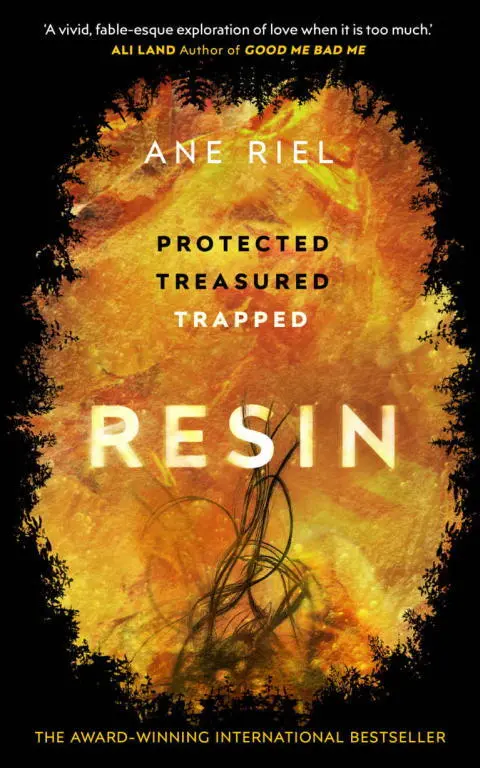
Ane Riel - Resin
Здесь есть возможность читать онлайн «Ane Riel - Resin» весь текст электронной книги совершенно бесплатно (целиком полную версию без сокращений). В некоторых случаях можно слушать аудио, скачать через торрент в формате fb2 и присутствует краткое содержание. Город: London, Год выпуска: 2018, ISBN: 2018, Издательство: Transworld Publishers, Жанр: Триллер, на английском языке. Описание произведения, (предисловие) а так же отзывы посетителей доступны на портале библиотеки ЛибКат.
- Название:Resin
- Автор:
- Издательство:Transworld Publishers
- Жанр:
- Год:2018
- Город:London
- ISBN:978-0-857-52545-1
- Рейтинг книги:3 / 5. Голосов: 1
-
Избранное:Добавить в избранное
- Отзывы:
-
Ваша оценка:
Resin: краткое содержание, описание и аннотация
Предлагаем к чтению аннотацию, описание, краткое содержание или предисловие (зависит от того, что написал сам автор книги «Resin»). Если вы не нашли необходимую информацию о книге — напишите в комментариях, мы постараемся отыскать её.
But behind the boxes and the baskets crowding her dad’s workshop, Liv was hiding. This way, her dad had said, she’d never have to go to school; this way, she’d never have to leave her parents. This way, Liv would be safe.
Suspenseful and heartbreaking, Resin is the story of what can happen when you love someone too much – when your desire to keep them safe becomes the very thing that puts them in danger. For more information on Ane Riel and her books, see her website at
Resin — читать онлайн бесплатно полную книгу (весь текст) целиком
Ниже представлен текст книги, разбитый по страницам. Система сохранения места последней прочитанной страницы, позволяет с удобством читать онлайн бесплатно книгу «Resin», без необходимости каждый раз заново искать на чём Вы остановились. Поставьте закладку, и сможете в любой момент перейти на страницу, на которой закончили чтение.
Интервал:
Закладка:
However, what puzzled Roald wasn’t so much the gait. It was the direction. The child was following the road northwards. Did he live in one of the houses scattered along the road a little further up? Were there even children his age living there?
There were few streetlights north of Korsted. Roald hesitated momentarily at the prospect of moving in the dark. But the moon hung like a golden sabre, reflecting the rays of a distant sun. There was light, a little light. Enough for him to see the small figure ahead of him. But what if the boy saw him? He really didn’t want to frighten the child.
It was a great stroke of luck for Roald that the road was winding and flanked by different types of shrubs. It gave him the chance to move faster when he was under cover and in no danger of being seen; he was forced to admit that he was unable to move at the same speed as the child. The boy had to be as strong as an ox.
After some time the landscape opened up again and further ahead, where the road passed a small cluster of houses, there were streetlights, but only a few. The boy, however, seemed to want to evade the light because he veered off across the field and ran left around the houses. Halfway across the field, Roald had to stop. Panting, he stared after the small figure that had disappeared into the darkness to the north.
Was the boy really heading out to the Head?
Dear Liv
The other day you were about to say something about some traps – when you suddenly stopped. You wouldn’t say anything more. You’ve got me worried.
What kind of traps?
What are you not telling me?
I wish you were here now.
I wish you were here to keep me company. I miss you.
Love, MumRetention
Jens Horder carried the newborn baby outside. Outside the shrinking bedroom, along the narrow corridor, down the stairs that contracted with each step, through the rooms of the house, which dwindled to dusty airways. And he went out into the yard, where the sky tried to penetrate the forest of indispensable junk, but found the ground only when small passages criss-crossed the heaps like rabbit tracks in the grass. He reached his workshop and placed his newborn daughter on the workbench on the small quilted blanket in which he had carried her. She was a child who didn’t scream.
Jens Horder didn’t scream either, not any more. He was calm now, focused.
When Liv joined him, he had finished washing the child. Without asking questions, she carried the basin of water outside and emptied it behind the workshop, as he had asked her to. And she filled it again with water from the pump. For his hands, he had said. And she found the oils in the kitchen for him. And the empty jam jars. And she fetched the bags of gauze. And she helped him with the sack of salt. And she lit the camping stove outside and started cleaning the resin, as he had taught her. They would need it later, he said. Except for the jam jars and the salt; they were for now. She couldn’t see Carl anywhere.
Liv tried to stay calm, but she was scared and confused. And in that moment she was acutely aware that she was only a child.
Jens fetched a kitchen knife and held it over the flame while Liv sat next to him. She wanted to ask him, but couldn’t. She opened her mouth, but no air came in and no sounds came out. Then she followed him back inside the workshop. He walked as if he didn’t know that she was there; as if he didn’t see her. As if she were Carl.
Liv could see the edge of the quilted blanket hanging crookedly over the corner of the workbench, and she could see two bare feet which were so tiny, much smaller than hers. An oil lamp beside them caused the feet to cast woolly shadows. Only they didn’t look warm.
Carl had yet to turn up, and Liv didn’t know whether to stay or go. Her father was standing by the workbench and she could hear him breathe. The tiny toes lay very still. She walked closer, positioned herself on the other side of the workbench and looked up at him. He didn’t see her. He was looking down at the blanket.
Recently, his breathing had changed, as if there were wood shavings in the air he inhaled. Sometimes she wanted to help him breathe, breathe in unison with him or maybe breathe in while he breathed out. And at times she wanted to drag him out into the forest. They hadn’t been there for a long time now. The air in the forest was nicer than in the workshop… and far better than in the house and the container. She missed the forest.
And now she didn’t know what to do.
When she couldn’t make up her mind, her body made it for her. She slumped on to the floor behind the workbench in a gliding movement, as if falling into herself.
Then she rested her chin on the workbench crossbeam. The empty jam jars were in front of her on the sawdust on the floor. And so were her father’s legs. He had a hole in one trouser leg, a tear just below his knee, and she imagined his skin behind the hole. Would she be able to see it if she shone a torch at it? The beam from her tiny torch hit the hole and the skin, which looked like parched soil. It was full of small, thirsty wrinkles, and she wanted to touch it.
Suddenly the knees came towards her. A knee popped out of the tear, and she could see it clearly in the torchlight. It looked like a baby’s head coming out of its mum. Then her father’s hand reached down for a jam jar; he picked it up like a hook gripping it under water. And she heard his breath with wood shavings in it, and a sound like a knife going into a rabbit. And shortly afterwards the jam jar was lowered down on to the sawdust. Now it contained something dark. And his hand left dark imprints on the glass. Another jar was picked up and disappeared over the edge of the workbench, only to return with something in it. And so it went on. She stared at the full jars and remembered the rabbits and the stags. And she shone the torch at one of them and recognized what she was looking at.
At that moment Carl was back with her and took her hand.
She whispered for him not to be afraid. It was just their baby sister’s lungs in a jam jar.
Then her father came. No, first his knee moved forwards, then his upper body bent down, then one hand held on to the edge, then his head, which was tilted slightly, and with his head came his eyes looking at her over the crossbeam under the workbench. She switched off her torch.
‘What are you doing?’ he asked her quietly. His voice had changed. Perhaps his voice also had wood shavings in it now.
She could hear something drip from the workbench. At first several drops, then the intervals between them grew shorter before they turned into one sound, a spray.
‘Waiting, I think,’ Liv replied. ‘What are you doing?’
He sat very still. Just as still as Carl. Suddenly the spray became drops once more.
‘I’m getting your baby sister ready. So that we can take good care of her.’
‘OK.’
‘I think you should help.’
‘OK.’
‘Please would you stand up?’
‘Yes.’
Liv tried to stand up, but Carl refused. He pushed her down on to the floor as if she were a heavy sack of salt.
Her father became trouser legs once more.
‘So are you coming, Liv?’ he said from somewhere above her.
‘Yes,’ she said, without moving.
‘There’s nothing to be scared of,’ he said.
‘OK.’
Carl released his grip, and she stood up with his hand in hers. Together they held their breath.
Jens Horder didn’t remember the details; perhaps he had never known them. But preserved inside him were the outlines of knowledge, a rough skeleton of insight into the methods of ages past into which his father had once initiated him. And it was this knowledge which now guided his hands.
Читать дальшеИнтервал:
Закладка:
Похожие книги на «Resin»
Представляем Вашему вниманию похожие книги на «Resin» списком для выбора. Мы отобрали схожую по названию и смыслу литературу в надежде предоставить читателям больше вариантов отыскать новые, интересные, ещё непрочитанные произведения.












Обсуждение, отзывы о книге «Resin» и просто собственные мнения читателей. Оставьте ваши комментарии, напишите, что Вы думаете о произведении, его смысле или главных героях. Укажите что конкретно понравилось, а что нет, и почему Вы так считаете.