Kate Mosse - Labyrinth
Здесь есть возможность читать онлайн «Kate Mosse - Labyrinth» весь текст электронной книги совершенно бесплатно (целиком полную версию без сокращений). В некоторых случаях можно слушать аудио, скачать через торрент в формате fb2 и присутствует краткое содержание. Жанр: Триллер, на английском языке. Описание произведения, (предисловие) а так же отзывы посетителей доступны на портале библиотеки ЛибКат.
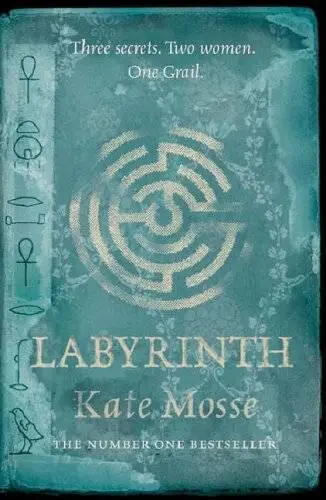
- Название:Labyrinth
- Автор:
- Жанр:
- Год:неизвестен
- ISBN:нет данных
- Рейтинг книги:3 / 5. Голосов: 1
-
Избранное:Добавить в избранное
- Отзывы:
-
Ваша оценка:
Labyrinth: краткое содержание, описание и аннотация
Предлагаем к чтению аннотацию, описание, краткое содержание или предисловие (зависит от того, что написал сам автор книги «Labyrinth»). Если вы не нашли необходимую информацию о книге — напишите в комментариях, мы постараемся отыскать её.
Labyrinth — читать онлайн бесплатно полную книгу (весь текст) целиком
Ниже представлен текст книги, разбитый по страницам. Система сохранения места последней прочитанной страницы, позволяет с удобством читать онлайн бесплатно книгу «Labyrinth», без необходимости каждый раз заново искать на чём Вы остановились. Поставьте закладку, и сможете в любой момент перейти на страницу, на которой закончили чтение.
Интервал:
Закладка:
“Ah, well, we cannot let the victors write our stories for us,” he said. “It is a term that I and others…” He stopped, smiling, as if sharing a joke with himself. There are many different explanations. Perhaps that the word catar in Occitan – cathare in French – came from the Greek katharos , meaning pure. Who can say what was intended?“
Alice frowned, realising she was missing something, but didn’t know what.
“Well, what of the religion itself then? Where did that originate? Not France originally?”
“The origins of European Catharism lie in Bogomilism, a dualist faith that flourished in Bulgaria, Macedonia and Dalmatia from the tenth century onwards. It was linked with older religious beliefs – such as Zoroastrianism in Persia or Manicheism. They believed in reincarnation.”
An idea started to take shape in her mind. The link between everything Audric was telling her and what she already knew.
Wait and it will find you. Be patient.
“In the Palais des Arts in Lyon,” he continued, “there is a manuscript copy of a Cathar text of St John’s Gospel, one of very few documents to escape destruction by the Inquisition. It is written in the langue d’Oc , possession of which in those days was considered a heretical, punishable act. Of all the texts sacred to the Bons Homes , the Gospel of John was the most important. It is the one which lays most stress on personal, individual enlightenment through knowledge – gnosis. Bons Homes refused to worship idols, crosses or altars – carved from the rocks and trees of the Devil’s base creation – they held the word of God in the very highest esteem.”
In the beginning was the Word, and the Word was with God, and the Word was God.
“Reincarnation,” she said slowly, thinking aloud. “How could this possibly be reconciled with orthodox Christian theology?”
“Central to the Christian covenant is the gift of everlasting life to those who believe in Christ and are redeemed through his sacrifice on the Cross. Reincarnation is also a form of eternal life.”
The labyrinth. The path to eternal life.
Audric stood up and walked over to the open window. As Alice stared at Baillard’s thin, upright back, she sensed a determination in him that had not been there before.
“Tell me, Madomaisela Tanner,” he said, turning to face her. “Do you believe in destiny? Or is it the path we choose to follow that makes us who we are?”
“I-” she started, then stopped. She was no longer sure what she thought. Here in the timeless mountains, high up in the clouds, the everyday world and values did not seem to matter. “I believe in my dreams,” she said in the end.
“Do you believe you can change your destiny?” he said, seeking an answer.
Alice found herself nodding. “Otherwise, what’s the point? If we are simply walking a path preordained, then all the experiences that make us who we are – love, grief, joy, learning, changing – would count for nothing.”
“And you would not stop another from making his own choices?”
“It would depend on the circumstances,” she said slowly, nervous now. “Why?”
“I ask you to remember it,” he said softly. “That is all. When the time comes, I ask you to remember this. Si es atal es atal .”
His words stirred something in her. Alice was sure she had heard them before. She shook her head, but the memory refused to come.
“Things will be as they will be,” he said softly.
CHAPTER 70
“Monsieur Baillard, I-”
Audric held up his hand. “ Benleu ,” he said, walking back to the table and picking up the threads of the story as if there had been no interruption. “I will tell you everything you need to know, I give you my word of that.”
She opened her mouth, then closed it again.
“It was crowded in the citadel,” he said, “but for all that, it was a happy time. For the first time in many years, Alais felt safe. Bertrande, now nearly ten years old, was popular with the many children who lived in and around the fortress. Harif, although old and frail, was also in good spirits. He had plenty of company: Bertrande to charm him, parfaits to argue with about the nature of God and the world. Sajhe was there at her side for much of the time. Alais was happy.”
Alice closed her eyes and let the past come to life in her mind.
“It was a good existence and might have continued so but for one, reckless act of vengeance. On the twenty-eighth of May 1242, Pierre Roger de Mirepoix received word that four Inquisitors had arrived in the town of Avignonet. The result would be more parfaits and credentes imprisoned or sent to the stake. He decided to act. Against the advice of his sergeants, including Sajhe, he assembled a troop of eighty-five knights from the Montsegur garrison, their numbers swelled by others who joined en route.
“They walked fifty miles to Avignonet, arriving the following day. Shortly after the Inquisitor Guillaume Arnaud and his three colleagues had gone to bed, someone within the house opened the locked door and admitted them. The doors to their bedrooms were smashed open and the four Inquisitors and their entourage were hacked to death. Seven different chevaliers claimed to have struck the first blows. It is said that Guillaume Arnaud died with the Te Deum on his lips. What is certain is that his Inquisitorial records were carried away and destroyed.”
“That was a good thing, surely.”
“It was the final act of provocation. The massacre brought a swift response. The King decreed that Montsegur was to be destroyed, once and for all. An army comprised of northern barons, Catholic inquisitors and mercenaries and collaborators set camp at the foot of the mountain. The siege started, but yet men and women from the Citadel still came and went as they pleased. After five months, the garrison had lost only three men and it seemed the siege would fail.
The Crusaders hired a platoon of Basque mercenaries, who clambered up and pitched camp a stone’s throw from the castle walls just as the bitter mountain winter was setting in. There was no imminent danger, but Pierre-Roger decided to withdraw his men from the outworks on the vulnerable eastern side. It was a costly mistake. Armed with information from local collaborators, the mercenaries succeeded in scaling the vertiginous slope on the southeastern side of the mountain. Knifing the sentinels, they took possession of the Roc de la Tour, a spike of stone rising up on the easternmost point of the summit ridge of Montsegur. They could only watch, helpless, as the catapults and mangomels were winched up to the Roc. At the same time, on the eastern side of the mountain, a powerful trebuchet started to inflict damage on the eastern barbican.
“At Christmas 1243, the French took the barbican. Now they were within only a few dozen yards of the fortress. They installed a new siege engine. The southern and eastern walls of the citadel were both within range.”
He was turning the ring round and round on his thumb as he talked.
Alice watched and, as she did so, the memory of another man, turning such a ring as he told her stories, floated into her mind.
“For the first time,” Audric continued, “they had to face the possibility that Montsegur would fall.
“In the valley below, the standards and banners of the Catholic Church and the fleur-de-lys of the French King – although tattered and faded after ten months of first heat, then rain, then snow – were still flying. The Crusader army, led by the seneschal of Carcassona, Hugues des Arcis, numbered between six and ten thousand. Inside were no more than a hunded fighting men.
Читать дальшеИнтервал:
Закладка:
Похожие книги на «Labyrinth»
Представляем Вашему вниманию похожие книги на «Labyrinth» списком для выбора. Мы отобрали схожую по названию и смыслу литературу в надежде предоставить читателям больше вариантов отыскать новые, интересные, ещё непрочитанные произведения.




Обсуждение, отзывы о книге «Labyrinth» и просто собственные мнения читателей. Оставьте ваши комментарии, напишите, что Вы думаете о произведении, его смысле или главных героях. Укажите что конкретно понравилось, а что нет, и почему Вы так считаете.