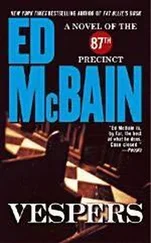
Jeff Rovin - Vespers
Здесь есть возможность читать онлайн «Jeff Rovin - Vespers» весь текст электронной книги совершенно бесплатно (целиком полную версию без сокращений). В некоторых случаях можно слушать аудио, скачать через торрент в формате fb2 и присутствует краткое содержание. Жанр: Триллер, на английском языке. Описание произведения, (предисловие) а так же отзывы посетителей доступны на портале библиотеки ЛибКат.
- Название:Vespers
- Автор:
- Жанр:
- Год:неизвестен
- ISBN:нет данных
- Рейтинг книги:5 / 5. Голосов: 1
-
Избранное:Добавить в избранное
- Отзывы:
-
Ваша оценка:
Vespers: краткое содержание, описание и аннотация
Предлагаем к чтению аннотацию, описание, краткое содержание или предисловие (зависит от того, что написал сам автор книги «Vespers»). Если вы не нашли необходимую информацию о книге — напишите в комментариях, мы постараемся отыскать её.
Vicious bat attacks moving southward along the Hudson River prompt Nancy Joyce, a bat scientist who works for the Bronx Zoo, to investigate. When the attacks move into the New York subway system, Manhattan police detective Robert Gentry becomes involved. Joyce and Gentry team up to determine what is causing this unusual behavior. What they discover will keep listeners pinned to their seats and clawing for more.
Vespers — читать онлайн бесплатно полную книгу (весь текст) целиком
Ниже представлен текст книги, разбитый по страницам. Система сохранения места последней прочитанной страницы, позволяет с удобством читать онлайн бесплатно книгу «Vespers», без необходимости каждый раз заново искать на чём Вы остановились. Поставьте закладку, и сможете в любой момент перейти на страницу, на которой закончили чтение.
Интервал:
Закладка:
“Bats communicate,” she said, thinking aloud. “We don’t know how or to what extent, but we think they’re a lot like dolphins in that sense. They send out short, pulselike sounds-‘clicks’-that come so fast they sound like high-pitched duck quacks. Bats use those sounds mostly to hunt.”
“Echolocation.”
“Yes. But deeper in the throat, in the larynx, they generate a very high whistle that can change pitch very quickly. We think those sounds are used to communicate everything from the location of food sources to sexual interest to organizational commands.”
“That’s very nice,” Gentry said. “But why would bats be moving to New York?”
“I don’t know. Why do bats move anywhere? Shelter or food.”
“Subways and cockroaches.”
“There’s also other wildlife,” Joyce said. “Baby pigeons, mice, rats, fish-New York is a big, rich smorgasbord for bats.”
“But so are the Catskills and Westchester and Connecticut. Right?”
Joyce started walking again. “For a normal colony, yes. But what if this one isn’t normal?”
She stopped beside a sign that pointed out the various roads and scenic sites in the area. But she wasn’t looking at the sign. She was looking at what was behind it. Gentry turned the flashlight in that direction.
There was a red and white iron bar waist-high across another dirt road. In the center was a sign with hours posted on it.
“Landfill,” Joyce said.
Gentry shined his light beyond the pole.
“It’s perfect,” she said. “It’s deserted at night. The remains of any animals would be bulldozed under, and the smell of the trash would cover the smell of guano.”
“Are we going in there?”
Joyce ducked under the pole.
“I guess so,” Gentry said as he followed her in.
They walked for roughly an eighth of a mile down the rutted dirt road. The full moon had risen above the mountains, casting the hills and thickly bunched trees in pale light. The only sounds were the crunch of their shoes on the stones, the leaves stirred by the night air, and now and then an animal fleeing through the underbrush.They moved slowly, Joyce reminding Gentry that the first time a bat came after either of them they were to back away immediately. Gentry understood and said he’d been less anxious raiding apartments when he was a narc. He knew and understood that kind of danger. Plus it was over in a few moments of intense activity. Now, he had no idea what to expect, or when.
When they reached the landfill, the vision was surreal. Crags of refuse, like blue-white lunar mountains, towered over the flat plains of dirt. The jagged peaks threw long, sharp shadows over their own lumpy foothills and across the occasional clumps of trash. Off to the right, near a shed, a bulldozer sat like a sleeping monster.
“Where do you want to look?” Gentry asked.
“I’m not sure.” Joyce took the flashlight from him. “I’ll just pick a spot.”
She walked toward the hills that surrounded the landfill. The nearest slope was about three hundred yards away. When she reached it, she walked slowly along the base, shining the light up through the surrounding trees and then down along the ground.
Gentry stood alone at the entrance to the landfill. Despite the gun, he felt naked.
After several minutes, Joyce stopped in front of a steep section of hill. She looked up and then down. Then she got down on her hands and knees. “Robert?” Her voice seemed very far away.
“Yes?”
“I found something.”
Gentry had had a feeling she would. She was like that, this lady. Had a sixth sense like a cop.
He walked quickly to where Joyce was standing. His pace wasn’t dictated by fear but sickness; the smell down here was a curious mixture of pine and rot. The sooner he got past the trash, the happier he’d be. He reached the scientist’s side and crouched beside her.
“What’ve you got?” he asked.
She pointed to a deep, damp rut cut by water. There was something dark lining the rut.
“Looks like diluted guano,” she said, rubbing some of the muddy black substance between her fingers and smelling it. She shined the light up the hill. “And up there is where it could have come from.”
Gentry looked.
Above them, maybe sixty feet, was a very large drain.
Twenty-Two
Gentry insisted on leading the way up the hillside.
Joyce didn’t argue. She wanted him to feel like he was contributing something other than the guns and the car. And she still felt bad about the Jupiter thing. She wasn’t a show-off and she hated coming off like one. Especially to someone who was every bit as professional in his way as she was in hers. Even when he’d kept her from going into the sublevels of Grand Central Station, he hadn’t insulted her intelligence or skill.
And Gentrywas contributing to this, though he probably didn’t realize it. He was making her feel like a member of a team, a partner in this search instead of an acolyte. Whenever she went on fieldtrips with Professor Lowery, he pushed her physically and intellectually. His prodding forced her to do things that established new high-water marks for where she could go and what she could accomplish. But they were always lonely experiences because he was looking down from his peak. He never pushed himself, made her feel like she was doing anything for him. That was why she’d allowed the professor to seduce her. It was an effort to bring him closer in a place and at a time of her life when she really needed it: her first year of grad school, her first time overseas. She did it to make him more accessible. Unfortunately, all it did was make her more “his.”
Gentry did not seem like that kind of man at all. Even with a gun in his hand, even when he’d been ordering her out of the subway tunnel, there was something gentle about him.
“So let’s work this forward from day one,” Gentry said as they climbed.
“All right,” she said.
“Mama bat gets away from Dr. Lipman. She makes her way to the river. She follows it and gives birth somewhere along the way.”
“Not in the open,” Joyce said.
“Why not?”
“Because hawks prowl the river. They’d have picked her pup off.”
“So the mother finds a quiet, enclosed place to give birth,” Gentry said.
“A place close to food and drink,” Joyce said.
“What would she have done next?”
“The routine would have been for the mother to look after her pup, then go out to feed. Then one day during the month she didn’t come back, probably succumbing to radiation poisoning. She’s found relatively soon thereafter, or else scavengers would have picked at her remains.”
“Could the baby bat have continued on its own after that?”
“Conceivably, as long as there was water and either insects or vegetation, depending on what kind of bat it was. Bats are pretty self-sufficient pretty early.”
“Would it have continued to live alone?”
“Probably not. When male or female bats are in heat they can be very aggressive.”
“How often does that happen?”
“In temperate regions that usually happens in the fall. That way they can give birth in the spring or summer when food is relatively populous. My guess is the bat would have tried to join an existing colony. If it was as big as we think, it could very well have taken over a colony.”
Gentry reached the drain and stopped. It was difficult to stand there because of the slope, and he was forced to hold on to a tree. He shined the light around the opening.
The drain was about four feet in diameter, and the concrete was nearly green from the minerals in the water.
“This is an old one,” Gentry said. “There’s a faded WPA logo here.”
Читать дальшеИнтервал:
Закладка:
Похожие книги на «Vespers»
Представляем Вашему вниманию похожие книги на «Vespers» списком для выбора. Мы отобрали схожую по названию и смыслу литературу в надежде предоставить читателям больше вариантов отыскать новые, интересные, ещё непрочитанные произведения.









Обсуждение, отзывы о книге «Vespers» и просто собственные мнения читателей. Оставьте ваши комментарии, напишите, что Вы думаете о произведении, его смысле или главных героях. Укажите что конкретно понравилось, а что нет, и почему Вы так считаете.