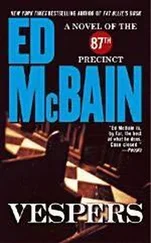
Jeff Rovin - Vespers
Здесь есть возможность читать онлайн «Jeff Rovin - Vespers» весь текст электронной книги совершенно бесплатно (целиком полную версию без сокращений). В некоторых случаях можно слушать аудио, скачать через торрент в формате fb2 и присутствует краткое содержание. Жанр: Триллер, на английском языке. Описание произведения, (предисловие) а так же отзывы посетителей доступны на портале библиотеки ЛибКат.
- Название:Vespers
- Автор:
- Жанр:
- Год:неизвестен
- ISBN:нет данных
- Рейтинг книги:5 / 5. Голосов: 1
-
Избранное:Добавить в избранное
- Отзывы:
-
Ваша оценка:
Vespers: краткое содержание, описание и аннотация
Предлагаем к чтению аннотацию, описание, краткое содержание или предисловие (зависит от того, что написал сам автор книги «Vespers»). Если вы не нашли необходимую информацию о книге — напишите в комментариях, мы постараемся отыскать её.
Vicious bat attacks moving southward along the Hudson River prompt Nancy Joyce, a bat scientist who works for the Bronx Zoo, to investigate. When the attacks move into the New York subway system, Manhattan police detective Robert Gentry becomes involved. Joyce and Gentry team up to determine what is causing this unusual behavior. What they discover will keep listeners pinned to their seats and clawing for more.
Vespers — читать онлайн бесплатно полную книгу (весь текст) целиком
Ниже представлен текст книги, разбитый по страницам. Система сохранения места последней прочитанной страницы, позволяет с удобством читать онлайн бесплатно книгу «Vespers», без необходимости каждый раз заново искать на чём Вы остановились. Поставьте закладку, и сможете в любой момент перейти на страницу, на которой закончили чтение.
Интервал:
Закладка:
“I’m very sorry to hear that.”
“There was an indication at several of the sites that there may be an oversized specimen of vespertilionid bat. A mutation. After reading your paper, we wondered if there might be a connection between the bats you encountered in Russia and the bats we’re seeing here.”
“What we need to know, sir,” Gentry said, “is whether you brought anything back from either trip to Siberia. Something that might have affected the bat population in some way?”
Lipman regarded Gentry. “Should I send for my attorney?”
“Doctor,” Joyce said quickly, “this isn’t an official inquiry. We’re not interested in placing blame. We’re simply trying to isolate a problem by tracing it to its source.”
Lipman folded his hands in his lap. “The source of the problem is selfishness. Doing what is expedient. Russia, the Soviet Union, was very good at that. Did you ever hear of Dzerzhinsk?”
Joyce said she hadn’t. Gentry shook his head.
“It’s a city of three hundred thousand people, two hundred fifty miles east of Moscow. For forty years toxic gases were manufactured in factories there. Blister and mustard gas, rocket fuel, DDT-everything. When the Soviet Union shut down, do you know what was done with the poison that had not been distributed? It was buried. Rusted, bloated barrels were buried right there in the soil. I was called in when thousands of children became ill. And what do you suppose was causing the illnesses? Coal. Coal that was being burned in the homes. Coal that had absorbed lethal levels of dioxin while it was still in the ground.” He snickered. “The Russian solution to the problem was not to try and clean up the city. No. It was, ‘Don’t burn coal from here,’ or, ‘Don’t eat food grown here.’ It was pathetic.”
“You couldn’t have been surprised,” Joyce said. “The Soviets didn’t admit there was a problem at Chernobyl until high radiation levels were detected in Sweden.”
“I wasn’t surprised,” Lipman said. “Just sad for the people. Their solution to the radiation at the Chelyabinsk site was the same. Contain and downplay. So I would know how to treat the children, I tried to find out if there were anything else buried in that cave, any chemical barrels like the ones in Dzerzhinsk. But no one evenknew. They simply didn’t care.”
“A toxicological soup,” Joyce said.
“Nearly half a century old,” Lipman remarked. “And who knows where else in the world there are similar ‘soups’? China, Iraq, other sites in the former Soviet Union-maybe even the United States, God help us. The potential for ecological catastrophe is enormous. But getting back to Chelyabinsk, during my first visit there, the Russian military eradicated all the bats in the cave. There were thousands of them. Tens of thousands. I didn’t see the colony myself, but I heard that they were not…normal.”
“In what way?” Joyce asked.
“One of the soldiers who went into the cave said that some of them, in what looked like the nursery, had bodies the size of foxes.”
“How were the bats destroyed?” Joyce asked.
“The troops used fire, flamethrowers. You could smell the death for more than a mile. The few bats that managed to escape were on fire, squealing. It was awful. The engineers dammed the river inside the cave, sealed the entrance with explosives, and then drained the section of lake near the camp. The water was trucked away, and the lake bed was filled with rocks and soil. The radiation count was negligible, and that was that. Except-” He stopped.
“Go on,” Joyce said.
“I stayed on to help the United Nations team treat the children. Most of them were taken to a local clinic for observation. They were suffering from acute radiation syndrome-very, very mild cases that resulted in headaches, nausea and vomiting, malaise. All of them were ambulatory. I kept the children out in the daylight as much as possible. Sometimes, here, I treat my own patients out back. I’ve always believed in the therapeutic effects of the sun. I had my large medical case with me at all times. You never know what you’ll need in a foreign country. Among the things I had in there were dried banana chips. They contain high levels of potassium, a very useful cleansing agent for bodily fluids, and children don’t mind eating them-”
“One of the bats got in there,” Joyce said.
Lipman steepled this thumbs and tapped them together. His expression was pinched, odd.
“Driven from its home. Hungry. Cold. It got in your case.”
“I wasn’t with the case at all times,” Lipman admitted. “Sometimes I walked away with the children. I didn’t think-didn’t know.”
“What happened?” Joyce passed.
Lipman looked down. “When I came home, the bag flew with me in the cabin and was not inspected at customs. One of the perks of charity work. I put it in the backseat of the car, and because I got home very late, I left it there until the next morning. When I got it, I smelled something funny, so I opened the case. The banana chips were gone and there were feces in the bag. I moved my instruments aside and took out my journal. A bat was lying on its back beneath it.”
“What did it look like?” Joyce asked.
“Like nothing I’d have wanted my kids to see.” Lipman rubbed his mouth. “It was misshapen. The body was large, muscular, all shoulders, legs, and belly. The head was difficult to see because it was tucked low against the chest. But the mouth was extremely wide and the eyes were red and protruding-like the large marbles children used to play with. The ears were high, but I couldn’t see them clearly. The wings were folded against its side, but I remember there was a very long hook on top of each wing.
“That’s digit one,” Joyce said. “The thumb.”
“What happened to the bat?” Gentry asked.
“When I saw it, I was startled,” Lipman said. “I jumped away and the bag spilled over. The bat crawled out.”
“It didn’t fly?” Joyce asked.
“No.”
“Had the wings been hurt in the fire?”
“They didn’t seem to be, but I never saw them spread. The bat crept along the carpet, right here,” he said. “It was maybe nine or ten inches long and it moved slowly, arduously.”
“But it never spread its wings?” Joyce asked.
“No. I wanted to help the poor thing. But when I walked toward it, it vaulted up to the window there”-he pointed to a double window above the couch-“tore through the screen, and jumped out. By the time I went outside, it was gone.”
“Do you have any idea where?”
“I didn’t then,” he said. “I called the wildlife commissioner and told him there was something potentially dangerous out by the Walkill. I wasn’t worried about it being radioactive, but just something alien in the wild. They searched for it up and down the river but found nothing. I didn’t know what happened to it until about a month later.”
“What did happen?” Gentry asked.
“Some hikers found it up the road a way. It was dead. They took a picture of it. I saw the photo in the wildlife section of the local newspaper, and it was unmistakably that bat. Same face, same general build, though it was somewhat desiccated from having been out in the sun. There was one difference, though.”
“It was no longer as bloated as it had been,” Joyce said.
Lipman looked at her. “That’s right. How did you know?”
“Because,” she said, “it was no longer pregnant.”
Twenty-One
"I have a question,” Gentry said.
The detective was driving slowly through the early evening dark. The sky was blue-black, and a very bright, clear star was already up in the northwest. Gentry’s goal was a wooded area just off of Route 32 North. Located nearly a mile northeast of Dr. Lipman’s home, that was where the newspaper article said the dead bat had been found. Gentry didn’t know what Nancy expected to find there some eight years later, and she didn’t say. But he agreed that since they were in the area it was probably worth a look.
Читать дальшеИнтервал:
Закладка:
Похожие книги на «Vespers»
Представляем Вашему вниманию похожие книги на «Vespers» списком для выбора. Мы отобрали схожую по названию и смыслу литературу в надежде предоставить читателям больше вариантов отыскать новые, интересные, ещё непрочитанные произведения.






Обсуждение, отзывы о книге «Vespers» и просто собственные мнения читателей. Оставьте ваши комментарии, напишите, что Вы думаете о произведении, его смысле или главных героях. Укажите что конкретно понравилось, а что нет, и почему Вы так считаете.