Jason Elliot - The Network
Здесь есть возможность читать онлайн «Jason Elliot - The Network» весь текст электронной книги совершенно бесплатно (целиком полную версию без сокращений). В некоторых случаях можно слушать аудио, скачать через торрент в формате fb2 и присутствует краткое содержание. Жанр: Триллер, на английском языке. Описание произведения, (предисловие) а так же отзывы посетителей доступны на портале библиотеки ЛибКат.
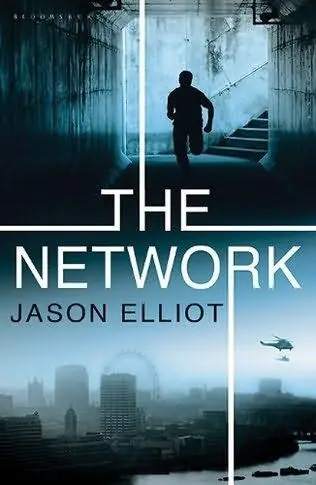
- Название:The Network
- Автор:
- Жанр:
- Год:неизвестен
- ISBN:нет данных
- Рейтинг книги:4 / 5. Голосов: 1
-
Избранное:Добавить в избранное
- Отзывы:
-
Ваша оценка:
The Network: краткое содержание, описание и аннотация
Предлагаем к чтению аннотацию, описание, краткое содержание или предисловие (зависит от того, что написал сам автор книги «The Network»). Если вы не нашли необходимую информацию о книге — напишите в комментариях, мы постараемся отыскать её.
The Network — читать онлайн бесплатно полную книгу (весь текст) целиком
Ниже представлен текст книги, разбитый по страницам. Система сохранения места последней прочитанной страницы, позволяет с удобством читать онлайн бесплатно книгу «The Network», без необходимости каждый раз заново искать на чём Вы остановились. Поставьте закладку, и сможете в любой момент перейти на страницу, на которой закончили чтение.
Интервал:
Закладка:
There is no Internet, mobile or terrestrial phone network, nor even a reliable postal system in Afghanistan at the time, so the address to which Manny’s messages must be delivered is transmitted in a pre-recorded code by radio from England. Radio enthusiasts call such transmissions number stations, and rightly suppose they are the preferred method of communicating with agents in the field, though no government has ever officially acknowledged them. Orpheus needs only an ordinary short-wave radio to receive the signal, which is transmitted every day. But he has no other special equipment of his own, so his reports must be personally delivered by couriers who know nothing of their hidden content.
They begin to arrive at the trust’s office in Kabul a month later, addressed to a pseudonym. The first takes the form of a book of Afghan poetry. Into its spine he’s glued a sheet of paper, dense with handwritten numbers. I copy the numbers onto a grid called a straddling chequerboard, and transpose them using a keyword into letters that reveal the message.
Slowly, as the words take shape, I’m filled with a sense of awe that that our fragile link has successfully spanned so many hazards. The numbers we’ve agreed to use as a security device are correct and the message opens with characteristic humour: bgns msg 0786 all well despite urgent need saqi. I am filled with relief to learn that he’s well, despite a craving for wine. He’s living at the Jalalabad headquarters of an Afghan mujaheddin commander called Sayyaf, known for his extreme Islamicist outlook and strong links with fundamentalists in the Arab world. Orpheus’s knowledge of Arabic is allowing him to translate for his Afghan hosts and to serve as interpreter when Arab guests visit the headquarters. It’s not much news but it’s the sign of life we’ve been waiting for. The final line of the message alludes to the need for patience by reminding me that one of the Muslim names of God is the Patient One, al-saboor: allahu saboor send greetings uk qsl msg ends.
I fax news of the message to the Baroness using the satellite phone at the office, knowing that she will arrange for confirmation of its receipt to be sent by a one-way signal which Orpheus can hear on a short-wave radio. Our little portion of the Network, against the odds, is up and running.
Orpheus’s messages continue in the same manner for the next six months. They are, not surprisingly, irregular. Afghanistan is spiralling downward into ever more violent civil war, and on those days when the rockets rain into the south and west of the city I spend much of the time in the basement of my rented home. Because of the ongoing fighting, most of the trust’s work takes me north of Kabul to the once fertile and prosperous Shomali plain, which bears the scars of fifteen years of conflict. We survey minefields sown by the Soviets and gather unexploded ordnance from settlements where people are still living. In collaboration with the United Nations we develop a mine awareness course but the daily casualties from mines and UXOs are a constant reminder of the hugeness of our task. It is difficult at times not to be seized by depression.
The messages from Orpheus arrive with traders, drivers and refugees, who will occasionally accept a reward for their efforts and from whom I gain a picture of events in the south. Then the first of the computer diskettes arrives, hidden this time in the thick cover of a Qur’an. Orpheus now has access to a computer, which eliminates the long task of manual encryption and decryption and enables him to send messages of infinitely greater length.
It’s the beginning of a series of long disturbing reports that confirm the violent intentions of the broad spectrum of foreign militants gathering in the south of the country. They are financed from overseas and the Afghan government is too weak to touch them. The Afghans, in any case, don’t have the money to finance terrorists and can’t even pay the salaries of their own government ministers. The religious fervour of these new foreigners has no place in their culture.
To judge from his reports, Orpheus has also gained access to lists of names, financial details and plans for plots against targets all over the world. I can only wonder about how he’s being affected by the company he’s keeping. He writes at length about the ideas and aspirations of the organisations he’s learning about. A new kind of international war, aimed far beyond Afghanistan, is steadily incubating. Its proponents use Islam, traditionally a religion of tolerance, as a rallying banner, but increasingly stripped of its humane principles and twisted towards violence.
Extremism is new to Afghanistan, but it’s on the rise. One of Orpheus’s reports accurately predicts the unprecedented mas-sacre of Hazara families in Afshar by henchmen of the brutal warlord Sayyaf, and in another he forecasts the assassinations of rival mujaheddin leaders both in Pakistan and Afghanistan. But there are also details of larger-scale acts of terror, which are increasingly inventive and ambitious. They seem fantastic and unrealisable. There are plots to blow up hotels in the Middle East and public buildings in New York, and to hijack airliners in Europe. There are details of a plan to kill both the Pope and the US president. Orpheus has been tasked to translate American military manuals on improvised explosives, poisons and the manufacture of biological toxins. But in the very country where these unprecedented campaigns are taking shape, the powers at which they are directed have no plans to intervene.
Then the reports stop. The newly formed Taliban is advancing through the south and west of the country, and I can only assume that the headquarters where Orpheus lives has been overrun or dispersed. Communication and transport between Kabul and the rest of the country are virtually severed. I allow myself to hope that he’s safe, but that it’s become impossible for him to get messages out from wherever he is.
Three months pass and there’s nothing from him. The daily stress of life adds to my feelings of desperation. Twice I visit the front lines in the west of the city towards the Taliban positions in Maidan Shahr, and find myself drawn too close to the fighting for my own good. I notice that I am taking risks with my own security and losing my sensitivity to danger. I don’t know it at the time, but the effects of the war are reaching into me in unexpected ways, and I am being changed by them. I am surrounded by destruction and the randomness of death, which I cannot fathom. I have felt the closeness of death as tangibly as the intimate whisper of a murderous seducer, and felt the richness, twinged by guilt, of having escaped its grasp. I have seen too often the numb lost look of men consumed by undiluted grief, and heard the howl of children as their mothers are pulled from the rubble of a rocket-blasted home, and I am coming to understand the long dark pain of those who silently endure what at first seems unendurable.
One evening, in the gloomy, oak-panelled bar of the United Nations club, an Australian journalist friend who’s been covering the war gives me his characteristically frank assessment.
‘You’re a bloody basket case,’ he says. ‘Got it written all over you,’ he gestures, drawing a finger across his chest. ‘Burned out. You need to get yourself out of this shit hole and get some R amp; R before someone has to pick you up in little bits and put them in a paper bag.’
A week later he’s badly wounded by a mortar explosion and is flown out of the city by the International Red Cross. He’s paralysed and will live the rest of his life in a wheelchair. The news hits me hard. It’s as if he’s shown me my own fate.
I have no wish to abandon Orpheus, but it’s time to pull out, so after nearly two years I resign from the trust. Nothing can describe my feelings of devastation as I board a United Nations flight to New Delhi and circle away from the airfield at Kabul, where the surrounding fields are still littered with the debris of destroyed Soviet aircraft. My sense of ruin is complete.
Читать дальшеИнтервал:
Закладка:
Похожие книги на «The Network»
Представляем Вашему вниманию похожие книги на «The Network» списком для выбора. Мы отобрали схожую по названию и смыслу литературу в надежде предоставить читателям больше вариантов отыскать новые, интересные, ещё непрочитанные произведения.








Обсуждение, отзывы о книге «The Network» и просто собственные мнения читателей. Оставьте ваши комментарии, напишите, что Вы думаете о произведении, его смысле или главных героях. Укажите что конкретно понравилось, а что нет, и почему Вы так считаете.