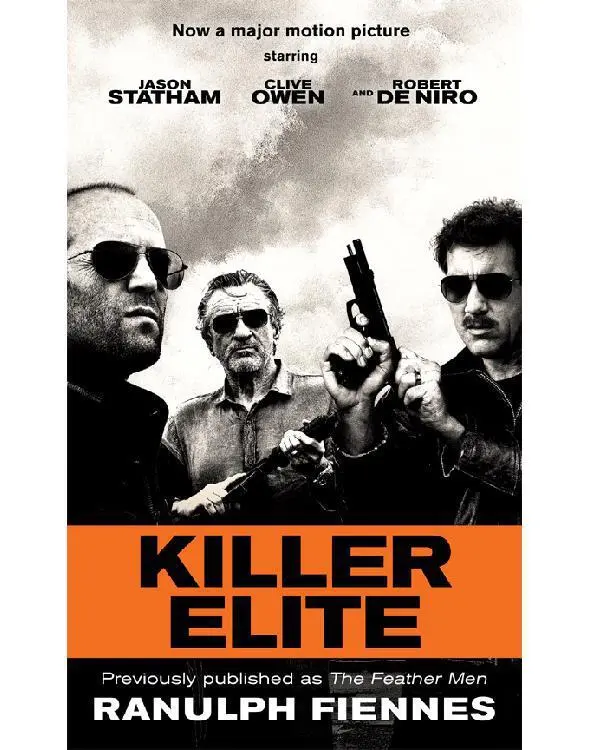
Ranulph Fiennes - Killer Elite
Здесь есть возможность читать онлайн «Ranulph Fiennes - Killer Elite» весь текст электронной книги совершенно бесплатно (целиком полную версию без сокращений). В некоторых случаях можно слушать аудио, скачать через торрент в формате fb2 и присутствует краткое содержание. Жанр: Триллер, на английском языке. Описание произведения, (предисловие) а так же отзывы посетителей доступны на портале библиотеки ЛибКат.
- Название:Killer Elite
- Автор:
- Жанр:
- Год:неизвестен
- ISBN:нет данных
- Рейтинг книги:3 / 5. Голосов: 1
-
Избранное:Добавить в избранное
- Отзывы:
-
Ваша оценка:
Killer Elite: краткое содержание, описание и аннотация
Предлагаем к чтению аннотацию, описание, краткое содержание или предисловие (зависит от того, что написал сам автор книги «Killer Elite»). Если вы не нашли необходимую информацию о книге — напишите в комментариях, мы постараемся отыскать её.
Killer Elite — читать онлайн бесплатно полную книгу (весь текст) целиком
Ниже представлен текст книги, разбитый по страницам. Система сохранения места последней прочитанной страницы, позволяет с удобством читать онлайн бесплатно книгу «Killer Elite», без необходимости каждый раз заново искать на чём Вы остановились. Поставьте закладку, и сможете в любой момент перейти на страницу, на которой закончили чтение.
Интервал:
Закладка:
He paused, but I made no comment.
“After much soul-searching, we have reached a decision. This has been forced upon us and we do not take it lightly. It is the lesser of two evils. We have reason to believe that one of our past members, now an ill man, intends to publish a book about our existence and our past activities. This book will be a sadly warped version of the truth.” He turned to Spike and nodded. “Go ahead.”
“Rather than have this happen,” Spike said, “we have concluded that we need the true story told.” I listened carefully, for his voice was low and expressionless. “The other would-be author must find that he has been preempted and no publisher will reckon it commercially worthwhile to take on his vitriolic tale.”
“May I ask how you are so sure this other man’s account will be as you describe it?”
“We have a lady friend,” Spike replied, “who works as his secretary. About two weeks ago she saw the outline synopsis of his work-a tissue of distortion, as she described it-and was horrified.”
He tapped two folders that lay on his lap. “She has copied a series of papers held by this man-I will call him Bletchley-and given them to us. They are the detailed reports by our field operators on their attempts to catch the contract killers. Bletchley intends to base his book very largely on these papers, so we must do the same. We always protect the names of our people, but some will, through these files, be known to Bletchley, and if you decide to write our book, we can make them available to you along with the contents of these files.”
“What other materials would I have?” I asked.
“The full and very detailed results of my debriefing of the senior contract killer. It amounts to his life story and, contrary to what you might expect, is not that of an archetypal villain. You will also be able to ask me whatever questions you feel appropriate and necessary to complete your account of the events.”
“Is the aim to produce a story of your group’s history?”
“Negative. We can tell you only about our involvement in the long hunt for the people who planned to kill you on Monday.”
My head swam. I never sit on decisions. I believe in intuition. If I were to agree to this book, I would have to shelve my novel and many months of work on it. On the other hand, I could always publish the novel in a year or two, whereas this offer was on a “now or never” basis. There was another issue too. I instinctively liked these people and felt a deep, personal gratitude to them.
“Spike, Colonel, I do not want to sound ungrateful but I must ask you three up-front queries. It may take me a long time to write your book, assuming I find a literary agent willing to take it on. I am expecting to lose my job with Armand Hammer in the near future and I have a wife and farm to support. Will the revenue from the book be mine?”
“All of it,” Macpherson replied. “We want only a widely published work giving a fair and balanced picture of the events.”
“Secondly,” I pressed, “since it is my name that will appear as author, any libel suits that may result will be directed at me, not you. I will, therefore, need to go and see anybody mentioned by name, even the next of kin of the dead men, to obtain their approval.”
Again Macpherson nodded. “Obviously the next of kin will know nothing of the killers, but they will be able to tell you what they think happened to their husbands. So you will be able to cross-check what we tell you.”
“Good. My third point concerns my own safety. How will I know that the people in Dubai will not hire other men to kill me?”
Spike smiled. “You have my personal assurance. One of our men will be in Dubai next week. You will never be troubled again.”
“I will write your book,” I told them, “providing the facts tally and, of course, assuming I can find an agent and publisher.”
We shook hands. For the next three weeks, whenever my normal work allowed, I met Spike in the same room, and together we prepared a framework by which I could relate the events accurately but in a readable manner. For a while there were two areas of disagreement. I needed the real name of a real person within the Feather Men in order to authenticate the book.
“You have at least twenty real names already,” Spike had protested.
“I do not have yours or the colonel’s.”
“You do,” he replied with a smile. “Simply check the names of your 1979 Export Committee.” He became serious. “We had already identified the need for an indisputable means of authentication. Much as the colonel dislikes the idea, there is no alternative. You will have his identity.”
“And yours?”
“That,” said Spike, “will not be necessary.”
My second problem was an inability to explain to prospective readers, at an early stage of the book, the nature of the work of the Feather Men. I needed a single example, but Spike refused with persistence. Involvement with the killers, yes; any other operation, definitely not. In the end I made my point and was given an account of a 1976 action in Bristol involving two of Spike’s men whose identities would anyway be revealed by the book.
On November 6 Spike informed me that the man he had sent to Dubai, his Arab specialist, had just called him. He had seen the sheikh the previous day and shown him a photograph of de Villiers in captivity as well as the video taken in the Exmoor barn. Under threat of exposure to the Royal Oman Police and the British authorities, the sheikh had handed over the original films and video copies of the previous activities by the killers. He also promised, in the name of God, that he would cease all further involvement with his father’s thaa’r. The aim of his father had been to reinstate his sons in Dhofar. That, he could see, was no longer an option.
During the winter of 1990 and the following spring, I traced and visited twenty-six people who were still alive and, wittingly or unwittingly, had been involved with the events of Spike’s story. Some aspects of his account initially struck me as implausible in the extreme but again and again I found that the facts and the figures tallied.
Since none of those I approached knew of, or even suspected, the contract killers’ intentions, I had to present the series of events, especially the point where their own lives had been affected, as pure hypothesis. This was especially important in the case of the next of kin of the four men, whom I had no wish to alarm or distress.
After reading the field reports of Spike’s Locals, I met three of them and tried to ascertain their personal motivations and memories of the events. As they were instinctively reticent, I was not as successful as I would have wished, except in the case of David Mason, with whom I was at an advantage as I had known him in Oman, in Antarctica and in London. I had always thought of him as a rather cool and arrogant individual. But after three long interviews with him to discuss his reports in depth, I came away with a very different picture. He cared deeply for certain principles and people. His strength of character and the depth of his resolve were awesome. I would not have wanted him as an enemy.
I decided to include the SAS Headquarters in my list of people to visit, but Spike advised against it. “They will kick you out of the door, Ran. Forget it. Any noncurricular activity is anathema to them. They know nothing about us nor have we ever involved any of their members, past or present.”
Spike was also reticent when pressed about the fate of the surviving contract killer and his cronies from the agency.
“Are they dead?” I asked.
“No,” he replied.
“Did you pass him to the police?”
“No.”
“Why not?”
Читать дальшеИнтервал:
Закладка:
Похожие книги на «Killer Elite»
Представляем Вашему вниманию похожие книги на «Killer Elite» списком для выбора. Мы отобрали схожую по названию и смыслу литературу в надежде предоставить читателям больше вариантов отыскать новые, интересные, ещё непрочитанные произведения.












Обсуждение, отзывы о книге «Killer Elite» и просто собственные мнения читателей. Оставьте ваши комментарии, напишите, что Вы думаете о произведении, его смысле или главных героях. Укажите что конкретно понравилось, а что нет, и почему Вы так считаете.