Ranulph Fiennes - Killer Elite
Здесь есть возможность читать онлайн «Ranulph Fiennes - Killer Elite» весь текст электронной книги совершенно бесплатно (целиком полную версию без сокращений). В некоторых случаях можно слушать аудио, скачать через торрент в формате fb2 и присутствует краткое содержание. Жанр: Триллер, на английском языке. Описание произведения, (предисловие) а так же отзывы посетителей доступны на портале библиотеки ЛибКат.
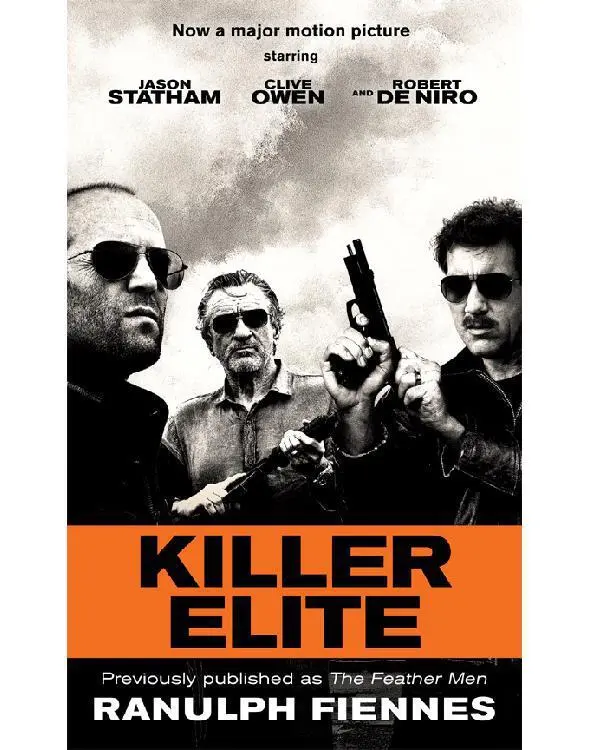
- Название:Killer Elite
- Автор:
- Жанр:
- Год:неизвестен
- ISBN:нет данных
- Рейтинг книги:3 / 5. Голосов: 1
-
Избранное:Добавить в избранное
- Отзывы:
-
Ваша оценка:
Killer Elite: краткое содержание, описание и аннотация
Предлагаем к чтению аннотацию, описание, краткое содержание или предисловие (зависит от того, что написал сам автор книги «Killer Elite»). Если вы не нашли необходимую информацию о книге — напишите в комментариях, мы постараемся отыскать её.
Killer Elite — читать онлайн бесплатно полную книгу (весь текст) целиком
Ниже представлен текст книги, разбитый по страницам. Система сохранения места последней прочитанной страницы, позволяет с удобством читать онлайн бесплатно книгу «Killer Elite», без необходимости каждый раз заново искать на чём Вы остановились. Поставьте закладку, и сможете в любой момент перейти на страницу, на которой закончили чтение.
Интервал:
Закладка:
On his third visit to Johannesburg, Quinn handed MacEllen a suitcase containing $2 million worth of Rhodesian dollars. MacEllen, an optimist who rated Ian Smith’s chances of winning as high, had agreed to exchange Quinn’s Rhodesian money, then at an all-time low, directly for diamonds. Because Quinn was buying with cash, he avoided the standard government duty of twenty-five percent and so had good reason to keep clear of Internal Affairs and their Customs agents.
The meeting was held in MacEllen’s office. The room was electronically monitored. Even if Quinn had been a police plant, any recording device, whether a passive recorder or an active bug, would have been identified, warning MacEllen to conduct no unofficial business. Equally, if Quinn were to have announced that he was a Customs agent only at the very moment MacEllen handed him diamonds in exchange for his money, then MacEllen could easily maintain that the relevant stones were officially registered. After all, a quantity of stones of all varieties passed legitimately through his hands most weeks of the year.
Like many diamond dealers the world over, MacEllen’s business was mainly official, his polishing work above-board, and his stock of unofficial stones-well hidden by supporting documents-were stored alongside his official supply. Because he held a government warehouse, or VSJ, number he could buy and sell without tax payments, but only in business with other VSJ number holders. As he also held a standard rough-diamond dealer’s license he could always state, should the Quinn deal fall foul of the law, that he was intending to “prepare a full and legal invoice shortly.” He was as knowledgeable as any IDB (Illegal Diamond Buying) policeman from John Vorster Square as to the exact statutory powers that he possessed.
MacEllen counted out Quinn’s money and handed him a parcel containing almost a thousand carats of polished diamonds, all large, brilliant, flawless stones with the highest-grade colors and quality. He then gave Quinn the address of an elderly Jewish jeweler in downtown Kerk Street. The Quinns went there at once by taxi and received the jeweler’s receipt for the diamonds. He sketched them various designs for possible settings and Davisee selected her favorite. The jeweler promised to have everything ready in five to six weeks, exactly as specified by the Quinns.
Two months later they flew to London, the most popular destination for South African emigres since-despite the generally foul weather-it has always remained a daily destination for South African Airways and has a population generally sympathetic to the lot of white South Africans. On top of which few South Africans ever learn to speak anything but Afrikaans or English, so their choice of a new country is limited. By the end of 1976 London was the third biggest “South African” city after Johannesburg and Soweto.
The Quinns stayed at the Savoy Hotel within easy walking distance of the Hatton Garden diamond market. They experienced no trouble at all with Customs at Heathrow, simply wheeling their trolleys through the Green section. Over half their diamonds adorned the curvaceous body of Davisee, fashioned by the Johannesburg jeweler into a body set. She felt wonderful, like a film star, but she had fasted throughout the thirteen-hour flight, including the Nairobi stopover. Despite this precaution the act of walking was decidedly awkward due to the presence of a condom containing cotton wool wrapped around the three best stones. These had been kept back from the jeweler at a last-minute whim of Davisee.
In the back room of a Hatton Garden diamond dealer recommended by his Mauritius hotelier friend, Quinn deposited the jewelry and the three unset stones. He watched as the in-house setter deftly extracted the stones from the low-carat gold clasps and setting, turning the jewelry back into a mere scattering of polished diamonds.
The dealer then spent half an hour checking every stone, his face registering neither pleasure nor disappointment. The Quinns were on hot coals but refrained from showing their impatience.
At last the dealer gave a peremptory sigh. “The three stones that you kept separate are fine and I am prepared to give you $200,000.” He looked up at Mr. Quinn.
There was a pregnant silence, broken at length by an exasperated Quinn. “And the rest? What will you give me for the rest?”
The Jew’s heavily jowled face was expressionless, his grape-black eyes marbled by thick lenses.
“Nothing, Mr. Quinn. I can give you not a cent for the rest of these items. You will not find a dealer anywhere in Europe who will buy these from you. They are all fakes. The chemical name is cubic zirconium. Since you are obviously no fraud yourself, I assume you have been duped by the person who sold you these stones.”
The Quinns were devastated. Their world had collapsed and their dreams of a happy, secure future built on a lifetime of hard work turned quickly to bitter resentment, to blind hatred, and finally to an all-consuming desire for revenge.
Quinn obtained an introduction to the London criminal fraternity through a lawyer friend of the dealer and, after parting with?500 in cash to a middle man, received a visit from a representative of Tadnams Light Removals. • • •
A lack of current employment and an ever-gnawing curiosity about Anne Fontaine attracted de Villiers when his agent mentioned a South African job. He met up with the unfortunate Mr. Quinn and, having been briefed as quickly as possible, took a British Airways flight to Johannesburg.
Within a fortnight de Villiers had homed in on the fairly common malpractices that had so impoverished his new client. He anticipated an easy job with no need to summon Meier or Davies.
Krannie MacEllen, he discovered, had given Quinn real diamonds, but at a heavily overpriced value. He had to all intents and purposes stolen several hundred thousand dollars of Quinn’s money.
The Johannesburg jeweler, a crafty craftsman, had substituted cubic zirconium for the real diamonds, knowing that once they were set, the fakes would be very difficult to detect, even by an expert, until removed from their settings. The refractive index of CZ, and therefore its fire and brilliance, matches that of real diamonds.
De Villiers telephoned Quinn with his findings. Did he wish both men terminated? Quinn burst out that he wanted his diamonds or his money back. If that was not possible, then he wanted revenge. De Villiers pointed out that he dealt in removals, not retrieval work, but that for twice the initially agreed sum of $100,000 plus expenses, he would do his best. Either Quinn’s goods would be recovered or the guilty parties targeted.
The fraudulent jeweler, being of a nervous disposition, gave de Villiers all of Quinn’s original stones that he still possessed and a cash payment in place of those he had sold. His personal policy was to yield and live to thrive another day.
Krannie MacEllen appeared to be timidity personified on de Villiers’s first visit, promising he would collect a suitable amount of cash by the following day. De Villiers sensed trouble. Five hours before the agreed upon time for the cash handover, he arrived in a hired car and parked outside the Cinerama building, directly opposite the Star Cinema Complex and the Diamond Exchange that housed MacEllen’s office. De Villiers watched the plainclothes members of the Hillbrow Flying Squad slip a tight and unobtrusive net around the building. He gave them six out of ten for the subtlety and camouflage of their agents. MacEllen had blown his survival option.
MacEllen and his family kept a powerboat by their riverside house-he called it their dacha-on the banks of the Vaal River outside the city. With or without friends, they went there most weekends to relax, float on air beds or cruise with a braiifleis, or barbecue, hamper.
Читать дальшеИнтервал:
Закладка:
Похожие книги на «Killer Elite»
Представляем Вашему вниманию похожие книги на «Killer Elite» списком для выбора. Мы отобрали схожую по названию и смыслу литературу в надежде предоставить читателям больше вариантов отыскать новые, интересные, ещё непрочитанные произведения.








Обсуждение, отзывы о книге «Killer Elite» и просто собственные мнения читателей. Оставьте ваши комментарии, напишите, что Вы думаете о произведении, его смысле или главных героях. Укажите что конкретно понравилось, а что нет, и почему Вы так считаете.