Ranulph Fiennes - Killer Elite
Здесь есть возможность читать онлайн «Ranulph Fiennes - Killer Elite» весь текст электронной книги совершенно бесплатно (целиком полную версию без сокращений). В некоторых случаях можно слушать аудио, скачать через торрент в формате fb2 и присутствует краткое содержание. Жанр: Триллер, на английском языке. Описание произведения, (предисловие) а так же отзывы посетителей доступны на портале библиотеки ЛибКат.
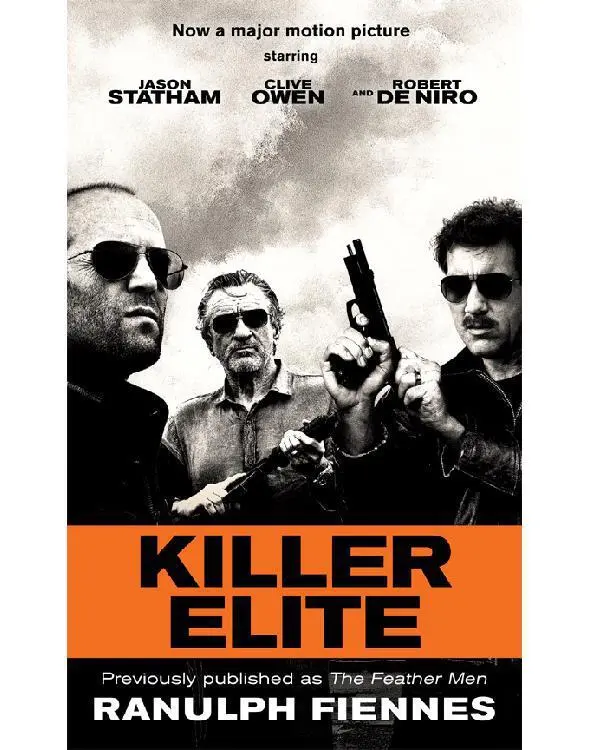
- Название:Killer Elite
- Автор:
- Жанр:
- Год:неизвестен
- ISBN:нет данных
- Рейтинг книги:3 / 5. Голосов: 1
-
Избранное:Добавить в избранное
- Отзывы:
-
Ваша оценка:
Killer Elite: краткое содержание, описание и аннотация
Предлагаем к чтению аннотацию, описание, краткое содержание или предисловие (зависит от того, что написал сам автор книги «Killer Elite»). Если вы не нашли необходимую информацию о книге — напишите в комментариях, мы постараемся отыскать её.
Killer Elite — читать онлайн бесплатно полную книгу (весь текст) целиком
Ниже представлен текст книги, разбитый по страницам. Система сохранения места последней прочитанной страницы, позволяет с удобством читать онлайн бесплатно книгу «Killer Elite», без необходимости каждый раз заново искать на чём Вы остановились. Поставьте закладку, и сможете в любой момент перейти на страницу, на которой закончили чтение.
Интервал:
Закладка:
Aware of sounds of uneasiness in the main cabin, John found time to shout over his shoulder, “ Maa shekhof. Maa shekhof. Kull shay ba stawi zehn, insh’ Allah ” (“Don’t worry. All will be well, God willing”).
But all was far from well for, at this critical moment, a combination of unrelated factors came together: John’s relative inexperience of high gross weights at higher than normal density altitudes combined with the sudden hydraulic failure.
John fought hard and nearly won the aerodynamic battle. He turned the dive into a bouncing blow with skids and belly. His mind raced to stay ahead of the developing emergency. He would not accept that the situation was irretrievable. His greatest fear was that the helicopter’s nose would contact the water, and to avoid this, he needed a delicate response from his controls; this he did not have.
John’s concentration centered on the stubborn collective lever and this had the subsidiary effect of coarsening his handling of the cyclic lever. He pulled the Bell’s nose up a little too far and became immediately concerned lest the tail rotor strike the water.
To level out he pushed the cyclic forward. Once again his touch was a little too heavy. At two or three feet above the water, a little too far was too far and the nose touched the sea.
John’s veins stood out on his forehead as he wrenched up on the stubborn collective with his left hand while simultaneously attempting a delicate correction to the nose with his right.
A lesser pilot would have lost control at that point. John kept his head to the last. Somehow he managed to claw the Bell out of the water, but was still caught in a lethal dilemma. Above all he needed delicate controls to lift the nose without ditching the tail. Once again a minute and unavoidable overcorrection made the nose touch the leaden surface of the sea.
Although the Bell’s hull had leveled out at the moment of impact, the deceleration effect of the initial immersion was catastrophic. The gear box was torn from its mountings and smashed its way forward to shear through the roof of both cabin and cockpit. The massive control feedback caused a momentary surge of pressure to some 5,000 psi and dislodged a number of lee-plugs within the other two undoctored cylinders.
John and Ali, haltered by lap but not shoulder straps, catapulted forward and were knocked senseless by the instrument panel.
The stricken Bell floated for some seconds. Then, in less than a minute, she sank to the seabed some forty feet below. The cockpit filled with water. John and Ali drowned without regaining consciousness.
A rescue operation was swiftly mounted. Within minutes men with scuba gear, including George Halbert, were inside the hull, hoping for survivors trapped in an air bubble. Five cadets failed to escape; the rest surfaced and were quickly rescued. Had the machine nosedived on the first impact, all on board would certainly have died.
The meticulous investigation and the resulting accident report concluded that the crash was caused by many factors. The blown lee-plugs were noted but no suspicion was aroused.
Three days later in Berlin, after reading of the accident in the Times obituary column, Mason phoned the Air Wing in Seeb. Bill Bailey was away but another officer told him, “There is no question of sabotage. It was either pilot error or some mechanical defect.”
Bill Bailey was sure that the accident could not have been connected with sabotage. He was uncertain of Mason’s identity or whereabouts since there was no response from his answering machine and Mason himself never reappeared. He realized that there could be no connection between Mason’s visit and the unfortunate accident but even so he passed the photograph of Meier to one of the Omani police officers peripherally involved in the accident investigation. No follow-up action was possible, for there was no starting point nor indeed any reason for any inquiries.
The Times obituary on March 22, 1977, for John Milling was straightforward: “On 20th March, as a result of an air accident in Oman, John, late of the Royal Marines serving with the Royal Oman Police Air Wing, beloved husband of Bridget (nee Wallis) and dear father of Oliver, much beloved son of Desmond and Diana, Co. Antrim.”
An article in the Globe and Laurel, the Royal Marines’ magazine, stated, “It is a fitting tribute to John and a measure of the respect and fondness in which he was held that the news of his death brought messages of sympathy from His Majesty Sultan Qaboos and Omanis and Britons throughout both countries.”
John was buried in the Christian burial ground that overlooks Mina al Fahal and the Gulf of Oman. A great many friends, Christian and Muslim, were present. Eminent Omanis and simple soldiers were saddened by the loss of a true friend of their country.
PART 3
19
… In the Second World War diamonds were needed for tools in new armaments factories, so the value of suitable stones shot up. Then, during the Korean War, people throughout the West bought diamonds, often mortgaging their homes in order to do so, for they thought the Third World War was about to start. When there was no war the price of diamonds slumped, and many suicides followed. Until 1979 there was no further spectacular rise in the diamond price but then the world situation caused the great 1980 boom. The price for a one-carat D flawless diamond rose as high as $65,000. Only a year later the value of such a stone had fallen as low as $7,000.
Because diamonds, like drugs, are so much easier to conceal and transport than gold, they are the root of much crime.
In April 1976 a successful Rhodesian restaurateur, Derryck Quinn, joined the rising number of whites wanting to get themselves, their wealth and their families-often in that order-to a safer country. At the time South Africa appeared to be a safe haven compared with Rhodesia, but June of that year saw the first great Soweto riots and then there was little to choose between the two countries. Both offered decidedly insecure futures for whites.
The international embargo against Ian Smith’s UDI-Unilateral Declaration of Independence-was officially supported by South Africa but a sufficiency of critical materials, including oil, continued to reach Rhodesia by truck and train over the Limpopo River.
Quinn had for years benefited from being in a cash business. He stashed his money on his estate in the Bulawayo suburbs, a practice totally alien to the inflation-wary people of most Western countries but a common enough safety device of many a Rhodesian and South African ever since the mid-fifties. Their greatest fear, undermining any ability to live an unworried and secure existence, was a black takeover, possibly with time to escape but more likely sudden and bloody, with wives and daughters raped against a backdrop of villa and possessions in flames.
An old school friend from South Africa, a hotelier with resorts in Mauritius and Namibia, gave Quinn an address that galvanized years of vague intention into excited action.
Quinn was without children but proud of his pretty Eurasian wife, Davisee. He took her into his confidence at once, and made her an integral part of his plan.
Twice over a period of four months he flew to Johannesburg, each time to the plush offices of diamond dealer Krannie MacEllen. These were situated within the Diamond Exchange Building at the corner of Quartz and de Villiers Street on the northern edge of the city. Mentioning the name of his hotelier friend, Quinn discovered, made him checkable and therefore more acceptable to MacEllen, a naturally suspicious person.
Had Quinn wished to settle in South Africa, he could have done so without too much trouble but he believed in the domino theory. Once Rhodesia fell, South Africa and Namibia would not be long in following suit. He wanted his money in the safest of places, and this he believed was Geneva. Davisee, who would be classified as colored in South Africa, persuaded Quinn that they should settle in London.
Читать дальшеИнтервал:
Закладка:
Похожие книги на «Killer Elite»
Представляем Вашему вниманию похожие книги на «Killer Elite» списком для выбора. Мы отобрали схожую по названию и смыслу литературу в надежде предоставить читателям больше вариантов отыскать новые, интересные, ещё непрочитанные произведения.











Обсуждение, отзывы о книге «Killer Elite» и просто собственные мнения читателей. Оставьте ваши комментарии, напишите, что Вы думаете о произведении, его смысле или главных героях. Укажите что конкретно понравилось, а что нет, и почему Вы так считаете.