Dan Brown - Inferno
Здесь есть возможность читать онлайн «Dan Brown - Inferno» — ознакомительный отрывок электронной книги совершенно бесплатно, а после прочтения отрывка купить полную версию. В некоторых случаях можно слушать аудио, скачать через торрент в формате fb2 и присутствует краткое содержание. Город: London, Год выпуска: 2013, Жанр: Триллер, на английском языке. Описание произведения, (предисловие) а так же отзывы посетителей доступны на портале библиотеки ЛибКат.
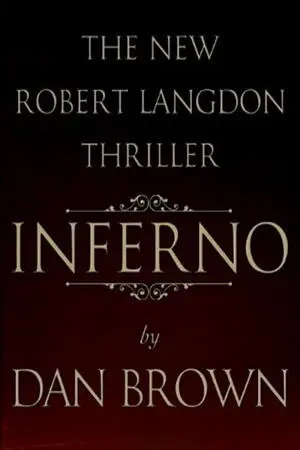
- Название:Inferno
- Автор:
- Жанр:
- Год:2013
- Город:London
- ISBN:нет данных
- Рейтинг книги:4 / 5. Голосов: 2
-
Избранное:Добавить в избранное
- Отзывы:
-
Ваша оценка:
Inferno: краткое содержание, описание и аннотация
Предлагаем к чтению аннотацию, описание, краткое содержание или предисловие (зависит от того, что написал сам автор книги «Inferno»). Если вы не нашли необходимую информацию о книге — напишите в комментариях, мы постараемся отыскать её.
A threat to his life will propel him and a young doctor, Sienna Brooks, into a breakneck chase across the city of Florence. Only Langdon’s knowledge of hidden passageways and ancient secrets that lie behind its historic facade can save them from the clutches of their unknown pursuers.
With only a few lines from Dante’s dark and epic masterpiece,
, to guide them, they must decipher a sequence of codes buried deep within some of the most celebrated artefacts of the Renaissance — sculptures, paintings, buildings — to find the answers to a puzzle which may, or may not, help them save the world from a terrifying threat…
Set against an extraordinary landscape inspired by one of history’s most ominous literary classics,
is Dan Brown’s most compelling and thought-provoking novel yet, a breathless race-against-time thriller that will grab you from page one and not let you go until you close the book.
Inferno — читать онлайн ознакомительный отрывок
Ниже представлен текст книги, разбитый по страницам. Система сохранения места последней прочитанной страницы, позволяет с удобством читать онлайн бесплатно книгу «Inferno», без необходимости каждый раз заново искать на чём Вы остановились. Поставьте закладку, и сможете в любой момент перейти на страницу, на которой закончили чтение.
Интервал:
Закладка:
“Absolutely,” Sinskey said. “A leader of the movement. In addition to being highly intelligent, he was enormously charismatic and penned doomsday articles that spawned an entire cult of zealots for Transhumanism. Today, many of his fanatical disciples use these code names, all of which take a similar form — two letters and a four-digit number — for example, DG-2064, BA-2105, or the one you just mentioned.”
“FS-2080.”
Sinskey nodded. “That could only be a Transhumanist code name.”
“Do the numbers and letters have meaning?”
Sinskey motioned to his computer. “Pull up your browser. I’ll show you.”
The provost looked uncertain but went to his computer and launched a search engine.
“Search for ‘FM-2030,’ ” Sinskey said, settling in behind him.
The provost typed FM-2030 , and thousands of Web pages appeared.
“Click any of them,” Sinskey said.
The provost clicked the top hit, which returned a Wikipedia page showing a picture of a handsome Iranian man— Fereidoun M. Esfandiary —whom it described as an author, philosopher, futurist, and forefather of the Transhumanist movement. Born in 1930, he was credited with introducing Transhumanist philosophy to the multitudes, as well as presciently predicting in vitro fertilization, genetic engineering, and the globalization of civilization.
According to Wikipedia, Esfandiary’s boldest claim was that new technologies would enable him to live to be a hundred years old, a rarity for his generation. As a display of his confidence in future technology, Fereidoun M. Esfandiary changed his name to FM-2030, a code name created by combining his first and middle initials along with the year in which he would turn one hundred. Sadly, he succumbed to pancreatic cancer at age seventy and never reached his goal, but in honor of his memory, zealous Transhumanist followers still paid tribute to FM-2030 by adopting his naming technique.
When the provost finished reading, he stood up and walked to the window, staring blankly out at the ocean for a long moment.
“So,” he finally whispered, as if thinking aloud. “Bertrand Zobrist’s lover — this FS-2080—is obviously one of these … Transhumanists .”
“Without a doubt,” Sinskey replied. “I’m sorry I don’t know exactly who this FS-2080 is, but—”
“That was my point,” the provost interrupted, still staring out to sea. “I do know. I know exactly who it is.”
CHAPTER 74
The air itself seems fashioned of gold.
Robert Langdon had visited many magnificent cathedrals in his life, but the ambience of St. Mark’s Chiesa d’Oro always struck him as truly singular. For centuries it had been claimed that simply breathing the air of St. Mark’s would make you a richer person. The statement was intended to be understood not only metaphorically, but also literally.
With an interior veneer consisting of several million ancient gold tiles, many of the dust particles hovering in the air were said to be actual flecks of gold. This suspended gold dust, combined with the bright sunlight that streamed through the large western window, made for a vibrant atmosphere that helped the faithful attain both spiritual wealth and, provided they inhaled deeply, a more worldly enrichment in the form of gilding their lungs.
At this hour, the low sun piercing the west window spread out over Langdon’s head like a broad, gleaming fan, or an awning of radiant silk. Langdon could not help but draw an awestruck breath, and he sensed Sienna and Ferris do the same beside him.
“Which way?” Sienna whispered.
Langdon motioned toward a set of ascending stairs. The museum section of the church was on the upper level and contained an extensive exhibit devoted to the Horses of St. Mark’s, which Langdon believed would quickly reveal the identity of the mysterious doge who had severed the animals’ heads.
As they climbed the stairs, he could see that Ferris was struggling again with his breathing, and Sienna caught Langdon’s eye, which she had been trying to do for several minutes now. Her expression was cautionary as she nodded discreetly toward Ferris and mouthed something Langdon couldn’t understand. Before he could ask her for clarification, though, Ferris glanced back, a split second too late, for Sienna had already averted her eyes and was staring directly at Ferris.
“You okay, Doctor?” she asked innocently.
Ferris nodded and climbed faster.
The talented actress , Langdon thought, but what was she trying to tell me?
When they reached the second tier, they could see the entire basilica spread out beneath them. The sanctuary had been constructed in the form of a Greek Cross, far more square in appearance than the elongated rectangles of St. Peter’s or Notre-Dame. With a shorter distance from narthex to altar, St. Mark’s exuded a robust, sturdy quality, as well as a feeling of greater accessibility.
Not to appear too accessible, however, the church’s altar resided behind a columned screen topped by an imposing crucifix. It was sheltered by an elegant ciborium and boasted one of the most valuable altarpieces in the world — the famed Pala d’Oro. An expansive backdrop of gilded silver, this “golden cloth” was a fabric only in the sense that it was a fused tapestry of previous works — primarily Byzantine enamel — all interwoven into a single Gothic frame. Adorned with some thirteen hundred pearls, four hundred garnets, three hundred sapphires, as well as emeralds, amethysts, and rubies, the Pala d’Oro was considered, along with the Horses of St. Mark’s, to be one of the finest treasures in Venice.
Architecturally speaking, the word basilica defined any eastern, Byzantine-style church erected in Europe or the West. Being a replica of Justinian’s Basilica of the Holy Apostles in Constantinople, St. Mark’s was so eastern in style that guidebooks often suggested it as a viable alternative to visiting Turkish mosques, many of which were Byzantine cathedrals that had been turned into Muslim houses of worship.
While Langdon would never consider St. Mark’s a stand-in for the spectacular mosques of Turkey, he did have to admit that one’s passion for Byzantine art could be satisfied with a visit to the secret suite of rooms just off the right transept in this church, in which was hidden the so-called Treasure of St. Mark — a glittering collection of 283 precious icons, jewels, and chalices acquired during the looting of Constantinople.
Langdon was pleased to find the basilica relatively quiet this afternoon. There were still throngs of people, but at least there was room to maneuver. Weaving in and out of various groups, Langdon guided Ferris and Sienna toward the west window, where visitors could step outside and see the horses on the balcony. Despite Langdon’s confidence in their ability to identify the doge in question, he remained concerned about the step they’d have to take after that — locating the doge himself. His tomb? His statue? This would probably require some form of assistance, considering the hundreds of statues housed in the church proper, the lower crypt, and the domed tombs along the church’s north arm.
Langdon spotted a young female docent giving a tour, and he politely interrupted her talk. “Excuse me,” he said. “Is Ettore Vio here this afternoon?”
“Ettore Vio?” The woman gave Langdon an odd look. “Sì, certo, ma—” She stopped short, her eyes brightening. “Lei è Robert Langdon, vero?!” You’re Robert Langdon, aren’t you?
Langdon smiled patiently. “ Sì, sono io. Is it possible to speak with Ettore?”
Читать дальшеИнтервал:
Закладка:
Похожие книги на «Inferno»
Представляем Вашему вниманию похожие книги на «Inferno» списком для выбора. Мы отобрали схожую по названию и смыслу литературу в надежде предоставить читателям больше вариантов отыскать новые, интересные, ещё непрочитанные произведения.



Обсуждение, отзывы о книге «Inferno» и просто собственные мнения читателей. Оставьте ваши комментарии, напишите, что Вы думаете о произведении, его смысле или главных героях. Укажите что конкретно понравилось, а что нет, и почему Вы так считаете.