Dan Brown - Inferno
Здесь есть возможность читать онлайн «Dan Brown - Inferno» — ознакомительный отрывок электронной книги совершенно бесплатно, а после прочтения отрывка купить полную версию. В некоторых случаях можно слушать аудио, скачать через торрент в формате fb2 и присутствует краткое содержание. Город: London, Год выпуска: 2013, Жанр: Триллер, на английском языке. Описание произведения, (предисловие) а так же отзывы посетителей доступны на портале библиотеки ЛибКат.

- Название:Inferno
- Автор:
- Жанр:
- Год:2013
- Город:London
- ISBN:нет данных
- Рейтинг книги:4 / 5. Голосов: 2
-
Избранное:Добавить в избранное
- Отзывы:
-
Ваша оценка:
Inferno: краткое содержание, описание и аннотация
Предлагаем к чтению аннотацию, описание, краткое содержание или предисловие (зависит от того, что написал сам автор книги «Inferno»). Если вы не нашли необходимую информацию о книге — напишите в комментариях, мы постараемся отыскать её.
A threat to his life will propel him and a young doctor, Sienna Brooks, into a breakneck chase across the city of Florence. Only Langdon’s knowledge of hidden passageways and ancient secrets that lie behind its historic facade can save them from the clutches of their unknown pursuers.
With only a few lines from Dante’s dark and epic masterpiece,
, to guide them, they must decipher a sequence of codes buried deep within some of the most celebrated artefacts of the Renaissance — sculptures, paintings, buildings — to find the answers to a puzzle which may, or may not, help them save the world from a terrifying threat…
Set against an extraordinary landscape inspired by one of history’s most ominous literary classics,
is Dan Brown’s most compelling and thought-provoking novel yet, a breathless race-against-time thriller that will grab you from page one and not let you go until you close the book.
Inferno — читать онлайн ознакомительный отрывок
Ниже представлен текст книги, разбитый по страницам. Система сохранения места последней прочитанной страницы, позволяет с удобством читать онлайн бесплатно книгу «Inferno», без необходимости каждый раз заново искать на чём Вы остановились. Поставьте закладку, и сможете в любой момент перейти на страницу, на которой закончили чтение.
Интервал:
Закладка:
Sienna seemed equally uncertain as she eyed the towering ten-story cruise liner that was now passing in front of them, only three hundred yards off. The ship’s decks were crawling with passengers, all packed against the railings, taking photos of St. Mark’s Square from the water. In the churning wake of this ship, three others were lined up, awaiting their chance to drive past Venice’s best-known landmark. Langdon had heard that in recent years, the number of ships had multiplied so quickly that an endless line of cruises passed all day and all night.
At the helm, Maurizio studied the line of oncoming cruise liners and then glanced to his left at a canopied dock not far away. “I park at Harry’s Bar?” He motioned to the restaurant famous for having invented the Bellini. “St. Mark’s Square is very short walking.”
“No, take us all the way,” Ferris commanded, pointing across the lagoon toward the docks at St. Mark’s Square.
Maurizio shrugged good-naturedly. “Your choice. Hold on!”
The engines revved and the limo began cutting through the heavy chop, falling into one of the travel lanes marked by buoys. The passing cruise liners looked like floating apartment buildings, their wakes tossing the other boats like corks.
To Langdon’s surprise, dozens of gondolas were making this same crossing. Their slender hulls — at nearly forty feet in length and almost fourteen hundred pounds — appeared remarkably stable in the rough waters. Each vessel was piloted by a sure-footed gondolier who stood on a platform on the left side of the stern in his traditional black-and-white-striped shirt and rowed a single oar attached to the right-hand gunwale. Even in the rough water, it was evident that every gondola listed mysteriously to the left, an oddity that Langdon had learned was caused by the boat’s asymmetrical construction; every gondola’s hull was curved to the right, away from the gondolier, to resist the boat’s tendency to turn left from the right-sided rowing.
Maurizio pointed proudly to one of the gondolas as they powered past it. “You see the metal design on the front?” he called over his shoulder, motioning to the elegant ornament protruding from the bow. “It’s the only metal on a gondola — called ferro di prua —the iron of the prow. It is a picture of Venice!”
Maurizio explained that the scythelike decoration that protruded from the bow of every gondola in Venice had a symbolic meaning. The ferro ’s curved shape represented the Grand Canal, its six teeth reflected the six sestieri or districts of Venice, and its oblong blade was the stylized headpiece of the Venetian doge.
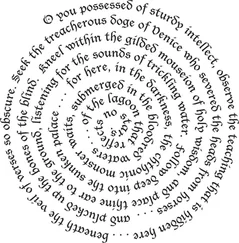
The doge , Langdon thought, his thoughts returning to the task ahead. Seek the treacherous doge of Venice who severed the heads from horses … and plucked up the bones of the blind.
Langdon raised his gaze to the shoreline ahead, where a small wooded park met the water’s edge. Above the trees, silhouetted against a cloudless sky, rose the redbrick spire of St. Mark’s bell tower, atop which a golden Archangel Gabriel peered down from a dizzying three hundred feet.
In a city where high-rises were nonexistent as a result of their tendency to sink, the towering Campanile di San Marco served as a navigational beacon to all who ventured into Venice’s maze of canals and passageways; a lost traveler, with a single glance skyward, would see the way back to St. Mark’s Square. Langdon still found it hard to believe that this massive tower had collapsed in 1902, leaving an enormous pile of rubble on St. Mark’s Square. Remarkably, the lone casualty in the disaster had been a cat.
Visitors to Venice could experience the city’s inimitable atmosphere in any number of breathtaking locales, and yet Langdon’s favorite had always been the Riva degli Schiavoni. The wide stone promenade that sat along the water’s edge had been built in the ninth century from dredged silt and ran from the old Arsenal all the way to St. Mark’s Square.
Lined with fine cafés, elegant hotels, and even the home church of Antonio Vivaldi, the Riva began its course at the Arsenal — Venice’s ancient shipbuilding yards — where the piney scent of boiling tree sap had once filled the air as boatbuilders smeared hot pitch on their unsound vessels to plug the holes. Allegedly it had been a visit to these very shipyards that had inspired Dante Alighieri to include rivers of boiling pitch as a torture device in his Inferno .
Langdon’s gaze moved to the right, tracing the Riva along the waterfront, and coming to rest on the promenade’s dramatic ending. Here, at the southernmost edge of St. Mark’s Square, the vast expanse of pavement met the open sea. During Venice’s golden age, this stark precipice had been proudly dubbed “the edge of all civilization.”
Today, the three-hundred-yard-long stretch where St. Mark’s Square met the sea was lined, as it always was, with no fewer than a hundred black gondolas, which bobbed against their moorings, their scythelike bow ornaments rising and falling against the white marble buildings of the piazza.
Langdon still found it hard to fathom that this tiny city — just twice the size of Central Park in New York — had somehow risen out of the sea to become the largest and richest empire in the west.
As Maurizio powered the boat closer, Langdon could see that the main square was absolutely mobbed with people. Napoleon had once referred to St. Mark’s Square as “the drawing room of Europe,” and from the looks of things, this “room” was hosting a party for far too many guests. The entire piazza looked almost as if it would sink beneath the weight of its admirers.
“My God,” Sienna whispered, gazing out at the throngs of people.
Langdon wasn’t sure whether she was saying this out of fear that Zobrist might have chosen such a heavily populated location to release his plague … or because she sensed that Zobrist might actually have had a point in warning about the dangers of overpopulation.
Venice hosted a staggering number of tourists every year — an estimated one-third of 1 percent of the world’s population — some twenty million visitors in the year 2000. With the additional billion added to the earth’s population since that year, the city was now groaning under the weight of three million more tourists per year. Venice, like the planet itself, had only a finite amount of space, and at some point would no longer be able to import enough food, dispose of enough waste, or find enough beds for all those who wanted to visit it.
Ferris stood nearby, his eyes turned not toward the mainland, but out to sea, watching all the incoming ships.
“You okay?” Sienna asked, eyeing him curiously.
Ferris turned abruptly. “Yeah, fine … just thinking.” He faced front and called up to Maurizio: “Park as close to St. Mark’s as you can.”
“No problem!” Their driver gave a wave. “Two minutes!”
The limo had now come even with St. Mark’s Square, and the Doge’s Palace rose majestically to their right, dominating the shoreline.
A perfect example of Venetian Gothic architecture, the palace was an exercise in understated elegance. With none of the turrets or spires normally associated with the palaces of France or England, it was conceived as a massive rectangular prism, which provided for the largest possible amount of interior square footage in which to house the doge’s substantial government and support staff.
Viewed from the ocean, the palace’s massive expanse of white limestone would have been overbearing had the effect not been carefully muted by the addition of porticos, columns, a loggia, and quatrefoil perforations. Geometric patterns of pink limestone ran throughout the exterior, reminding Langdon of the Alhambra in Spain.
Читать дальшеИнтервал:
Закладка:
Похожие книги на «Inferno»
Представляем Вашему вниманию похожие книги на «Inferno» списком для выбора. Мы отобрали схожую по названию и смыслу литературу в надежде предоставить читателям больше вариантов отыскать новые, интересные, ещё непрочитанные произведения.







Обсуждение, отзывы о книге «Inferno» и просто собственные мнения читателей. Оставьте ваши комментарии, напишите, что Вы думаете о произведении, его смысле или главных героях. Укажите что конкретно понравилось, а что нет, и почему Вы так считаете.