Nicola Griffith - Always
Здесь есть возможность читать онлайн «Nicola Griffith - Always» весь текст электронной книги совершенно бесплатно (целиком полную версию без сокращений). В некоторых случаях можно слушать аудио, скачать через торрент в формате fb2 и присутствует краткое содержание. Город: New York, Год выпуска: 2007, ISBN: 2007, Издательство: Riverhead Books, Жанр: Триллер, на английском языке. Описание произведения, (предисловие) а так же отзывы посетителей доступны на портале библиотеки ЛибКат.
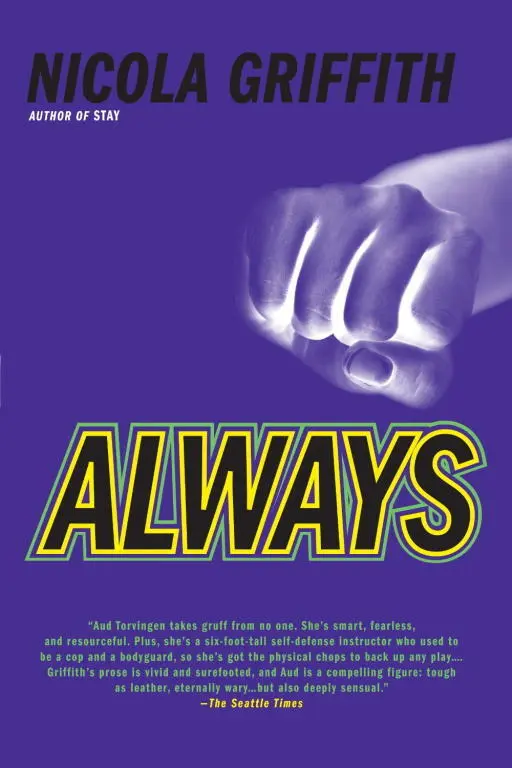
- Название:Always
- Автор:
- Издательство:Riverhead Books
- Жанр:
- Год:2007
- Город:New York
- ISBN:9781594482946
- Рейтинг книги:3 / 5. Голосов: 1
-
Избранное:Добавить в избранное
- Отзывы:
-
Ваша оценка:
Always: краткое содержание, описание и аннотация
Предлагаем к чтению аннотацию, описание, краткое содержание или предисловие (зависит от того, что написал сам автор книги «Always»). Если вы не нашли необходимую информацию о книге — напишите в комментариях, мы постараемся отыскать её.
) returns in an exhilarating new thriller. It doesn’t matter how well trained you are, how big, how fast, how strong; there will always be someone out there bigger or faster or stronger. Always. That’s what Aud Torvingen teaches the students in her self-defense class. But the question is whether Aud really believes this lesson herself-and if not, what it will take for her to learn it.
Aud has trained herself to achieve a fierce, machine-like precision, in hand-to-hand combat as well as life. But in Always she is abruptly confronted with the limits of her own power. Her self-defense classes spin violently out of her grasp and, still reeling from the consequences, she embarks on a seemingly simple investigation of Seattle real estate fraud that pulls her into something far more complicated and dangerous than she had imagined.
Always — читать онлайн бесплатно полную книгу (весь текст) целиком
Ниже представлен текст книги, разбитый по страницам. Система сохранения места последней прочитанной страницы, позволяет с удобством читать онлайн бесплатно книгу «Always», без необходимости каждый раз заново искать на чём Вы остановились. Поставьте закладку, и сможете в любой момент перейти на страницу, на которой закончили чтение.
Интервал:
Закладка:
Kedgeree.
She stirred, turned down the heat. “You remember where the napkins and silverware are.”
I laid the table. Now that I wasn’t dazed with drugs or hormones, I saw that it was an old piece, solid cherry carcass, with a polished mahogany veneer. I found cork place mats piled on the stretcher of a battered-looking secretaire in the corner, gave us two each. Green cotton napkins. Knife, fork, spoon.
She dished onto two plates. Carried them to the table. Nodded at the kettle, from which steam was still easing, which I took to mean Make the tea. A small teapot, some green tea, and two beautiful mugs stood ready. I brought the pot and mugs to the table. Put a mug each on a place mat, got out another for the pot. Sat.
Albinoni streamed as clear as the sun into the dining room. The old mahogany glowed like bronze. The flatware winked. The smoked salmon in the kedgeree was flecked with nutmeg and nestled amid nutty, moist rice. Kick wore blue and grey.
Soon I’d be flying back to Atlanta with Dornan.
“You look as though you don’t know if you’re in heaven or hell.”
“Kedgeree is my favorite breakfast food.”
She smiled, as playful as an otter. I leaned over and kissed her. The fly ran back and forth. I poured tea for us both. This was where I asked her what she was doing tonight, but I already knew. The silence grew. The otter slowly submerged.
“Will I see you on the set this afternoon?” I said.
“I’ll be busy.”
“I see.”
“No, you don’t. We have location shots.” The otter popped back up. “But tomorrow is another day. Now I have to eat and run.”
She ate at lightning speed, with clean, deft movements of fork to mouth, cup to mouth, napkin to mouth and then plate, and rose from her chair like an acrobat, with no visible effort.
“You take your time.” She kissed me, not a millimeter of lip in the wrong place, not an ounce of weight on the wrong leg, perfectly balanced. She scrutinized me for a full two seconds, but gave no hint of what she thought. “Let me know how you like the muffins. Drop the latch on your way out,” she said, and left.
I finished my kedgeree, poured more tea, and listened to the rest of Albinoni.
TEN O’CLOCK.Sixty-nine degrees, light breeze, cheerful pedestrians. I drove carefully.
She had left me in her house. I could have done anything: stolen her things, searched out her secrets, fingered through her most personal possessions, spat in her milk. But she knew I wouldn’t. She probably knew I would look for airtight tubs to put away the remainder of the kedgeree; find a tin for the muffins; make sure the kettle was unplugged; rinse the dishes and turn on the dishwasher; make the bed. Turn off the CD player. Check that the lights and oven were off. Leave my cell phone number on her table. Just as she had known that I liked food with different textures. Just as she had known that I liked to wrap my arm around her waist and hold her tight against me as she moved. Just as I knew nothing of what she thought, or why.
I pulled over on Westlake, dialed her number, and after three rings got the machine.
“It’s Aud. It’s… There’s a fly. In the dining room. It can’t get out. You’ll probably have to take off the window screens. You’ll need a ladder to get at them from the outside. I can do it, if you like.”
Or she could just open the front door and shoo it out. Or catch it in her hands. I imagined her small hands cupping the fly. The scent of her fingers.
I’m having dinner with him tomorrow. I closed the phone. Stupid, stupid, my forebrain said. But another part of my brain, the old, animal limbic system, sat back on its heels, raised its face to the sun, and crooned. And, unbidden, the underside of my arms remembered the soft swell of her breasts as I turned her in bed, the press of her lips and slick of her tongue, and the car felt as alien as a mother ship.
A truck rumbled by, the driver singing to something on a classic rock station, looking pleased with and in charge of his world.
I shut my windows. Opened them again. Breathed in, deep and slow, and out again, long and slow and steady, using the muscles in my abdomen to force the air out in a steady hiss. In again, for a count of ten. Pause. Out, to ten. In. Out. Then I called Dornan.
It rang and rang. I imagined him looking at my number on his screen and deliberately turning it off. I hung up before his voice mail finished inviting me to leave a message.
IN MYsuite I walked naked and dripping from the shower to my laptop, where I searched randomly through Norwegian and English dictionaries. Elske. Elsker. Forelske seg. That disposition or state of feeling with regard to a person that manifests itself in solicitude for the welfare of the object, and usually also in delight in his or her presence and desire for his or her approval; warm affection, attachment. The affection that subsides between lover and sweetheart and is the normal basis of marriage. The animal instinct between the sexes. Liker. To feel attracted to or favorably impressed by. Kjœreste. One who is loved illicitly…
I called Dornan again. This time I left a message.
WE METfor lunch at a bistro on First Avenue. The menu was aggressively French. I chose the soup—lentils and chicken livers, with a Rainier cherry compote—mainly because I couldn’t imagine how it would taste. It also had the sets of ingredients Kick had recommended.
We ate without saying much, and I wiped up the last traces of lentil and cherry with bread. “Good soup.”
“But it’s a shame about the service.”
“Yes.” West Coast hipsters trying to do French attitude.
“Seattle,” he said. “If you don’t like the weather, wait ten minutes; if you don’t like the service, wait ten minutes.”
It was Kick’s phrasing, Kick’s intonation; she could have been sitting between us. I didn’t know how to begin. How did friends talk about something like this?
The sun spilled right down the center of the avenue as we walked to the gallery. Before I met Julia, I never went to art galleries. When she died, I began to visit them, because they reminded me of her. Now it was merely a habit.
The gallery wasn’t as empty as I’d expected, but there were few enough people that we could move from painting to painting at our own pace. I worked along the right-hand wall, Dornan the left.
The heart-of-pine floor creaked as I walked from picture to picture. Hyperrealist still life in oils. It seemed to glisten, as though coated with glycerine. An American artist. Interesting, but not something I’d want in my house. A series of fuzzy-looking black-and-white lithographs of cityscapes viewed from second-story windows, empty industrial complexes, a stand of silver birches in the snow. None of them worth more than a minute. Two huge abstract French pieces, nine feet by six, of what looked like something between Christmas ornaments and the insides of a clock. Then a woman in a red silk Chinese robe, bending over a guitar, glass beads in her hair. I paused. It was ugly, drenched with hatred—the woman’s face wasn’t deformed, but it made me shudder—but the beads were irresistible; like a child, I wanted to scoop them up and put them in my mouth, and something about the light slanting across the floor intrigued me. I leaned in close. The brushwork was textured and confident. The next was by the same artist, a nude reclining on a couch, her back to the room. It was a twenty-first-century painting in the style of a nineteenth-century Russian or French master, every tassel of the velvet rope hanging from the bedpost, every strand of hair exquisitely rendered, yet the background was curiously abstract. The model’s profile was Asian, but the body was fleshy and Dutch. I went back to the first painting, and the block of text about the artist. Lu Jian Jun. Forty-two. Chinese, winner of several national prizes, now living in San Francisco.
Читать дальшеИнтервал:
Закладка:
Похожие книги на «Always»
Представляем Вашему вниманию похожие книги на «Always» списком для выбора. Мы отобрали схожую по названию и смыслу литературу в надежде предоставить читателям больше вариантов отыскать новые, интересные, ещё непрочитанные произведения.










Обсуждение, отзывы о книге «Always» и просто собственные мнения читателей. Оставьте ваши комментарии, напишите, что Вы думаете о произведении, его смысле или главных героях. Укажите что конкретно понравилось, а что нет, и почему Вы так считаете.