Nicola Griffith - Always
Здесь есть возможность читать онлайн «Nicola Griffith - Always» весь текст электронной книги совершенно бесплатно (целиком полную версию без сокращений). В некоторых случаях можно слушать аудио, скачать через торрент в формате fb2 и присутствует краткое содержание. Город: New York, Год выпуска: 2007, ISBN: 2007, Издательство: Riverhead Books, Жанр: Триллер, на английском языке. Описание произведения, (предисловие) а так же отзывы посетителей доступны на портале библиотеки ЛибКат.
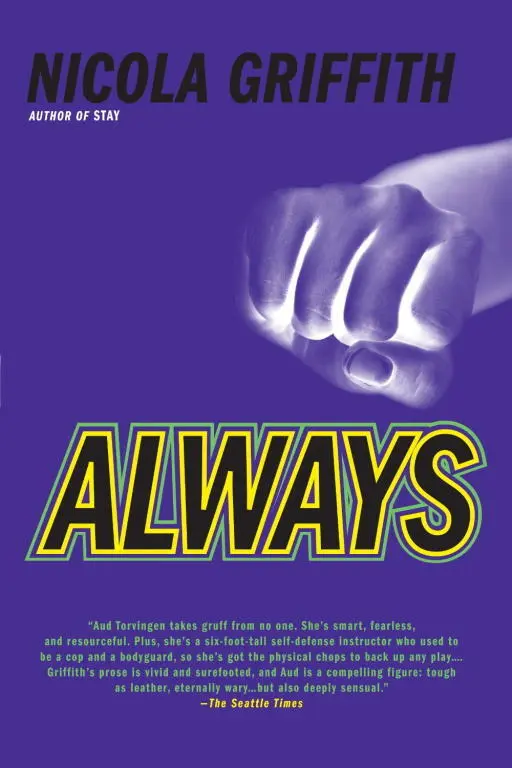
- Название:Always
- Автор:
- Издательство:Riverhead Books
- Жанр:
- Год:2007
- Город:New York
- ISBN:9781594482946
- Рейтинг книги:3 / 5. Голосов: 1
-
Избранное:Добавить в избранное
- Отзывы:
-
Ваша оценка:
Always: краткое содержание, описание и аннотация
Предлагаем к чтению аннотацию, описание, краткое содержание или предисловие (зависит от того, что написал сам автор книги «Always»). Если вы не нашли необходимую информацию о книге — напишите в комментариях, мы постараемся отыскать её.
) returns in an exhilarating new thriller. It doesn’t matter how well trained you are, how big, how fast, how strong; there will always be someone out there bigger or faster or stronger. Always. That’s what Aud Torvingen teaches the students in her self-defense class. But the question is whether Aud really believes this lesson herself-and if not, what it will take for her to learn it.
Aud has trained herself to achieve a fierce, machine-like precision, in hand-to-hand combat as well as life. But in Always she is abruptly confronted with the limits of her own power. Her self-defense classes spin violently out of her grasp and, still reeling from the consequences, she embarks on a seemingly simple investigation of Seattle real estate fraud that pulls her into something far more complicated and dangerous than she had imagined.
Always — читать онлайн бесплатно полную книгу (весь текст) целиком
Ниже представлен текст книги, разбитый по страницам. Система сохранения места последней прочитанной страницы, позволяет с удобством читать онлайн бесплатно книгу «Always», без необходимости каждый раз заново искать на чём Вы остановились. Поставьте закладку, и сможете в любой момент перейти на страницу, на которой закончили чтение.
Интервал:
Закладка:
“But I’m right-handed.”
“All right. Sandra, for now, hold the razor against her other cheek.”
Sandra gave me an amused we-know-it-wouldn’t-be-this-convenient look, and swapped hands. She was beginning to annoy me.
“Now,” I said to Pauletta, “try again. Pivot, yes, cross slam, yes. Excellent. But try to use the outside of your forearm, like this.”
“Why?” said Pauletta, as though it were just another detail I was using deliberately to confuse her. Sandra maintained her veiled-secret expression; she already knew.
“Because there are fewer important nerves, blood vessels, and tendons to be damaged on the outside. Also, it will hurt less when you take the impact on muscles when you’re hitting as hard as you can. Also,” I said, raising my voice to the whole class, “when you move, yell. Not only will it remind you to breathe, it will be a further distraction to your attacker. You can never have too many distractions or too much noise.” I plowed ahead before they could get twisted up about that. “We’ll do it together. On the count of three. Okay. Knives on cheeks. One. Deep breath. Focus. Three. Yell! And pivot. Slam. Excellent. And again. Knives. Breathe. Yell and pivot. And again.”
“Ow!” said Jennifer.
“Slow motion, Therese, but very good.” Pauletta had hit Sandra twice as hard, but Sandra hadn’t made a murmur. “And again.”
“Ow,” Katherine said, too, as Tonya’s bottle ran across her throat for the second time.
“Try again,” I said.
She did. Same result. “I can’t do this,” Katherine said.
“Sure you can,” said Tonya.
“I can’t.”
“Not yet,” I said. “That’s why you have to practice.”
“If Tonya was a great big guy and that was a real bottle, do you think I’d really have a chance?”
“Yes.”
“It’s ridiculous. I can’t do this.”
“All right,” I said.
“All right? All right?!”
“I’m not going to force you.”
“I just, I want… I want you to teach us how to not get hurt.”
“Infallibly? I can’t. No one can. There is no perfect security. Yes, most men are taller and stronger than most women. That’s not the point. You can be seven feet tall, and in fighting trim, and there will always be someone out there who is bigger and stronger and faster. The point is to do the best you can, then stop worrying.”
“Stop worrying? I dream about this stuff every night now. I worry that someone is lurking under my car, that they’re assembling clues from my e-mail conversations, that they’ll watch my every movement and rape me on the subway platform.”
“The fact that you’re worrying about these things now makes it less likely for them to happen. You’ll never be carjacked by someone lying underneath your car because now you look.”
“Maybe you’ll die of worry,” Suze muttered.
“I heard that.”
“Hey, then at least you’re not deaf, just stupid.”
“All right,” I said. “Everyone, swap roles. Five minutes. Then we’re going to sit.”
When they were done, I carried around the bin so they could ceremonially throw away their polystyrene weapons.
“You did well. Yes, even you, Katherine. You’ve all learnt a lot in the last six weeks. You’re not perfect killing machines, no, but there again, that was never the goal.”
“Hey, speak for yourself,” said Suze. Surprisingly, Therese nodded agreement.
“My goal is to make sure you’ve thought and planned and practiced so that you can relax in everyday life. Here’s something that might help.” I handed out the list I’d compiled after last week. “Read it carefully and we’ll talk about it next week.”
“Hell,” said Nina, flipping the page, “now we’re all going to die of worry.”
“Next week?” said Jennifer. “Next week’s a holiday. I’m going out of town.”
“Then the week after is fine.”
“We should get together anyhow,” Katherine said. “Have a picnic or something. Leave the guys at home.”
“A field trip,” Nina said.
“I’ll be out of town,” Jennifer said again.
“I’m gonna be here,” Suze said.
“And me,” “Me too,” “I’m not going anywhere.”
They were all looking at me.
“How about my place on Lake Lanier,” Therese said. “A social event, not a class, so it doesn’t matter if some people can’t make it. A covered dish.”
EIGHT
WE DRANK CHAMPAGNE. KICK WAS AT THE SIX-BURNER STOVE, STIRRING A HUGEpot with a wooden spoon. “The stew sticks if I don’t watch it,” she said. She was wearing the same striped trousers and white T-shirt, but no sandals. Her feet didn’t look cold. I sat on a hard chair by the counter.
The windows were open but screened. The breeze had died to a sigh and the night that seeped in was soft with moisture, potent with change. In the low atmospheric pressure the voices of moviegoers leaving the theaters on 45th, the sudden metallic judder of engines flaring to life, the music from the Jitterbug restaurant and Murphy’s Pub carried clearly and mixed with earthy blues from her CD player. The city-lit sky swam with clouds, sleek as seals.
The kitchen was big, and open, all cherry and pine—even the ceiling was pine—and continued to the dining room. I carried my champagne over to the dining room windows. Judging by the slight unevenness of the floor and the change in windows, it was an extension built less than ten years ago. It jutted out over a patio. A pear tree rustled against the left-hand window. On the other side, a little farther away, the silhouette of a cherry tree overhung the extension and the garage. Beyond the patio the garden seemed stepped, maybe to a lawn.
The house smelled like Spain in April: bread and olive oil and simmering beans and lemon juice and garlic. Some kind of unctuous meat roasting. If it were Spain it might be kid, but it was probably lamb. I went back into the kitchen. My mouth watered.
“Ah,” she said, “want something right away?”
I nodded.
She got two small dishes from a cupboard near my head, and turned off the gas under the pot. “Spoons in that drawer in front of you. Napkins in the drawer underneath.” She got busy with a ladle. “Here.” She handed me a bowl without ceremony. “Pond-bottom stew.”
It was a reddish-brown soup. I put it on the counter and handed her a spoon. She refused the napkin and just ate a couple of mouthfuls, leaning back against the stove.
I spread a napkin on my lap and balanced the bowl carefully.
“Spilled stuff cleans up. Just taste it.”
I dipped my spoon into the stew cautiously. “It smells a bit like fasolada. ”
“Same basic principle. Lots of olive oil and celery and garlic, some lemon, but instead of just white beans, I’ve added kidney beans and carrots. Really it’s a fall stew, hearty, warming. But it seemed like something you’d enjoy. When it’s cooked as long as it should, it gets sort of sludgy, like something you’d scrape off the bottom of a pond. Eat.”
I ate.
“Well?”
It tasted as fresh and clean as a shoot bursting free of winter-hard dirt. It filled me with hope that I might enjoy food again. I had the ridiculous urge to burst into tears.
“Do you like it?”
I showed her my empty bowl. She smiled. I eyed the pot on the stove.
“No. No more right now. I’ve made half a dozen things. I thought we’d try a bit of this and bit of that, just graze, see what works.”
Graze. Maybe that roasting smell wasn’t for me. “Is it all vegetarian?”
She smiled. “You don’t strike me as a vegetarian. Let’s move to the table so it doesn’t get messy.”
There was no ceremonial laying of places or careful positioning of silverware. No candles, no shimmering crystal. Just the music, and the champagne, and the food.
Читать дальшеИнтервал:
Закладка:
Похожие книги на «Always»
Представляем Вашему вниманию похожие книги на «Always» списком для выбора. Мы отобрали схожую по названию и смыслу литературу в надежде предоставить читателям больше вариантов отыскать новые, интересные, ещё непрочитанные произведения.









Обсуждение, отзывы о книге «Always» и просто собственные мнения читателей. Оставьте ваши комментарии, напишите, что Вы думаете о произведении, его смысле или главных героях. Укажите что конкретно понравилось, а что нет, и почему Вы так считаете.