Matthew Pearl - The Poe Shadow
Здесь есть возможность читать онлайн «Matthew Pearl - The Poe Shadow» весь текст электронной книги совершенно бесплатно (целиком полную версию без сокращений). В некоторых случаях можно слушать аудио, скачать через торрент в формате fb2 и присутствует краткое содержание. Жанр: Исторический детектив, на английском языке. Описание произведения, (предисловие) а так же отзывы посетителей доступны на портале библиотеки ЛибКат.
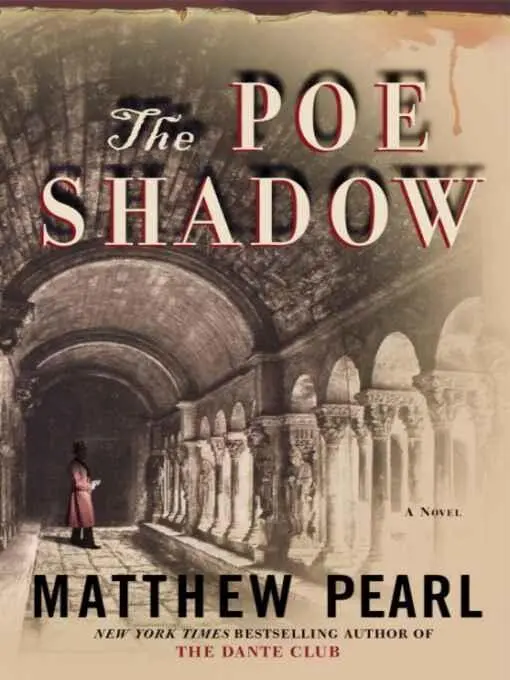
- Название:The Poe Shadow
- Автор:
- Жанр:
- Год:неизвестен
- ISBN:нет данных
- Рейтинг книги:5 / 5. Голосов: 1
-
Избранное:Добавить в избранное
- Отзывы:
-
Ваша оценка:
The Poe Shadow: краткое содержание, описание и аннотация
Предлагаем к чтению аннотацию, описание, краткое содержание или предисловие (зависит от того, что написал сам автор книги «The Poe Shadow»). Если вы не нашли необходимую информацию о книге — напишите в комментариях, мы постараемся отыскать её.
Poe was supposed to be almost anywhere other than Baltimore: he was traveling from Richmond to New York with a planned stop in Philadelphia, not Baltimore. No one knows how he came to be in the city – or, for that matter, how he ended up at the tavern. For some of us, this pretty much describes a really great Saturday night, but when it happens to the master of darkness, just days before his untimely death, it has the makings of a mystery.
Pearl takes us back to those few lost days through the inquiries of Quentin Clark, a Poe-mad young Baltimorean who is dismayed not just by the writer's death but by the press's apathetic reponse to the news. Clark takes it upon himself to look into matters and rectify this slight to his hero. The trouble is, Clark is a stock character from the world of commercial thrillers: a man with a lot to lose, imperiled by his own obsession. Engaged to a beautiful young woman, the son of wealthy and very proper parents and pursuing a career as a lawyer, he may sacrifice them all to his devotion to Poe.
Clark haunts the writer's grave, visits the hospital where he lay dying and tracks down the Poe cousins. But wherever he turns, he's met with indifference or outright obstruction. Finally, in desperation, he turns to another source of information: the pages of a book. Clark has always admired Poe's "Murders in the Rue Morgue" and the other mysteries featuring C. Auguste Dupin, the brilliant Frenchman who solves crimes too baffling for the Paris police. "Dupin's reasoning followed a method Poe called ratiocination," Clark reminds himself, "employing one's imagination to achieve analysis, and one's analysis to climb the heights of imagination."
When Clark stumbles on a newspaper item suggesting that Dupin was based on a real Frenchman, he promptly takes off for the Continent. Of course, there turns out to be more than one candidate for this honor, and soon a couple of testy Frenchmen are racing back to America, eager to snatch whatever glory they might from Poe's death.
Baroquely orchestrated complications ensue, up to and including a threat to the future of the French republic. As he demonstrated in his serial-killers-and-philosophers best seller, "The Dante Club," Pearl is a fine scene-setter and a resolute, if not always inspired, plotter. "The Poe Shadow" is thick with intrigue and thicker still with carefully researched (and ostentatiously displayed) details.
Pearl, who taught literature at Harvard before embarking on his literary career, sometimes displays a wonderfully knowing tone, and enjoys playing with 19th-century lingo. When a Baltimore police officer asks Clark if he has a wife and is told that he has a fiancée, the officer warns: "You should have much to occupy yourself without needing to think of this unhappy affair, then. Or your sweetheart might give you the mitten." Sadly, Pearl's plot is not all sweethearts and mittens.
With its bewildered narrator and its attempt to marry the rational and the spooky, "The Poe Shadow" seems to be modeled on Poe's own writing, but it's missing a crucial element: brevity. Although Pearl has a real affinity for 19th-century America, he overwhelms the strengths of his book with a hurricane of ersatz Victorian prose. He doesn't just disinter Poe's story; he disinters the language of Poe's time. After a while, you feel like you're trapped in a sepia-toned faux-daguerrotype. Pearl has created a museum rather than a world. And no one lives in a museum.
The Poe Shadow — читать онлайн бесплатно полную книгу (весь текст) целиком
Ниже представлен текст книги, разбитый по страницам. Система сохранения места последней прочитанной страницы, позволяет с удобством читать онлайн бесплатно книгу «The Poe Shadow», без необходимости каждый раз заново искать на чём Вы остановились. Поставьте закладку, и сможете в любой момент перейти на страницу, на которой закончили чтение.
Интервал:
Закладка:
"Of course, monsieur," said Duponte, using his eyeglass but hardly reading the article.
I was startled. "You have already thought that?"
"No."
"Then how is it you respond to me by saying, ‘Of course'?"
"I mean to say, ‘Of course the paper is quite mistaken. '"
"But how do you know that?" I asked.
"Newspapers are almost always quite mistaken about everything," he said. "If you should find one of the tenets of your religion in type on the sheet, it is likely time to reconsider your form of God-worship."
"But, monsieur! You have spent the better part of every day reading the newspapers at my library table! Why waste all that time?"
"You must notice their errors, Monsieur Clark, in order to advance to the truth."
I stared at him until he continued.
He arched his eyebrows in a particularly French fashion. "A demonstration. Take this matter of Monsieur Poe's garments that your paper mentions. The Richmond Observer has lately written that Poe had, some days before his arrival in Baltimore, inadvertently switched his own walking stick with the Malacca cane of a friend in Richmond, one Dr. John Carter. In the same paper we read-in a burlesque error somewhat different from the equally erroneous disguise camp-that Poe's clothes were stolen and had been replaced in a robbery during his time in Baltimore. To place the garments in the central position of importance, because they are easily visible to those who found Poe, is to subdue reason to fancy."
"How do you know, without further information, that the clothes were not stolen in this way?"
"Have you ever heard of a thief stealing one's clothes-rare enough-and then replacing the clothes of a victim with other dress? An idea only someone who is not a thief could devise. The editors have merely taken the most common scenario against a visitor, a robbery, and altered it to match the end results without regard to likelihood. At all events, the special quality of the borrowed cane alone tells us it is most unlikely."
In the newspaper article to which Duponte had referred, the Observer reported that Poe had visited Dr. Carter and, after playing with the latter's new Malacca cane, took it with him by accident. Carter also speaks of the fact that Poe left an 1819 volume of Thomas Moore's Melodies in his office. "But this says nothing more in detail about the cane than that it is ‘Malacca.' How, from that, do you determine that it has any special quality?"
Duponte had already moved on to a new topic. "Would you," Duponte said, "bring me the trunk that arrived just this morning?"
I was perplexed, and a bit irritated, that this request would interrupt our discourse, particularly since I had already stored the trunk in Duponte's chambers. I went upstairs and then wheeled the trunk from there down into the library where we sat. Duponte instructed me to open the lid. I did. My eyes widened at what I saw.
I bent down and reached in with reverence. It contained one object lying at the bottom of the trunk. "Is this…?"
"Poe's cane. Yes."
I picked it up cautiously in both hands and said, with wholly renewed wonder at my guest, "Duponte, how in the world-? How has Poe's cane come to appear in your trunk?!"
Duponte explained. "Not the actual one carried by Poe at the time of his death, but the very same kind, we can be sure. That the cane Poe borrowed was identified as ‘Malacca,' as you have just read, revealed quite more than its wood. I guessed that a finite number of canes were sold in America from that specific palm, which grows on the coasts of the Malay Peninsula, out of the beaten track. On my walk the other day, you will remember I said I stopped at some stores. I found from speaking with sellers of walking sticks that my guess was correct: there were but four or five chief selections of canes available made from Malacca in Baltimore, and likely in Richmond, as well. I purchased one of each. Then I emptied one of my trunks and sent the canes with a messenger to the Washington College Hospital, where Poe died, along with a note to Dr. Moran, the physician who attended to Poe. It explained that a shipment to Richmond had been mixed up with other canes, and kindly requested him to identify the one cane that had been held by Poe and return it here."
"But how did you know Dr. Moran would have sent such a shipment to Carter?"
"Oh, I did not suppose he had, which is why he would not have found my request odd. More likely, Dr. Moran sent all the effects to one of Poe's family members-possibly your acquaintance Neilson. He, in turn, would have attempted to return articles to their respective owners. As gratitude for the favor, my note to Dr. Moran made a gift of the other three Malacca canes I sent him. As I hoped, Moran has sent me one back. Do you find anything special about the cane, Monsieur Clark?"
"If Poe were assaulted in a robbery," I said, realizing its significance, "the thieves would surely have taken a stick this fine!"
"You have come closer to the truth by finding what is false." Duponte nodded approvingly. "And now this cane is yours."
My next errand in the city-to where, I cannot now remember-was also a good excuse to make use of my new walking stick. It was a very handsome ornament. It even inspired me to lend more attention to my dress, and I employed the deliberation of a statesman in selecting a hat and a vest that complimented the new accessory. Several representatives of the kinder sex, both younger ladies and those who watch after them, looked upon me with visible approval as I went through Old Town.
Oh yes, the errand-it was to two dronish men who had left word for me to call on them about various investments I held through my father's will. With a delay in the planned expansion of the Baltimore amp; Ohio Railroad to the Ohio River, various interests were affected, and they passed on to me a thick portfolio of papers that required my review. Naturally, I'd had little time during all else that was happening to peruse these papers very meticulously.
I found myself that afternoon again in the neighborhood where Poe was discovered on the third of October 1849. I decided to walk to the establishment, Ryan's hotel, where Poe had turned up in poor condition. I thought about what might have been done or said at that time-to save Poe, or at least to reassure him-in those crucial moments now two years ago.
My melancholy reverie was interrupted with shouting from around the corner. There was nothing of much consequence about stray noise in the streets of a city like Baltimore, where rattling fire engines and hollering continued through the nights and sometimes erupted into riots between rival fire companies or against groups of foreigners. But this lone scream, crackling like the death aria in an opera, sent chills straight through me.
"Reynolds…!"
"Reynolds!"
It was the word Poe had cried out in the hospital as he died.
Now, remember where this cry found me. Standing before the spot where Poe was removed to his hospital deathbed. Think of my disorientation, as though I had suddenly been lifted into someone else's life-someone else's death.
I crept forward. It rang out once more!
I turned onto the next street and stepped into the shadows of a narrow passage between two buildings, closing in on the sounds. A short man wearing spectacles and a morning coat walked right by, sending me jumping back, and now I recognized the voice of the man chasing him.
"Why, Mr. Reynolds!" the pursuer boomed out.
"Leave me be, won't you," replied the man-well, now we are free to say replied Reynolds.
"Good sir," protested the Baron Dupin, "I must remind you that I am a special constable."
"Special constable?" Reynolds repeated doubtfully.
Читать дальшеИнтервал:
Закладка:
Похожие книги на «The Poe Shadow»
Представляем Вашему вниманию похожие книги на «The Poe Shadow» списком для выбора. Мы отобрали схожую по названию и смыслу литературу в надежде предоставить читателям больше вариантов отыскать новые, интересные, ещё непрочитанные произведения.








Обсуждение, отзывы о книге «The Poe Shadow» и просто собственные мнения читателей. Оставьте ваши комментарии, напишите, что Вы думаете о произведении, его смысле или главных героях. Укажите что конкретно понравилось, а что нет, и почему Вы так считаете.