Matthew Pearl - The Poe Shadow
Здесь есть возможность читать онлайн «Matthew Pearl - The Poe Shadow» весь текст электронной книги совершенно бесплатно (целиком полную версию без сокращений). В некоторых случаях можно слушать аудио, скачать через торрент в формате fb2 и присутствует краткое содержание. Жанр: Исторический детектив, на английском языке. Описание произведения, (предисловие) а так же отзывы посетителей доступны на портале библиотеки ЛибКат.
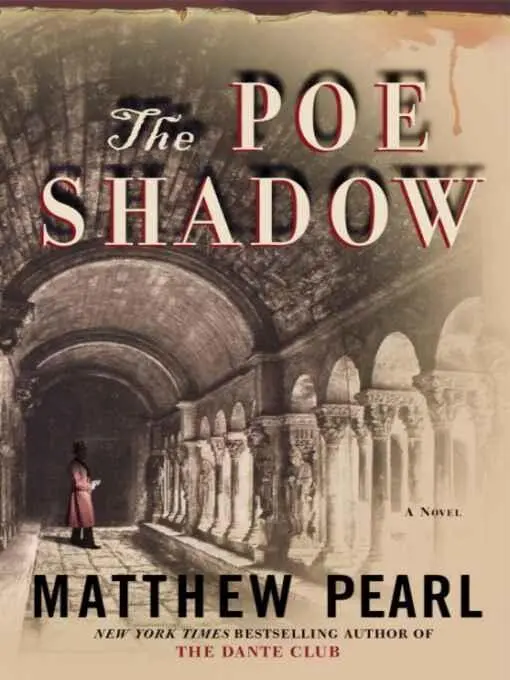
- Название:The Poe Shadow
- Автор:
- Жанр:
- Год:неизвестен
- ISBN:нет данных
- Рейтинг книги:5 / 5. Голосов: 1
-
Избранное:Добавить в избранное
- Отзывы:
-
Ваша оценка:
The Poe Shadow: краткое содержание, описание и аннотация
Предлагаем к чтению аннотацию, описание, краткое содержание или предисловие (зависит от того, что написал сам автор книги «The Poe Shadow»). Если вы не нашли необходимую информацию о книге — напишите в комментариях, мы постараемся отыскать её.
Poe was supposed to be almost anywhere other than Baltimore: he was traveling from Richmond to New York with a planned stop in Philadelphia, not Baltimore. No one knows how he came to be in the city – or, for that matter, how he ended up at the tavern. For some of us, this pretty much describes a really great Saturday night, but when it happens to the master of darkness, just days before his untimely death, it has the makings of a mystery.
Pearl takes us back to those few lost days through the inquiries of Quentin Clark, a Poe-mad young Baltimorean who is dismayed not just by the writer's death but by the press's apathetic reponse to the news. Clark takes it upon himself to look into matters and rectify this slight to his hero. The trouble is, Clark is a stock character from the world of commercial thrillers: a man with a lot to lose, imperiled by his own obsession. Engaged to a beautiful young woman, the son of wealthy and very proper parents and pursuing a career as a lawyer, he may sacrifice them all to his devotion to Poe.
Clark haunts the writer's grave, visits the hospital where he lay dying and tracks down the Poe cousins. But wherever he turns, he's met with indifference or outright obstruction. Finally, in desperation, he turns to another source of information: the pages of a book. Clark has always admired Poe's "Murders in the Rue Morgue" and the other mysteries featuring C. Auguste Dupin, the brilliant Frenchman who solves crimes too baffling for the Paris police. "Dupin's reasoning followed a method Poe called ratiocination," Clark reminds himself, "employing one's imagination to achieve analysis, and one's analysis to climb the heights of imagination."
When Clark stumbles on a newspaper item suggesting that Dupin was based on a real Frenchman, he promptly takes off for the Continent. Of course, there turns out to be more than one candidate for this honor, and soon a couple of testy Frenchmen are racing back to America, eager to snatch whatever glory they might from Poe's death.
Baroquely orchestrated complications ensue, up to and including a threat to the future of the French republic. As he demonstrated in his serial-killers-and-philosophers best seller, "The Dante Club," Pearl is a fine scene-setter and a resolute, if not always inspired, plotter. "The Poe Shadow" is thick with intrigue and thicker still with carefully researched (and ostentatiously displayed) details.
Pearl, who taught literature at Harvard before embarking on his literary career, sometimes displays a wonderfully knowing tone, and enjoys playing with 19th-century lingo. When a Baltimore police officer asks Clark if he has a wife and is told that he has a fiancée, the officer warns: "You should have much to occupy yourself without needing to think of this unhappy affair, then. Or your sweetheart might give you the mitten." Sadly, Pearl's plot is not all sweethearts and mittens.
With its bewildered narrator and its attempt to marry the rational and the spooky, "The Poe Shadow" seems to be modeled on Poe's own writing, but it's missing a crucial element: brevity. Although Pearl has a real affinity for 19th-century America, he overwhelms the strengths of his book with a hurricane of ersatz Victorian prose. He doesn't just disinter Poe's story; he disinters the language of Poe's time. After a while, you feel like you're trapped in a sepia-toned faux-daguerrotype. Pearl has created a museum rather than a world. And no one lives in a museum.
The Poe Shadow — читать онлайн бесплатно полную книгу (весь текст) целиком
Ниже представлен текст книги, разбитый по страницам. Система сохранения места последней прочитанной страницы, позволяет с удобством читать онлайн бесплатно книгу «The Poe Shadow», без необходимости каждый раз заново искать на чём Вы остановились. Поставьте закладку, и сможете в любой момент перейти на страницу, на которой закончили чтение.
Интервал:
Закладка:
I spotted the Baron's carriage ahead and kept enough of a distance to be safely concealed by the night. I could see that a heavy package was being transferred into the vehicle, and then another figure disappeared into the dark of the cemetery. Though I was careful not to be noticed by them, I was taken with a rush of panic when their carriage started to drive away from the cemetery. I had no wish to be alone in this kingdom of the dead after dark (no Baltimorean would), and I scurried along with the grace of a rodent.
Now hurrying to the right of the graveyard, I followed the sounds of the carriage toward the Washington College Hospital -the hospital where Edgar Poe had been brought from Ryan's hotel, and where he had died. This large brick building, with its two severe towers hovering above, was hardly less dismal than the neighboring burial yard. In fact, not long after Poe's death, the faculty of the college had decided the location was too inconvenient to the center of Baltimore, and there was now only sporadic use of the building as a hospital. The college, overstraining its financial resources with new locations, was now attempting to sell the barren edifice and its property.
The Baron's carriage was parked nearby. I found the gates to the hospital yard locked.
"No more bodies!" a voice shouted at me, from a front window of the building.
I ignored this strange pronouncement and was testing the gate again when the caretaker appeared once more in a state of agitation.
"We don't need no more bodies! We got a fresh one in!"
Newly deceased corpses were used by the doctors to instruct their students in the practice of surgery. The resurrection men would furtively sneak into cemeteries and use an iron rod with a hook on the end to pierce a hole in a coffin. These fishermen of bodies would catch the corpse under the chin and pull it up from the ground, sometimes only hours after it had received a respectful burial. The proximity of this cemetery to the college hospital made it an especial target for the theft of bodies. Few persons even of the bravest constitution would venture near the Baltimore Cemetery and Washington College Hospital at night, for it was said that sometimes, when no fresh corpse was to be found, passersby would be kidnapped and made to suit the purpose-earning the kidnappers the usual ten-dollar award from the doctors.
"You heard me now? No more bodies." The face squinted from its place in the window.
"My apologies, sir," I said.
He retreated inside. I paced along the fence until I found a section lying flat in the mud and stepped over this. The street door to the hospital building was still unlocked from the recent entry of the Baron Dupin and Bonjour.
This division of the hospital seemed empty. It was much colder in here than outside, as though the old building congealed and chilled the air. I jumped every time there was a noise, thinking the caretaker had heard me come in and would nab me, but soon I realized that the windows and doors up and down the giant structure were slamming from the wind.
I climbed the stairs cautiously and upon reaching the third floor heard garbled voices from above. It sounded like the Baron and Bonjour were speaking with someone in a fourth-floor lecture room. However, the stairs curved right past that room, and as the door to that lecture room was open, I could not ascend the stairs without them seeing me. Meanwhile, I could hear their conversation only faintly.
I have told you, said an unfamiliar voice.
I surveyed my surroundings. If I could not raise my position quickly by some means other than the stairs, my aim would be lost. There did not seem to be a rear staircase. There was, however, a closet filled with barrels. Removing two of the lids in search of some helpful tools, I gasped to find them filled to the top with human bones.
Growing despondent at having come so far to no avail, I soon found a hollow shaft in the wall that seemed like a sort of oversized dumbwaiter. Though it was pitch-black in the shaft except for the light that dripped in from each floor, I reached inside and, fortunately enough, could feel there was a hoist and pulley. It rose up from below and continued above-right up to the lecture room. A stroke of great luck, it seemed.
Finding that my body fit with surprising ease into the passage, I placed my hat on the ground and then wrapped my legs as tightly as I could around the rope and inched upward by pulling on the opposite end of the rope. The air was noxious and stale. I tried my best not to look down at the three stories below as I approached the fourth floor. The conversation became clearer with each small advance upward toward the lecture room.
The man who was with them had a loud voice, almost as theatrical as the Baron's.
"And now the newspapermen have been dunning me about it. Why we must speak more of this, I cannot see."
"The particulars," Bonjour said calmly. "We need all your particulars."
"You see," Baron Dupin continued Bonjour's thought, "we are close to understanding exactly what happened to Poe on that singular day he was brought to you. You, Brother Moran, shall be the hero in a tale of injustice."
An intrigued pause in the exchange. Meanwhile, I looked around at the narrow and dark tunnel enclosing me. When I groped the wall for balance, it was slimy and cold. Then a pair of red eyes appeared in a crevice along the wall and a rat, alarmed by my hand on its hiding place, extended itself toward me. "Choo, choo," I pleaded with the rodent. Its horrific blood-red stare nearly caused me to slide back down, but my determination to hear more allowed me to climb closer to the voices.
The bit about being a hero seemed to enlarge Moran's voice as he continued. "Edgar Poe was brought in the afternoon of a Wednesday, around five, sent by hack. The driver assisted me in lifting him out. I paid him myself."
"Was there nobody else in the coach other than Poe and the driver?" asked the Baron.
"No. There was only a card from Dr. Snodgrass, the magazine editor, informing me that the man inside was Edgar Poe and required assistance. We gave him a very comfortable room on the second-floor tower with a window facing the courtyard. He was unconscious of his condition-who brought him or with whom he had been associating."
"What did Mr. Poe say? Did he mention the name Grey or E. S. T. Grey?"
"Grey? No. He talked, but it was vacant conversation with imaginary objects on the walls. He was pale, I remember, and drenched in perspiration. We tried to induce tranquillity. Naturally, I tried to get more information from him. He was able to mention that he had a wife in Richmond. I have since come to understand they were not yet married; no doubt he was confused mentally. He did not know when he had come to Baltimore or how he came to be here. That is when I said we would make him comfortable enough to soon enjoy the society of his friends."
As Moran was speaking, I climbed nearly even with the lecture room. My outstretched hand groped the dark and landed on some solid material. Canvas, it seemed. I squinted for a better view. This must have been the bag that was placed in the Baron's carriage at the cemetery. Its lower portion was now even with my head. Patting it with my hand, I struck upon the realization that I was grasping a lifeless human foot. Suddenly, I realized what the Baron had brought from the cemetery and knew that this was no dumbwaiter. The shaft I had climbed was used to hoist corpses to the various floors' dissection rooms.
The body had been moved from the rope on which I was clinging to a hook in the shaft, and by peering into the lecture room, I could see why it had not yet been transferred inside. There was already the body of a dead man, or part of a body, salted and covered with a white cloth on the examination table in the middle of the room. Aprons, both clean and bloody, were hanging nearby. They could not move in this new subject until the old one was disposed of.
Читать дальшеИнтервал:
Закладка:
Похожие книги на «The Poe Shadow»
Представляем Вашему вниманию похожие книги на «The Poe Shadow» списком для выбора. Мы отобрали схожую по названию и смыслу литературу в надежде предоставить читателям больше вариантов отыскать новые, интересные, ещё непрочитанные произведения.










Обсуждение, отзывы о книге «The Poe Shadow» и просто собственные мнения читателей. Оставьте ваши комментарии, напишите, что Вы думаете о произведении, его смысле или главных героях. Укажите что конкретно понравилось, а что нет, и почему Вы так считаете.