Brian Freeman - Marathon
Здесь есть возможность читать онлайн «Brian Freeman - Marathon» весь текст электронной книги совершенно бесплатно (целиком полную версию без сокращений). В некоторых случаях можно слушать аудио, скачать через торрент в формате fb2 и присутствует краткое содержание. Город: New York, Год выпуска: 2017, ISBN: 2017, Издательство: Quercus, Жанр: Детектив, на английском языке. Описание произведения, (предисловие) а так же отзывы посетителей доступны на портале библиотеки ЛибКат.
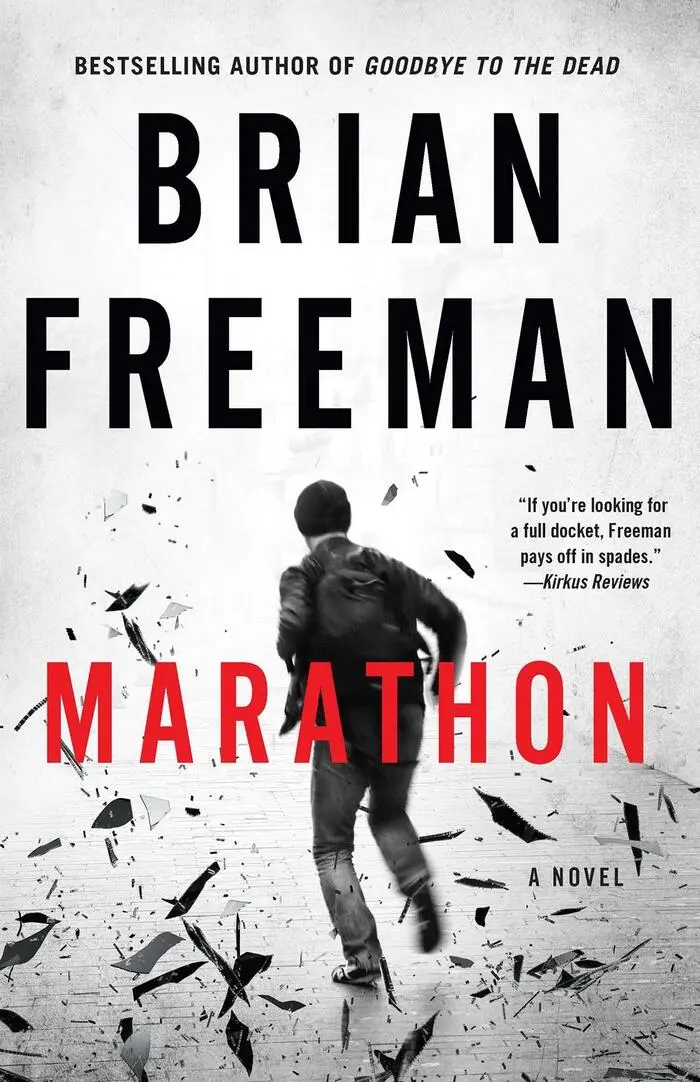
- Название:Marathon
- Автор:
- Издательство:Quercus
- Жанр:
- Год:2017
- Город:New York
- ISBN:978-1-68144-241-9
- Рейтинг книги:4 / 5. Голосов: 1
-
Избранное:Добавить в избранное
- Отзывы:
-
Ваша оценка:
Marathon: краткое содержание, описание и аннотация
Предлагаем к чтению аннотацию, описание, краткое содержание или предисловие (зависит от того, что написал сам автор книги «Marathon»). Если вы не нашли необходимую информацию о книге — напишите в комментариях, мы постараемся отыскать её.
Within minutes, Jonathan Stride, Serena Dial, and Maggie Bei are at work with the FBI to find the terrorists behind the tragedy. As social media feeds a flood of rumors and misinformation, one spectator remembers being jostled by a young man with a backpack not far from the bomb site. He spots a Muslim man in a tourist’s photo of the event and is convinced that this was the man who bumped into him in the crowd — but now the man’s backpack is missing.
When he tweets the photo to the public, the young man, Khan Rashid, becomes the most wanted man in the city. And the manhunt is on.
But are the answers behind the Duluth bombing more complex than anyone realizes? And can Stride, Serena, and Maggie find the truth before more innocent people are killed?
Marathon — читать онлайн бесплатно полную книгу (весь текст) целиком
Ниже представлен текст книги, разбитый по страницам. Система сохранения места последней прочитанной страницы, позволяет с удобством читать онлайн бесплатно книгу «Marathon», без необходимости каждый раз заново искать на чём Вы остановились. Поставьте закладку, и сможете в любой момент перейти на страницу, на которой закончили чтение.
Интервал:
Закладка:
Durkin’s face, which was normally as hard and expressionless as marble, softened. “Yeah, that was Ron.”
“Anyway, I just wanted to tell you I was sorry. Losing family is never easy.”
“No, it’s not.” She put her sunglasses back on, and just like that, her mask was back. “I guess you know about my screwup with that Somali kid. Don’t worry about me, though, Stride. I’ve got things under control now.”
“I’m sure you do.” But he wasn’t sure at all.
“Do you think I’m biased against Muslims?” Durkin asked.
“I don’t know. Are you?”
“Look, what’s in my heart is my business. As long as my feelings don’t get in the way of the job, then there’s no problem. I’m good at what I do. That’s all that matters.”
They walked through a neighborhood of square green lawns and modest houses dating back to the 1920s. Old trees overhung the street. Stride shoved his hands into his pockets.
“How old are you, Durkin?” he asked.
“Thirty-three. Why? Do you think I’m too young?”
“Not at all. Thirty-three is a good age for a lot of things. When I was thirty-three, I knew everything. I knew a hell of a lot more than my bosses, that’s for sure. It pissed me off that they didn’t realize it.”
“Funny,” Durkin replied sourly. “I get it.”
“What makes you think I’m joking?” Stride asked. “I was pretty damn smart back then.”
Durkin finally laughed. “Yeah, okay. I know a lack of confidence isn’t exactly my problem. Sorry. If you show weakness around the FBI boys, they eat you alive.”
“Don’t apologize for it. Maggie is the same way. There’s nothing wrong with being cocky if you can back it up. And believe me, I wasn’t kidding. Getting older hasn’t made me smarter. It’s more like the reverse. Now I have a lot more respect for everything I don’t know.”
“Yeah? Like what?”
“Like how to separate my heart from my job,” Stride told her. “I can’t be a cop without being a human being, too. My feelings get in the way all the time. But if you’ve figured out how to do it, Durkin, then good for you.”
Durkin said nothing at all. He hadn’t expected to reach her, and he didn’t.
They got to the end of the block, and the FBI agent checked her phone and said in a stony voice, “This is the alley. Malik Noon lives down here. Let’s go.”
The alley was cracked and patched over with shovelfuls of asphalt. Greenery made a wall on their left, growing up to the height of the telephone wires. On their right, they passed detached garages and postage-stamp backyards. Halfway down the alley, Durkin pointed at a two-story house with peeling pink paint. Four cars squeezed onto the narrow lot next to a collapsing fence. A plastic lawn chair and rusted charcoal grill sat forlornly in the long grass. In the driveway, Stride noticed a yellow cab that was several years old but as clean as if it had just come off the manufacturing line.
“This is it,” Durkin said.
As they approached the back door, a Somali student emerged, pushing a bicycle. He wore a kufi on his head , a paisley shirt, and blue jeans. Stride didn’t need to show a badge. The kid knew the look of cops.
“Does Malik Noon live here?” Stride asked.
“Top of the stairs,” the young man replied, “but he’s not here.”
“When did you last see him?”
“A week ago. Why are you looking for Malik?”
“We just have some questions for him,” Stride said.
The Somali student shrugged and climbed onto his bicycle. He didn’t look at them as he headed down the alley, with his back straight and his arms outstretched to the handlebars. He pedaled fast.
“He knows what questions we want to ask,” Durkin said.
They went inside. A dusty corridor led deeper into the house. On their left, worn stairs climbed at a steep angle toward the attic. The house smelled of dirty laundry. Stride went first, with Durkin behind him. Halfway up the stairs, he froze. Leaning back, he whispered, “Door’s open.”
Stride swept back the flap of his jacket, giving his hand ready access to his gun. “Malik Noon?” he called. “I’m Lieutenant Stride. Duluth Police. I want to talk with you.”
Five seconds of silence passed.
Then someone above them called, “Malik is not here.”
A man appeared in the open doorway at the top of the stairs. He wasn’t a college student; he was older, in his thirties. The man was good-looking, with swept-back black hair, a long face, and a beard that neatly followed the line of his chin. His dark eyes, behind bright silver glasses, were nervous.
“Who are you?” Stride asked.
“My name is Khan Rashid.”
“Do you know Malik Noon?”
The man hesitated. “He’s a friend of mine.”
“Is that your cab outside? Do you drive a taxi?”
“Yes.”
From behind him, Durkin called, “What you are doing here, Mr. Rashid?”
“I was looking for Malik, but he’s gone.”
“Do you know where he went?” she asked.
A trace of belligerence crossed Rashid’s face. “Obviously not, or I would be there.”
“Why are you looking for Malik?” Stride asked.
“I told you. He’s my friend.”
“If you’re his friend, do you know why we’re here?”
“I have no idea,” Rashid replied.
“People in the local Muslim community have been worried about Malik. They say he’s been radicalized. Do you know anything about that?”
“No.”
“And yet you’re his friend?”
Stride watched Rashid hesitate. His eyes flicked to the ceiling, and there was emotion in his face. Stride took another step closer. “Mr. Rashid, if you were worried about Malik, you should talk to us.”
“I don’t know anything.”
Behind him, Durkin murmured, “He’s lying. He knows something.”
“If Malik is in trouble, the best thing would be to tell us where he is,” Stride went on.
“I don’t know. Really, I don’t. I have to go.”
“Do you believe Malik had anything to do with the marathon bombing?” Stride asked.
Rashid hesitated again. He looked to be having a fierce argument with his conscience.
“I’m not a police officer. I don’t know about such things. Please, may I go? I have to get back to my family.”
Stride nodded. “Of course.”
Carefully, step by step, Rashid walked downward, getting closer and closer. Stride watched him with a careful eye. He thought the man was innocent, but he wasn’t prepared to risk his life on it. Rashid watched him, too, with the same fear, as if Stride might suddenly pull a gun and fire.
They were inches away and so very, very far apart.
Rashid squeezed past Stride and then Durkin, but the FBI agent stopped him with a firm hand on his shoulder. Stride watched her. She was under control. Rashid, on the other hand, looked like a rabbit ready to run.
“Mr. Rashid, were you at the marathon yesterday?” Durkin asked.
His eyes widened. He opened his mouth and closed it again. His agitation and the closeness of the stairway made him sweat.
Then he said, in a voice no louder than a whisper, “No. No, I wasn’t.”
He hurried down the rest of the stairs and disappeared. Stride heard the taxi engine as the cab roared away.
“What do you think?” he asked Durkin.
She didn’t hesitate.
“He was there,” she said.
14
Maggie sized up the two men in the hospital room. Wade Ralston, who was in bed, was wiry and small, with blond hair stretched across a mostly bald skull. He was in his early thirties. Travis Baker, who sat in a chair next to his boss, was younger and built like a gorilla. The two of them watched the television, which was tuned to CNN, but every few seconds, Ralston got impatient and switched channels.
Читать дальшеИнтервал:
Закладка:
Похожие книги на «Marathon»
Представляем Вашему вниманию похожие книги на «Marathon» списком для выбора. Мы отобрали схожую по названию и смыслу литературу в надежде предоставить читателям больше вариантов отыскать новые, интересные, ещё непрочитанные произведения.






Обсуждение, отзывы о книге «Marathon» и просто собственные мнения читателей. Оставьте ваши комментарии, напишите, что Вы думаете о произведении, его смысле или главных героях. Укажите что конкретно понравилось, а что нет, и почему Вы так считаете.