Brian Freeman - Marathon
Здесь есть возможность читать онлайн «Brian Freeman - Marathon» весь текст электронной книги совершенно бесплатно (целиком полную версию без сокращений). В некоторых случаях можно слушать аудио, скачать через торрент в формате fb2 и присутствует краткое содержание. Город: New York, Год выпуска: 2017, ISBN: 2017, Издательство: Quercus, Жанр: Детектив, на английском языке. Описание произведения, (предисловие) а так же отзывы посетителей доступны на портале библиотеки ЛибКат.
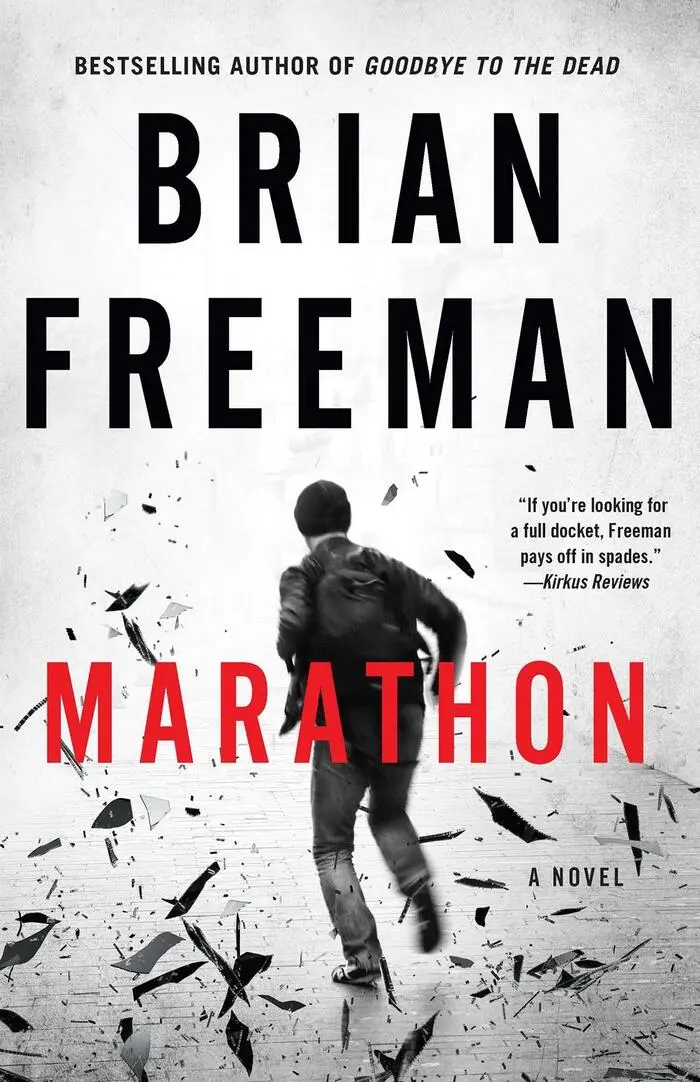
- Название:Marathon
- Автор:
- Издательство:Quercus
- Жанр:
- Год:2017
- Город:New York
- ISBN:978-1-68144-241-9
- Рейтинг книги:4 / 5. Голосов: 1
-
Избранное:Добавить в избранное
- Отзывы:
-
Ваша оценка:
Marathon: краткое содержание, описание и аннотация
Предлагаем к чтению аннотацию, описание, краткое содержание или предисловие (зависит от того, что написал сам автор книги «Marathon»). Если вы не нашли необходимую информацию о книге — напишите в комментариях, мы постараемся отыскать её.
Within minutes, Jonathan Stride, Serena Dial, and Maggie Bei are at work with the FBI to find the terrorists behind the tragedy. As social media feeds a flood of rumors and misinformation, one spectator remembers being jostled by a young man with a backpack not far from the bomb site. He spots a Muslim man in a tourist’s photo of the event and is convinced that this was the man who bumped into him in the crowd — but now the man’s backpack is missing.
When he tweets the photo to the public, the young man, Khan Rashid, becomes the most wanted man in the city. And the manhunt is on.
But are the answers behind the Duluth bombing more complex than anyone realizes? And can Stride, Serena, and Maggie find the truth before more innocent people are killed?
Marathon — читать онлайн бесплатно полную книгу (весь текст) целиком
Ниже представлен текст книги, разбитый по страницам. Система сохранения места последней прочитанной страницы, позволяет с удобством читать онлайн бесплатно книгу «Marathon», без необходимости каждый раз заново искать на чём Вы остановились. Поставьте закладку, и сможете в любой момент перейти на страницу, на которой закончили чтение.
Интервал:
Закладка:
“You’re right. I appreciate the reminder.”
“Please tell Cat we’re serious. Krista and I would love it if she came to see Michael.”
“I will.”
Serena walked away toward the street.
She was thinking about the homeless man who’d caused an incident inside the store. It was probably nothing. The percentage of mental illness and addiction among the homeless was extremely high, and the out-of-control behavior Drew had described happened in public parks and detox centers every night. It wasn’t unusual.
Even so, it had happened inside the Duluth Outdoor Company shop, and so did the marathon bombing. Just four days later.
Two unusual events in the same place always got her attention.
She needed to find that man.
Fifty yards away, Cat sat by herself on the asphalt of an outdoor basketball court in an elementary school playground. She could see Serena and Drew Olson. In Drew’s arms, she could see Michael. Her baby. Her son.
Serena had told her she was going to see Drew, and she’d suggested that Cat come along. Cat had said no, she wasn’t ready. Then, after Serena left, she’d taken her own car and followed. It wasn’t the first time she’d hung out near the Olson house. Ever since the weather had gotten nice, she’d come over here a couple of times a week. Drew and Krista had a cute little matchbox home at the corner of Central and Elinor. The house was old, but they kept it well. It was next to the elementary school, which would work out nicely when Michael got older.
Sometimes Cat got lucky, and she’d see them playing with Michael in the yard or pushing him past the school grounds in a stroller. Sometimes she crept close enough to the house to hear their voices as they talked to him.
They loved him.
She’d done the right thing, letting them take her child.
She wished she could walk over there right now and hold him. Talk to him.
“ Hi there. I’m your mom. I’m the reason you’re here, and you’re the one thing I did right in this whole world. ”
But that wasn’t fair. Michael didn’t need a mother, because he already had one. He didn’t need a single thing that Cat could give him. Not one thing. He was better off never knowing where he came from.
Cat waited until Serena was gone, and then she walked down the alley behind the houses to her car. She didn’t look back.
13
Khan opened the door to Malik’s attic studio in the student house near UMD. The room smelled of the honey-scented candles that Malik liked to burn. One white plate sat on his desk, a puddle of ochre wax congealed in the center. An engineering book lay open next to a mug of cold tea and a square of sweet burfi . Behind his desk, next to the single window looking out on the alley, was a poster of championship Pakistani wrestlers. Malik, despite his scrawny physique, had never lost a wrestling match in high school. He knew how to turn an opponent’s greater size and strength to his own advantage.
Clothes lay on the wooden floor. His bedsheets were twisted. It was as if Malik had left in a hurry and would climb back up the steep stairs any minute now, but Khan knew he wouldn’t. He’d taken his prayer mat for salat . His Qur’an was missing from the table by his bed. Malik was gone.
Khan had only been there once before. Most of the time, when he and his friend met, it was at Khan’s house, or at the mosque on Friday, or in the parkland around Duluth where they could walk and talk privately. For the first time, he wondered if Malik had been protecting him from suspicion.
They’d met when Khan and Ahdia moved to Duluth. That was three years ago, when Malik was a student from Detroit who was also new in town. He was different then. Funny. Happy. For Khan, it was like seeing what his brother should have grown up to be. They’d become friends, and Khan could see a bright future for Malik. He was smart, an excellent student; he would be a professional, a builder of bridges and buildings.
Then, a year ago, things had changed.
Malik grew darker, as if he were living under a shadow. Where the two of them used to talk, they now argued. Malik became prone to hostile outbursts at the mosque. He began to disappear on weekends to Minneapolis and refused to talk about the people he met there. He spent hours on his laptop into the dead of night, making connections with Muslims around the world. The wrong kind of Muslims. Extremists.
They all talked about it in hushed voices. Everyone was afraid.
When Dawn Basch came to town, Malik went further than the others in his protests. He began to brag about the violent things he could do to her. It was the kind of talk that no one wanted to hear, because if word got out, it would bring down the hard hand of the FBI on the entire community.
And then, a week ago, Malik disappeared.
A day ago, a bomb tore open the city.
Khan studied the room for answers. He yanked open each drawer in his friend’s desk, which overflowed with cables and circuit boards and engineering newsletters. He overturned Malik’s wastebasket onto the floor and sifted through the garbage. He found food wrappers and an empty can of sweetened milk. A pencil, worn down to a nub. Clippings from Malik’s beard.
And a brochure.
A brochure for the marathon. Map. Race times. Locations.
Khan dropped the brochure as if it were a hot coal. He told himself that half the homes in Duluth had that same brochure. It was in perfect condition. The brochure had no markings or folds to make him think that Malik had studied it in detail. It meant nothing.
Unless it meant everything.
He thought about seeing Malik in the forest near his house. I’ve dedicated my life to something else now.
Khan faced a choice. Talk to the police and tell them his suspicions. Or walk away and stay uninvolved. Ahdia had told him he shouldn’t be there at all. He was leaving fingerprints behind; he was putting himself at risk. Once the whirlwind started, it sucked up everyone in a torrent of dust and debris, innocent or not. And yet here he was.
Malik was a friend, but murder was murder. If Malik was guilty, Khan couldn’t stay silent.
But was Malik guilty?
Khan spotted a pair of jeans on the floor. He grabbed them by the cuffs and turned them upside down and shook them. Coins sprinkled out of the pockets. A crumpled dollar bill. A receipt for ice cream. He picked up the receipt and saw that it was from the Cold Stone Creamery shop in Canal Park.
Three doors down from the Duluth Outdoor Company. Oh, Malik, Malik, Malik.
He told himself: It was ice cream. Malik had a sweet tooth. It meant nothing.
Or it meant everything.
Khan saw that something else had spilled from Malik’s pockets. Something shiny, no more than an inch long, like a bright, tiny thread. He got down on all fours and delicately retrieved it between his thumb and middle finger. What he saw made him want to cry. Sweat bloomed on his neck and face and made his glasses slip.
It was a piece of copper wire.
As Khan held the wire in his fingers, he heard something below him, and his eyes shot to the doorway of Malik’s apartment in horror.
Someone was coming up the stairs.
“I met your brother once,” Stride told Agent Durkin as they crossed College Street from the UMD campus.
Durkin swept her sunglasses off her face. “You met Ron? When?”
“A year before he was killed. He was part of a volunteer team trying to live-trap an injured bobcat. He stumbled onto the body of a missing hiker in the woods.”
“I remember that. Ron was freaked out. He was sensitive about things like that.”
“It was big news around here when he was killed in Paris,” Stride told her. “When I saw his picture in the News-Tribune , I remembered talking to him during the investigation. I liked him. He was a nice kid.”
Читать дальшеИнтервал:
Закладка:
Похожие книги на «Marathon»
Представляем Вашему вниманию похожие книги на «Marathon» списком для выбора. Мы отобрали схожую по названию и смыслу литературу в надежде предоставить читателям больше вариантов отыскать новые, интересные, ещё непрочитанные произведения.


Обсуждение, отзывы о книге «Marathon» и просто собственные мнения читателей. Оставьте ваши комментарии, напишите, что Вы думаете о произведении, его смысле или главных героях. Укажите что конкретно понравилось, а что нет, и почему Вы так считаете.