Brian Freeman - Marathon
Здесь есть возможность читать онлайн «Brian Freeman - Marathon» весь текст электронной книги совершенно бесплатно (целиком полную версию без сокращений). В некоторых случаях можно слушать аудио, скачать через торрент в формате fb2 и присутствует краткое содержание. Город: New York, Год выпуска: 2017, ISBN: 2017, Издательство: Quercus, Жанр: Детектив, на английском языке. Описание произведения, (предисловие) а так же отзывы посетителей доступны на портале библиотеки ЛибКат.
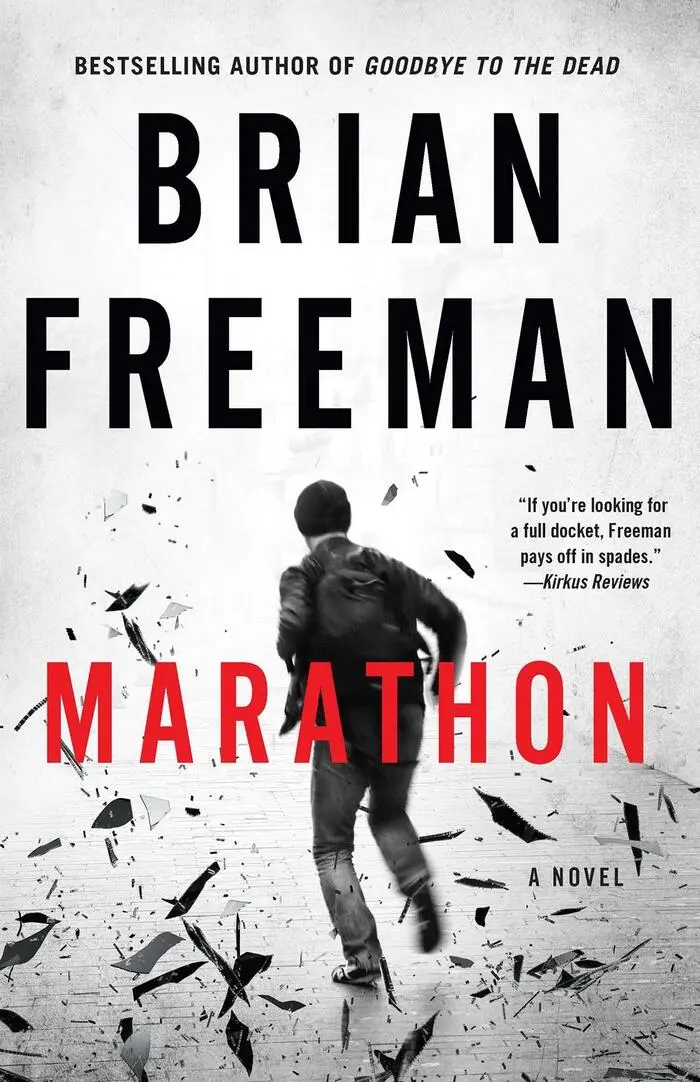
- Название:Marathon
- Автор:
- Издательство:Quercus
- Жанр:
- Год:2017
- Город:New York
- ISBN:978-1-68144-241-9
- Рейтинг книги:4 / 5. Голосов: 1
-
Избранное:Добавить в избранное
- Отзывы:
-
Ваша оценка:
Marathon: краткое содержание, описание и аннотация
Предлагаем к чтению аннотацию, описание, краткое содержание или предисловие (зависит от того, что написал сам автор книги «Marathon»). Если вы не нашли необходимую информацию о книге — напишите в комментариях, мы постараемся отыскать её.
Within minutes, Jonathan Stride, Serena Dial, and Maggie Bei are at work with the FBI to find the terrorists behind the tragedy. As social media feeds a flood of rumors and misinformation, one spectator remembers being jostled by a young man with a backpack not far from the bomb site. He spots a Muslim man in a tourist’s photo of the event and is convinced that this was the man who bumped into him in the crowd — but now the man’s backpack is missing.
When he tweets the photo to the public, the young man, Khan Rashid, becomes the most wanted man in the city. And the manhunt is on.
But are the answers behind the Duluth bombing more complex than anyone realizes? And can Stride, Serena, and Maggie find the truth before more innocent people are killed?
Marathon — читать онлайн бесплатно полную книгу (весь текст) целиком
Ниже представлен текст книги, разбитый по страницам. Система сохранения места последней прочитанной страницы, позволяет с удобством читать онлайн бесплатно книгу «Marathon», без необходимости каждый раз заново искать на чём Вы остановились. Поставьте закладку, и сможете в любой момент перейти на страницу, на которой закончили чтение.
Интервал:
Закладка:
In the name of God, Most Gracious, Most Merciful
Praise God, Lord of all that exists
Most Gracious, Most Merciful
Master of the Day of Judgment
You alone we worship, You alone we ask for help
Show us the straight way...
Ahdia followed smoothly behind him, and next to him, Pak did a sweet, clumsy imitation. Pak didn’t know all the words of the prayer yet, but every time he heard Khan say, “Allāh u akbar,” he repeated it earnestly, and he said “Aameen” loud and long at the end of the opening verses. When Khan bowed and put his hands on his knees, Pak did, too. When Khan prostrated himself and lay his forehead on the floor, Pak did, too.
Subhana Rabbiyal A’la.
Subhana Rabbiyal A’la.
Subhana Rabbiyal A’la.
Khan completed the ritual of the entire rakat , and then he performed it again, repeating the prayers aloud, and then one more time, silently, with only his lips moving as he recited the verses. Finally, he saluted the angels of his good deeds and misdeeds over each of his shoulders with the salaam .
They were done. Not even ten minutes had passed.
Pak scrambled to his feet, and as Khan stood up, too, his son wrapped his arms tightly around his father’s legs.
“I love you, Papa.”
“I love you, too.”
Ahdia went downstairs first. Her face was grave; prayer hadn’t soothed her anxiety. When she was gone, Khan hoisted Pak in his arms and carried him from the attic. He knew what he had to do. He let Pak scamper off to play, and he found Ahdia in the kitchen, where she was drying a dinner plate with a towel. Her tension was evident in how she held herself, stiffly, as if she was squeezing her emotions inside.
He stood beside her and said, “You’re right. Tomorrow I will talk to the police.”
She put the plate down. He could see her eyes fill with tears. She turned and threw her arms around his neck. “Thank you, Khan.”
“We will get through this, won’t we?” he asked.
“We will.”
The darkness lifted from her face. She was his wife again, with pink roses on her cheeks and teasing eyes and a smile that never went away. “Now I have an even more important errand for you,” she told him.
“Oh?”
“One of the women in my office is coming back from pregnancy leave tomorrow. I want to make laddu for her, and I have no coconut. Could you run out to the market and get me some?”
“Now?” he asked, eyeing the heavy rain that hammered the kitchen window.
“Please,” Ahdia said.
He smiled, because he could never resist her or say no to her. “I’ll get soaked, you know.”
“You’ll dry,” she told him.
“Just coconut?” he asked.
“That’s all.”
He turned to leave, but Ahdia took his hand and leaned close to him and placed a soft kiss on his cheek. “You’re a good man, Khan.”
His heart felt full. He grabbed his jacket and went to the front door, but he stood at the threshold without opening it. Music played from Pak’s room. He heard the clatter of dishes in the kitchen. He smelled the sweetness of ginger from dinner. They were little things, but he closed his eyes and concentrated, wanting to remember them forever. Then, not looking back, he ventured into the thick of the storm and left behind his perfect house, his perfect wife, and his perfect son.
16
That’s him , Michael Malville thought.
He examined the photo that had been posted online by a Twin Cities tourist named Janet Waller. She’d been standing near the Hampton Inn, facing Canal Park Drive, using an old camera phone that took two-megapixel images. The time stamp on the photo was seven minutes before the bombing. In the crowd across the street, in profile, he saw the torso of a tall, bearded man with dark hair and what looked like a casual, untucked, button-down shirt. When Michael enlarged the photo, the resolution made the details of the man’s face impossible to distinguish.
Even so, he repeated to himself: That’s him .
Or was it?
He’d had similar breakthroughs throughout the day, but each time, he’d concluded that he was wrong. There was no way to be sure based on a single photograph, particularly a low-quality jpeg taken at a distance. After hours of frustration, Michael had developed a system. As he analyzed photos, he classified them in a spreadsheet by time and location, so that he could easily call up corresponding images of the same crowd scene at the same time from different angles.
Instead of the back of someone’s head, he could see his face.
Instead of a partial image of a head or body, he could see the entire person.
The photo taken by Janet Waller showed a crowd of marathon spectators in front of Caribou Coffee. He searched his spreadsheet: Caribou . And then he narrowed down the photographs he’d reviewed near Caribou Coffee to those taken six to eight minutes before the bombing. Half a dozen photos met the search parameters, and he loaded them to his screen.
A minute later, he knew he was wrong.
He matched the man in Janet’s photo to one of the other Caribou photos and realized that what had looked like a beard from a blurry distance was actually a shadow. This man was clean-shaven.
He wasn’t the man who’d bumped into him on Superior Street.
Michael rocked back in his chair and exhaled in frustration. He grabbed his mug and drank cold coffee. He didn’t realize that his wife, Alison, had joined him in the attic, until she called to him from the doorway.
“Are you ever coming downstairs?” she asked. “You’ve been up here in front of that computer all day.”
“I know. Sorry.”
She came up beside him. Rain pummeled the roof over their heads. “Are you having any luck?”
“Not so far,” he admitted. “There are thousands of photographs posted, and I have to examine each face in each picture. When I see one that’s a possibility, I cross-reference with other photos, but a lot of the pictures aren’t time-stamped, which makes it harder.”
Alison chuckled. They’d been married a long time, and she knew he had an OCD streak that came out in projects like this.
“Seems to me there are people who do this for a living,” she told him gently. “People called the FBI.”
“Yes, but they weren’t there,” Michael replied. “They didn’t see this guy.”
“Honestly, did you really see him yourself? It happened so fast. Will you ever be sure?”
“I don’t know, but I have to try.”
She bent over and kissed him. “Well, come down soon. Evan misses you. So do I. I’m not going to let you stay up all night again. I have other plans for you tonight.”
“Another hour, and I’ll stop for today,” he promised her.
“Deal.”
Alison left him alone. He got up and stretched, and he made fresh coffee. He put his 1980s music collection on shuffle, because he was afraid the rain would lull him to sleep. He sat down and opened up the next series of photographs.
He blinked, and an hour passed.
And then another hour.
The process had a strange, addictive quality to it, like a video game. He felt as if he were peering into the lives of strangers. Some of the people showed up again and again in different pictures, and he began to think of them as friends. He saw the faces of people who were laughing. Arguing. Kissing. Singing. He watched face after face after face, until it felt as if he’d seen every runner and every single person on the sidelines cheering them on. He’d seen the entire marathon over and over, every mile, every inch of Duluth and the North Shore, every tree, every house, every store, every street sign.
Читать дальшеИнтервал:
Закладка:
Похожие книги на «Marathon»
Представляем Вашему вниманию похожие книги на «Marathon» списком для выбора. Мы отобрали схожую по названию и смыслу литературу в надежде предоставить читателям больше вариантов отыскать новые, интересные, ещё непрочитанные произведения.





Обсуждение, отзывы о книге «Marathon» и просто собственные мнения читателей. Оставьте ваши комментарии, напишите, что Вы думаете о произведении, его смысле или главных героях. Укажите что конкретно понравилось, а что нет, и почему Вы так считаете.