Brian Freeman - Marathon
Здесь есть возможность читать онлайн «Brian Freeman - Marathon» весь текст электронной книги совершенно бесплатно (целиком полную версию без сокращений). В некоторых случаях можно слушать аудио, скачать через торрент в формате fb2 и присутствует краткое содержание. Город: New York, Год выпуска: 2017, ISBN: 2017, Издательство: Quercus, Жанр: Детектив, на английском языке. Описание произведения, (предисловие) а так же отзывы посетителей доступны на портале библиотеки ЛибКат.
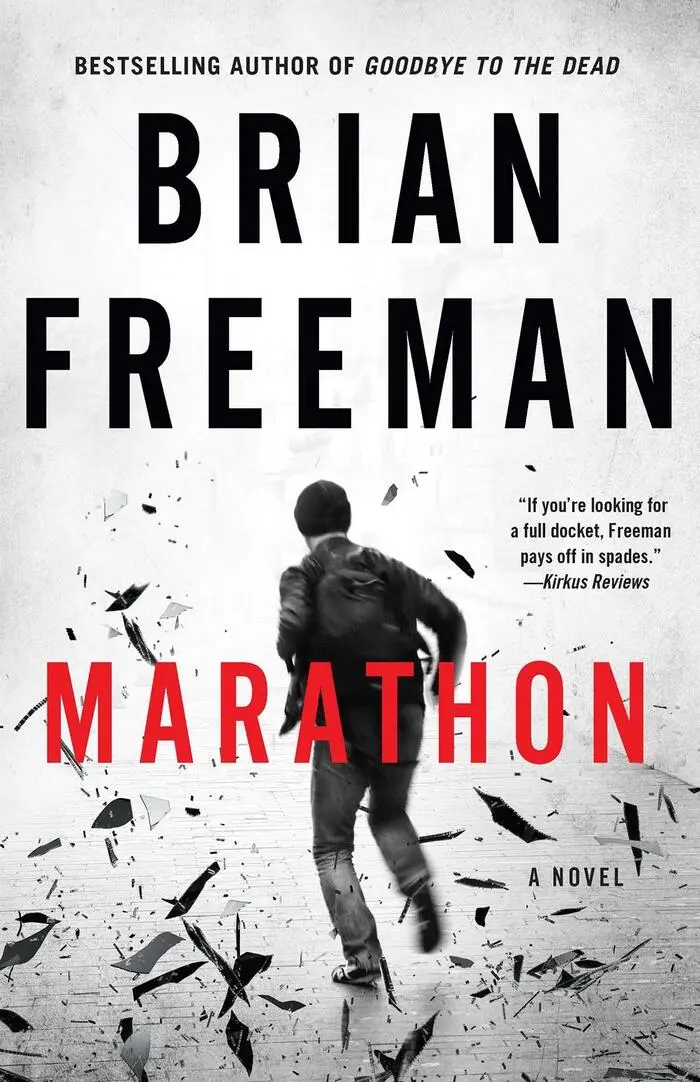
- Название:Marathon
- Автор:
- Издательство:Quercus
- Жанр:
- Год:2017
- Город:New York
- ISBN:978-1-68144-241-9
- Рейтинг книги:4 / 5. Голосов: 1
-
Избранное:Добавить в избранное
- Отзывы:
-
Ваша оценка:
Marathon: краткое содержание, описание и аннотация
Предлагаем к чтению аннотацию, описание, краткое содержание или предисловие (зависит от того, что написал сам автор книги «Marathon»). Если вы не нашли необходимую информацию о книге — напишите в комментариях, мы постараемся отыскать её.
Within minutes, Jonathan Stride, Serena Dial, and Maggie Bei are at work with the FBI to find the terrorists behind the tragedy. As social media feeds a flood of rumors and misinformation, one spectator remembers being jostled by a young man with a backpack not far from the bomb site. He spots a Muslim man in a tourist’s photo of the event and is convinced that this was the man who bumped into him in the crowd — but now the man’s backpack is missing.
When he tweets the photo to the public, the young man, Khan Rashid, becomes the most wanted man in the city. And the manhunt is on.
But are the answers behind the Duluth bombing more complex than anyone realizes? And can Stride, Serena, and Maggie find the truth before more innocent people are killed?
Marathon — читать онлайн бесплатно полную книгу (весь текст) целиком
Ниже представлен текст книги, разбитый по страницам. Система сохранения места последней прочитанной страницы, позволяет с удобством читать онлайн бесплатно книгу «Marathon», без необходимости каждый раз заново искать на чём Вы остановились. Поставьте закладку, и сможете в любой момент перейти на страницу, на которой закончили чтение.
Интервал:
Закладка:
The evening quickly bled away. Alison didn’t return to hassle him; she knew he’d come down when he was ready, or he wouldn’t come at all. Another hour passed.
He yawned. He clicked. His mind wandered, and he had to pinch himself to stay awake.
And then he saw him.
The photo was part of a collection that had been uploaded only half an hour earlier. A man with the screen name Shoe Geek had watched the race in the heart of Canal Park in the hour leading up to the explosion, and he’d posted dozens of high-resolution photos. Michael opened up a picture that was time-stamped ninety seconds before the bomb went off. Shoe Geek had taken a picture of the sidewalk heading up Canal Park Drive toward the lift bridge. When Michael enlarged the image on his screen, the resolution was crisp and sharp. He could see every face, and he could even clearly see the sign for the Duluth Outdoor Company shop suspended over the cobblestones. He was so focused on the crowd that he almost overlooked the empty, closed-off parking lot across from Grizzly’s restaurant.
There, framed against the brick wall of an old paper mill, was the man he’d spent the entire night and day hunting. He zoomed in, and he could see exactly what the man looked like. Tall. Dark hair. Beard. Loose, untucked, flowered shirt. Black jeans. The photo captured him in mid-stride, alone, rushing, looking back over his shoulder.
As if he were waiting for something. Waiting for the noise. The blast. The fire. The screams.
And one more thing: His backpack was gone.
Michael lurched out of the chair and paced under the high roof. His breathing accelerated. So did his heartbeat, thumping in his chest. He pounded his fist rhythmically against his chin as he went from wall to wall. He tried to concentrate, but he knew he was exhausted and light-headed. He was overwhelmed with the sheer volume of information he’d pumped into his brain during the past twenty-four hours.
He asked himself: Are you sure?
He went back to the desk and enlarged the photograph until only the man’s face filled the screen. Then even larger, until they were eye to eye. This man wore silver glasses. Had the man on the street worn glasses? Was that what had made his eyes seem so large and hostile?
Yes.
It was him.
This was the man on Superior Street. Thousands of people lined the marathon route, thousands with dark hair and beards — but this was the man . He was absolutely sure. This man had hammered into Michael and pushed Evan into the street. This man had looked back with nothing but cold hatred in his face. This man had continued on to Canal Park, shouldering a heavy navy-blue backpack.
There, in the parking lot near Grizzly’s, ninety seconds before the explosion, this same man didn’t have a backpack anymore. He’d left behind a killing machine in the Duluth Outdoor Company shop.
Michael had found him.
He’d found the bomber.
He was too tired and drunk with adrenaline to think about exactly what he was doing. His emotions carried him down a rushing river. He opened up his Twitter feed and dragged the photograph of Canal Park into a new post. He tapped out three simple sentences, and then he slid his mouse over the button labeled Tweet.
He hesitated for a moment.
A moment that was no longer than the entire time he’d spent staring into the man’s eyes during the race.
Michael thought: I’m about to change the world . And his finger tapped the mouse.
@malvileo tweeted:
This man passed me with a backpack on way to Canal Park. Photo here is 90 seconds before blast. No backpack.
Dawn Basch stood at the window of her hotel room at the Radisson, where her tenth-floor view was of the lake and the silver lift bridge. It was almost dark, and the rain fell in a steady downpour. Her long fingers with their red-tipped nails held a glass of minibar Chardonnay. She was still dressed for business, but she’d kicked off her heels, and she stood in stocking feet. She kept the room ice-cold. A late room-service dinner — egg-white spinach omelet, fruit, whole-wheat roll — was on the way.
It had been a long day of interviews. TV. Radio. Bloggers. Newspapers. The phone never stopped ringing. She was exactly where she wanted to be — at the center of everything. It didn’t matter that some people hated her. It didn’t matter that some people wanted to kill her. Sooner or later, one of them might get lucky, but if the Islamists could be martyrs, so could she.
With her phone in her hand, she reviewed the tweets about herself. She was pleased to see that she was trending and that her followers were winning the fierce tweet war. Whenever a liberal called her a racist, an army of defenders rose up to slap that person down. She’d gained ten thousand new Twitter followers from around the world since the bombing. People were listening. They were finally paying attention.
Dawn had traveled a long road in twenty years. She’d been one of the early online-news pioneers, starting her own website in the days before HuffPost and hustling ads from her Jersey City office while she wrote most of the content herself. It was all about clicks, because more clicks meant more ad money. That was why every serious post about politics and trade policy usually also teased readers with photos of celebrity nipple slips. Everybody clicked on those.
She’d never set out to be a First Amendment activist. Islam found her, not the other way around. After her website expanded to Europe, she’d published a freelance profile of a bizarre Swedish artist who liked to decorate his penis and take photographs of his erections. One of his strange creations was a turban-clad, bearded version of his genitals that he photographed in mid-orgasm and titled Spewing Muhammad.
Seeing it, Dawn had never laughed so hard in her life.
After she posted the article, it went viral, blowing up like a bomb. Lots of clicks. Millions of clicks. It also led to days of riots in Stockholm in which six buildings were burned and two people were killed. The artist himself fled the city, but a radical Islamist found him in Gothenburg, and he was castrated and beheaded.
Live. On video.
From that moment forward, Dawn Basch was never the same.
What horrified her almost more than the violence was the reaction from the left-wing media in New York and D.C. — people she’d considered colleagues and friends. They blamed her. They blamed the artist. They called his satire a needless provocation of Muslims. When they talked about the First Amendment, it was always with an asterisk for critics of Islam: “Free speech, but”; “Free speech, although”; “Free speech, unless.”
Their attitude made Dawn furious. In response, she sought out every portrayal of Muhammad she could find and posted it on the home page of her site. She began planning a First Amendment conference to send out the message that censoring anyone’s speech to avoid violence was the first step in giving up your free-speech rights altogether. That day, she coined the phrase “no exceptions,” which had become the slogan for her entire movement. It had made her enemies, but it had also made her rich.
Dawn didn’t care if people called her a hater, an Islamophobe, or a racist. If Christians were blowing up people over cartoons, she’d attack Christians, but they weren’t the threat to civilization. Only one religion was trying to stamp out freedom and kill nonbelievers, and that was Islam. People didn’t understand that this was a battle between two completely incompatible visions of human values. There was American freedom, and there was Islamic tyranny, and the former would never bow to the latter. Not as long as Dawn Basch was alive.
As she searched through tweets in front of the hotel window, she spotted a retweet in which she’d been tagged by one of her many followers. The woman’s message was:
Читать дальшеИнтервал:
Закладка:
Похожие книги на «Marathon»
Представляем Вашему вниманию похожие книги на «Marathon» списком для выбора. Мы отобрали схожую по названию и смыслу литературу в надежде предоставить читателям больше вариантов отыскать новые, интересные, ещё непрочитанные произведения.
Обсуждение, отзывы о книге «Marathon» и просто собственные мнения читателей. Оставьте ваши комментарии, напишите, что Вы думаете о произведении, его смысле или главных героях. Укажите что конкретно понравилось, а что нет, и почему Вы так считаете.