Махи Бинбин - Marrakech Noir
Здесь есть возможность читать онлайн «Махи Бинбин - Marrakech Noir» весь текст электронной книги совершенно бесплатно (целиком полную версию без сокращений). В некоторых случаях можно слушать аудио, скачать через торрент в формате fb2 и присутствует краткое содержание. Город: New York, Год выпуска: 2018, ISBN: 2018, Издательство: Akashic Books, Жанр: Детектив, на английском языке. Описание произведения, (предисловие) а так же отзывы посетителей доступны на портале библиотеки ЛибКат.
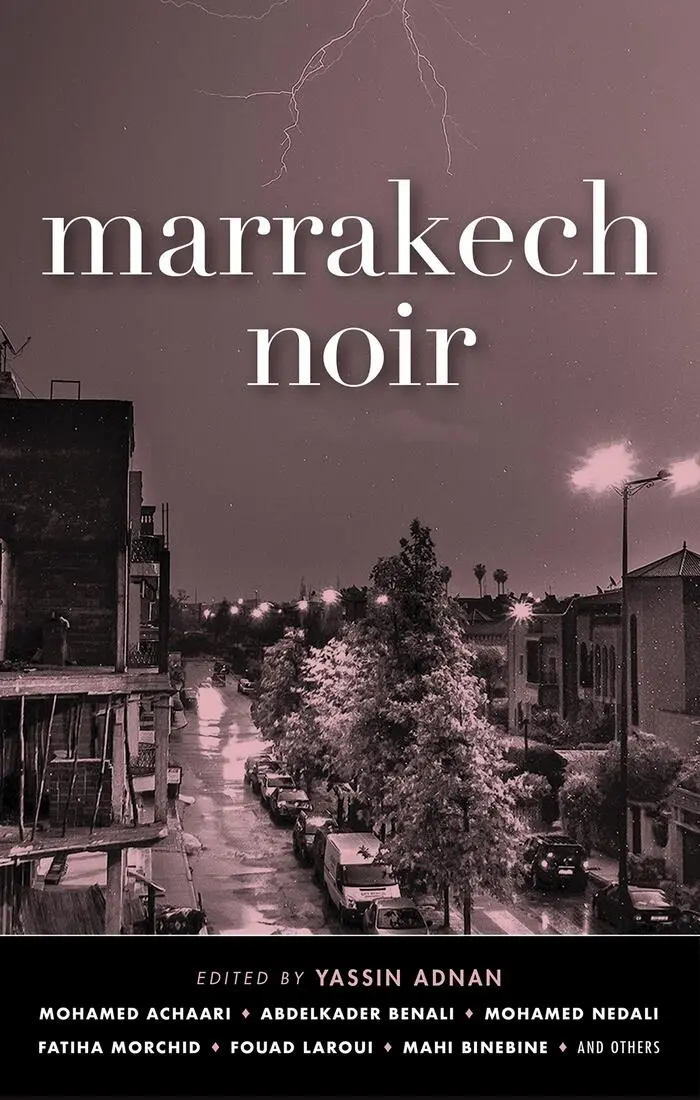
- Название:Marrakech Noir
- Автор:
- Издательство:Akashic Books
- Жанр:
- Год:2018
- Город:New York
- ISBN:978-1-61775-473-9
- Рейтинг книги:5 / 5. Голосов: 1
-
Избранное:Добавить в избранное
- Отзывы:
-
Ваша оценка:
Marrakech Noir: краткое содержание, описание и аннотация
Предлагаем к чтению аннотацию, описание, краткое содержание или предисловие (зависит от того, что написал сам автор книги «Marrakech Noir»). Если вы не нашли необходимую информацию о книге — напишите в комментариях, мы постараемся отыскать её.
Marrakech Noir — читать онлайн бесплатно полную книгу (весь текст) целиком
Ниже представлен текст книги, разбитый по страницам. Система сохранения места последней прочитанной страницы, позволяет с удобством читать онлайн бесплатно книгу «Marrakech Noir», без необходимости каждый раз заново искать на чём Вы остановились. Поставьте закладку, и сможете в любой момент перейти на страницу, на которой закончили чтение.
Интервал:
Закладка:
Mr. Alal would always sit in a chair in front of his shop, his body draped in brown trousers, hands covered by the sleeves of a woolen robe that reached his knees. Mr. Alal had been a carpentry teacher. But after years of work, piling one rial on top of another, he got together enough to buy two more shops in the building. And then there were his two sons, who worked under his supervision. But his hands stayed perpetually busy, whether filling smoking pipes from a baggie or preparing a mashmouma , or bong. My father jokingly nicknamed him The Machine. Mr. Alal would greet us from his seat in his hoarse voice and would gesture at one of his sons to bring two chairs. We would sit, my father and I, in front of the shop and pull out a low wooden drum, upon which they would place the requisite teapot, a pack of Pall Mall cigarettes, and spare pipes. My father was always telling me what a healthy weed kif was for adults.
Mr. Alal was a round-faced man, thin, dark-skinned, with a thick beard, shaggy black hair, and bulging eyes. Pouring us tea, he would get up to call for donuts from Café Rubio in the alley. Inside the shop thrummed the harmonious rhythms of sawmill and hammer, along with music from the radio. It remains anchored in my memory like a first love, emerging and living still inside me years later: The leaf enchants its blowing or Tonight wine and desires sing around us / A sail that swims in the light watches over our shade — how could my young self have known the meaning of such lines? But I loved those songs. I was as used to hearing them as I was to smelling the smoke from that salutary plant.
Long walks were good for long musings. I shared with my fetus these thoughts and memories, as we also shared the smells and sights and rhythms of Marrakech.
Selim turned two. I had nursed him throughout, even though my nipples were flat; I bought artificial rubber tips from the pharmacy. What an invention! Every time I attached them and contemplated the sight, I burst out laughing. And when Selim was teething we stayed up watching television to drown out his cries.
After a long discussion with my sister, I decided to leave my mother’s house. I would try to rebuild from the rubble accumulating inside me, to start afresh. To fashion a character and a life that might be suitable for motherhood: I wanted the child to be proud of me one day. But for now he would stay with my sister. She had a job, a tough one, and a house and car; independent and strong, she lived alone. The idea was hers from the beginning. She was wiser than me, and so much more patient. I left my son in her care, and though I did feel cowardly and selfish, I could already taste the breeze of freedom. It wasn’t hardness of heart — or was it? I thought I had a reason to live, a reason to challenge the world, to prove to everyone and to myself that I was worthy of respect, to return to give my son a life of pure light. Perhaps that was true. Perhaps these are excuses, attempts to tint the blackness of my memory, or to deny the things I can’t bear to face. Perhaps.
My friend Boushra got me a job in the Mamounia Casino and I moved with her into a small flat in Saada, on the road to Casablanca. Those new districts bore little trace of the city aside from the accents of some of their inhabitants, most of whom actually came from other cities or countries. The world took on new colors, as if I were in a city other than the one I grew up in. I worked nights, sometimes both days and nights. And along Red Beach, a kilometer outside of Marrakech, I was introduced to a vampire people. They gambled with their lives. I saw gay men and lesbians walking around unmolested, high-class sex workers on the lookout for dollars, euros, rials, dinars, and winning tickets, fluent in every language. I saw a people driven by desire, pleasure, money, adrenaline. And I saw the dregs upon whom the rich wiped their feet, and their other things. Climbers awaiting their prey, screwing whomever had anything to offer. In that period, I became friends with DJ Anas. From time to time I would go to his club, Theatro Marrakech, heading directly for the sound booth. I’d sit with him and watch from behind the glass while we smoked hash. I looked out upon that world with perfect neutrality as the DJ wrote the fates of its bodies in music.
A year passed and I grew bored, weighed down under a rhythm that stretched without a horizon. I was tired. And I needed to figure out what I wanted to be. In the past I had always imagined for myself another character, creative and distinguished, and yet here I was, locked into a repeating scene, the lights dimmed. I decided to go back to my studies, though my desire for that soon started to suffocate me. Even so, it didn’t take too much preparation. I moved to Casablanca after I’d figured out a living situation with Salma, another friend from those days of revolutionary dreaming. Soon after I arrived I found work in a translation agency. Not much pay, but enough to cover rent and food and cigarettes.
It was hard to get used to the new rhythm, and I waited anxiously for the beginning of the semester, when I would register to begin my BA in English literature. One ordinary weeknight I passed by Mohammed V Street and had a beer in a bar called Petit Poucet, in the courtyard of one of those colonial buildings that had always felt strangely familiar to me. It just so happened that a literary group was meeting that night to honor a Moroccan poet, dead of course. I was enchanted by the scene, the atmosphere — especially because they’d brought along an old-timer to sing Umm Kulthum and Mohammed Abdel Wahab in his husky voice, and to play on an oud, worn out from so many nights like these.
And I met him. A dream made real, a love story I will never be able to write. I knew him before I knew him. Of course this sounds absurdly romantic, but it could not be closer to the truth; it’s certainly truer than anything else I’ve known. I had never thought that I could make a man the focus of my whole world. And Samir was the older brother of my old partisan comrade, unacknowledged by his father. What a world! Love at first sight, or rather the second. That hadn’t been the season for love. But this new evening gave us an excuse to begin the tale.
A week later I moved in with him, as if by prior agreement from long ago; as though he’d been waiting for me. We were married with uncanny speed. There was no need to wait, to get to know each other. We soon learned what the other liked and disliked. I was dynamic, eager, quick to yearn and to love. I loved to immerse myself in him. Samir was sober, a lover of life, a rationalist — sometimes more than was necessary. He had a lot of experience with women, as I had with men. We were brought together by something I’d read about in romance novels, and which until I met him I thought was just ink on paper. Perhaps our story was not that surprising. I really don’t know.
My name is Sara. I’m thirty-two years old. I’m getting my doctoral degree in social sciences at the University of Chicago on a scholarship. The story above is not my own.
Alice, a friend of mine, was a resident doctor at Amerchich Hospital, an institution that resembled nothing so much as a prison. All patients who were considered a danger to others were taken to Amerchich, to this secret medical facility in what had once been the suburbs, but which had quickly become central once the Cadi Ayyad University was built in the seventies, not far from the building. A dirty and ancient hospital. There was a special wing there for mentally ill patients, and another for skin disease; internal injuries were covered too. And so it wasn’t uncommon for the newspapers to report, every now and then, news of the suicide of one of its inhabitants. Alice specialized in mental illnesses, and so she found herself there, at the Amerchich hospital in Daoudite. Her parents were French but she was Marrakechi through and through.
Читать дальшеИнтервал:
Закладка:
Похожие книги на «Marrakech Noir»
Представляем Вашему вниманию похожие книги на «Marrakech Noir» списком для выбора. Мы отобрали схожую по названию и смыслу литературу в надежде предоставить читателям больше вариантов отыскать новые, интересные, ещё непрочитанные произведения.






Обсуждение, отзывы о книге «Marrakech Noir» и просто собственные мнения читателей. Оставьте ваши комментарии, напишите, что Вы думаете о произведении, его смысле или главных героях. Укажите что конкретно понравилось, а что нет, и почему Вы так считаете.