Махи Бинбин - Marrakech Noir
Здесь есть возможность читать онлайн «Махи Бинбин - Marrakech Noir» весь текст электронной книги совершенно бесплатно (целиком полную версию без сокращений). В некоторых случаях можно слушать аудио, скачать через торрент в формате fb2 и присутствует краткое содержание. Город: New York, Год выпуска: 2018, ISBN: 2018, Издательство: Akashic Books, Жанр: Детектив, на английском языке. Описание произведения, (предисловие) а так же отзывы посетителей доступны на портале библиотеки ЛибКат.
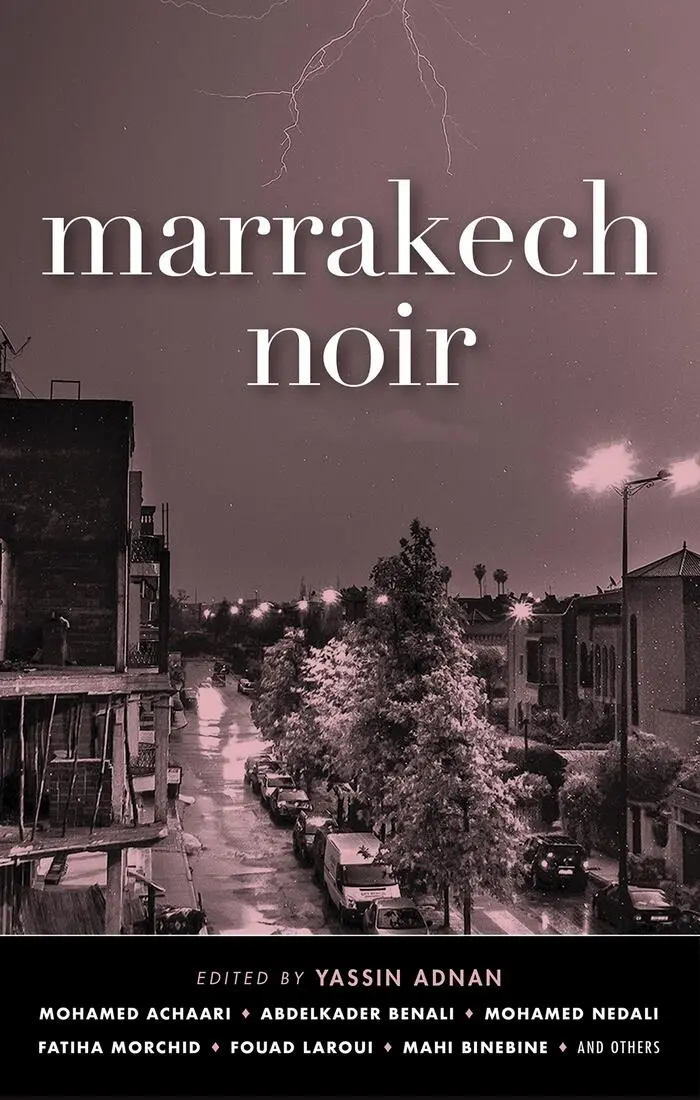
- Название:Marrakech Noir
- Автор:
- Издательство:Akashic Books
- Жанр:
- Год:2018
- Город:New York
- ISBN:978-1-61775-473-9
- Рейтинг книги:5 / 5. Голосов: 1
-
Избранное:Добавить в избранное
- Отзывы:
-
Ваша оценка:
Marrakech Noir: краткое содержание, описание и аннотация
Предлагаем к чтению аннотацию, описание, краткое содержание или предисловие (зависит от того, что написал сам автор книги «Marrakech Noir»). Если вы не нашли необходимую информацию о книге — напишите в комментариях, мы постараемся отыскать её.
Marrakech Noir — читать онлайн бесплатно полную книгу (весь текст) целиком
Ниже представлен текст книги, разбитый по страницам. Система сохранения места последней прочитанной страницы, позволяет с удобством читать онлайн бесплатно книгу «Marrakech Noir», без необходимости каждый раз заново искать на чём Вы остановились. Поставьте закладку, и сможете в любой момент перейти на страницу, на которой закончили чтение.
Интервал:
Закладка:
My son Selim, who is now seven years old, lives in Marrakech. I had him out of wedlock and in, so I thought, love. His father was a leftist — I adored his idealism: dreams of revolution, the cares of the proletariat, the Palestinian question, Guevara. I was a law school student back then, and had joined an organization on the far left. And since I loved poetry and literature and music, I turned easily into a dense bundle of romantic revolutionary attitudes. A year and a half into our relationship, I discovered I was pregnant. That revolutionary romance rendered abortion impossible: if I stole the right of this creature to life, I could never return to all those slogans I had recited so proudly, to myself and others, like sacred texts. I didn’t expect my partisan to evade his part of the responsibility — not he, who preached life as unending struggle! I had believed that in accordance with the ethics of the revolutionary, he would take a position of immediate gallantry. Instead he made it clear, over the phone, that this could not happen. He was not sure, indeed — he who mere seconds before had been glorifying my loyalty as his comrade — that he even had anything to do with my pregnancy, and said that I should call the real father. I resolved without hesitation to consider him dead. I would preserve his life for his successor.
One doesn’t picture a woman of nineteen carrying a child. She hides it away, after all, in her womb from her powerful mother, her conservative grandmother, in a society governed more by custom than law. All that matters is: What will the neighbors say? Hashouma! Shame! Still, I confronted my mother with it, but only after the end of the sixth month of a pregnancy that had been almost invisible. My body had barely changed and there was no sign of that telltale round belly below my breasts. I told my mother, and I convinced my sister, that I was prepared for everything required to raise a child. I made them both understand that if they tried to dissuade me, I would leave home at once and take refuge with a friend.
At that time I was working as a waitress in one of the guesthouses that had sprung up like mushrooms in the alleys of the Old Medina. The pay was low. But I was also giving lessons in French and English at a private school, and the salaries combined were enough to get by on, even with a child. I was determined to do this, as I had never been determined about anything in my life; I even seriously considered ending my studies. My mother only said, This is God’s will, and we’ll pay for it. My sister was silent — a speaking silence.
He visited me once, my partisan comrade, when I was three months pregnant. He called ahead to tell me he was at the Café de France in Jemaa el-Fnaa. I went to meet him still clutching a shred of hope, trying to tell myself he had been rash, that he regretted it. It doesn’t matter now. We drank our black coffee in near silence and then I took him to the Koutoubia Mosque. We smoked hash in the garden there and talked about mundane things, each of us evading a direct glance at the other, trying to dodge any mention of the pregnancy. When lunchtime came we went to Babylon Star Bar in Gueliz, not far from the Dawiya Bar. Babylon Star was one of those places that was difficult to comprehend — exactly what the situation required.
While I was on my fourth beer, I asked him drily, and without preamble: “Why did you come?” Later, upon leaving the bar, I realized I was stronger than this faltering comrade, who had stuttered as he searched for reasons to convince me to get rid of it, with, as he called it, a simple procedure. He’ll be biting his nails for years , I thought. Life would rattle and batter him, and guilt would deprive him of sleep.
During the months before the birth we slipped back into harmony with Marrakech, my fetus and I. I abandoned drinking and hash, and swapped my cafés for walking. Long, pondering walks. I wandered through Mowqaf Alley and Mouassine, Ksour and Riad Zitoun, and the little mass inside me each day came closer to life. I spoke to it a lot, telling it of my childhood and my adolescence, unfolding my dreams and desires. Once, as I passed by Arset el-Houta, memories of a spring day in 2000 came back to me like a dream. I’d snuck away from middle school that day, just for a while, with Yusuf, Ahmed, Fawzi, Hisham, and Said. I had always made friends with boys, they were better company. We took a trip to the Old Medina and ambled through its damp narrow alleys, shirking the sun that had dared to encroach on our spring. The smell of sewage was overpowering on the streets of Mellah, long since abandoned by its Jewish residents. And from Jinan Binshaqra we took the shortcut to Arset el-Houta, passing through Ba Ahmed Middle School and al-Farabi High School and the carpentry shops. In the midst of the vendors who rule the rest of that narrow space, we squeezed into an alley barely wide enough to fit a person. Fawzi pushed the door of one of the houses open and went in without knocking. Said and Hisham and the others followed. I wanted to go too, but Ahmed asked me to wait for them awhile, or to go back. This place was just for men.
They called the place Madam Kabora’s house, and would be received there in succession, to put their little pricks between the thighs of prostitutes their mothers’ ages in exchange for the dirhams extracted from them beforehand. I grew bored of waiting outside, so I went up. I found myself in a small hallway. There was a dirty table with a radio on it tuned to Radio Rabat, and I was taking in the vulgarity of the place when a voice, more vulgar still, addressed me: “What d’you want?”
I turned to see an obese woman waiting behind me, swathed in a kaftan and scarves. Her fingers were bare aside from a large gold ring. Unnerved, I approached the massive creature. I sat down beside her and told her, in a confused way, that I had come with my friends, and that I had to wait for them because I didn’t know the way back. In fact I was burning with curiosity. What was this place? Where were the boys? She said her name was Kabora and poured me a glass of tea. Without further introductions, and as naturally as if she were speaking with a grown woman, she began telling me about the troublesome police and the various other hardships of her life. I didn’t understand everything she said and I was baffled by that gruff voice, vibrating on like a tambourine.
After a few minutes the boys came running down. I smiled at Kabora and watched them without a word. They turned to me, perplexed. “What are you doing!?” they asked as one.
Cheerfully, I answered. “I met Kabora!”
Four years later, Hisham, my boyfriend through college, would tell me stories about Kabora, who lived next to his grandfather in Arset el-Houta. His aunt Safia hated her, claiming she brought disgrace to the whole neighborhood. He told me that Kabora housed girls from the Atlas Mountains and from Agadir and Safi, giving them food, shelter, and clothing, and putting them to work as prostitutes. Hisham also said he heard his father once tell his mother that Kabora had inherited the brothel from a glamorous aunt of hers who had, in the 1930s, been a concubine of Pasha el-Glaoui.
There were so many places I missed. As a child my father would take me around the ancient city on the back of his motorbike. I then infiltrated many of these places as a teenager, driven by a passion for discovery. The Sirsar Inn! I had heard my father telling my uncle its history. It had been a garage for cattle and trucks before it was sold by the guard employed by Sirsar’s son, Moulay Walid. The guard sold off the inn piece by piece for bottles of red wine and hash. Other times for dinner, or for someone to share his bed. After that, the place was colonized by carpentry workshops, metalworkers, bone carvers. Since most of the workmen were from another district, after using the workshops in the daytime they would often sleep there at night. Some of them married and had children, so the tight space grew even tighter and the inn gained another floor, creating conditions that perfectly defined the word slum. Cafés and grocery shops sprung up too. At six years old, I would travel with my father through the winding corridors of its lower level, dug out in all directions like dancing snakes, trailing behind him until we heard the sounds from the workshop growing louder.
Читать дальшеИнтервал:
Закладка:
Похожие книги на «Marrakech Noir»
Представляем Вашему вниманию похожие книги на «Marrakech Noir» списком для выбора. Мы отобрали схожую по названию и смыслу литературу в надежде предоставить читателям больше вариантов отыскать новые, интересные, ещё непрочитанные произведения.







Обсуждение, отзывы о книге «Marrakech Noir» и просто собственные мнения читателей. Оставьте ваши комментарии, напишите, что Вы думаете о произведении, его смысле или главных героях. Укажите что конкретно понравилось, а что нет, и почему Вы так считаете.