Elizabeth George - Just One Evil Act
Здесь есть возможность читать онлайн «Elizabeth George - Just One Evil Act» весь текст электронной книги совершенно бесплатно (целиком полную версию без сокращений). В некоторых случаях можно слушать аудио, скачать через торрент в формате fb2 и присутствует краткое содержание. Год выпуска: 2013, ISBN: 2013, Издательство: Dutton, Жанр: Детектив, на английском языке. Описание произведения, (предисловие) а так же отзывы посетителей доступны на портале библиотеки ЛибКат.
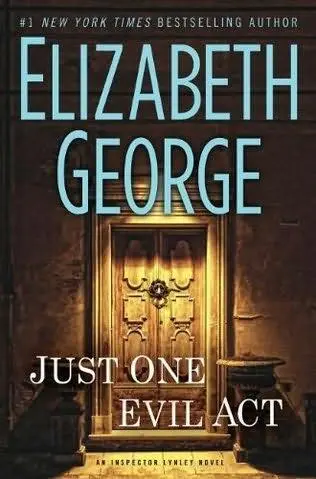
- Название:Just One Evil Act
- Автор:
- Издательство:Dutton
- Жанр:
- Год:2013
- ISBN:978-0-698-13828-5
- Рейтинг книги:5 / 5. Голосов: 1
-
Избранное:Добавить в избранное
- Отзывы:
-
Ваша оценка:
Just One Evil Act: краткое содержание, описание и аннотация
Предлагаем к чтению аннотацию, описание, краткое содержание или предисловие (зависит от того, что написал сам автор книги «Just One Evil Act»). Если вы не нашли необходимую информацию о книге — напишите в комментариях, мы постараемся отыскать её.
bestselling author Elizabeth George offers the latest in her Inspector Lynley series: a gripping child-in-danger story featuring fan favorite Barbara Havers. Detective Sergeant Barbara Havers is at a loss: The daughter of her friend Taymullah Azhar has been taken by her mother, and Barbara can't really help—Azhar had never married Angelina, and his name isn't on Hadiyyah's, their daughter's, birth certificate. He has no legal claim. Azhar and Barbara hire a private detective, but the trail goes cold.
Azhar is just beginning to accept his soul-crushing loss when Angelina reappears with shocking news: Hadiyyah is missing, kidnapped from an Italian marketplace. The Italian police are investigating, and the Yard won't get involved, until Barbara takes matters into her own hands. As she attempts to navigate the complicated waters of doing anything for the case against her superior's orders, her partner, Inspector Thomas Lynley, is dispatched to Italy as the liaison between the Italian police and Hadiyyah's distraught parents.
In time, both Barbara and Lynley discover that the case is far more complex than just a kidnapping, revealing secrets about Angelina; her new lover, Lorenzo; and even Azhar—secrets Barbara may not be willing to accept. With both her job and the life of a little girl on the line, Barbara must decide what matters most and how far she's willing to go to protect it.
Just One Evil Act — читать онлайн бесплатно полную книгу (весь текст) целиком
Ниже представлен текст книги, разбитый по страницам. Система сохранения места последней прочитанной страницы, позволяет с удобством читать онлайн бесплатно книгу «Just One Evil Act», без необходимости каждый раз заново искать на чём Вы остановились. Поставьте закладку, и сможете в любой момент перейти на страницу, на которой закончили чтение.
Интервал:
Закладка:
“I am the best but that means I have the kind of contacts you need in all the places you need them. It doesn’t mean I’m Superman.”
“Well, you need to become Superman. And you need to do it now.”
Emily, obviously, could take no more, for she burst out with “This is just great. It’s all made in heaven. I told you this was something we needed to stay away from. Now I’m telling you again. Why won’t you believe me?”
“We’re in the process of making ourselves as clean as newborns,” Doughty said. “That’s what this meeting is all about.”
“Have you ever seen a newborn?” Emily demanded.
“Point taken,” Doughty said. “Bad analogy. Given time, I’ll think of another.”
“Wonderful,” she said. “You don’t have time, Dwayne. And it’s your thinking that got us into this position.”
SOHO
LONDON
Esteban Castro’s dance studio was situated next to a car park at the midway point between Leicester Square and what went for Chinatown. Barbara Havers found it without much difficulty directly after work. Getting to it was more of a challenge, however. It was on the top floor of a six-storey building sans lift, and as she huffed and puffed her way up the stairs to the sound of postmodern music growing ever louder, Barbara gave serious thought to eliminating smoking from her life. Fortunately, as she liked to think of it, she’d recovered her sanity, if not her breath, by the time she got to the translucent half-glass door of Castro-Rourke Dance. So she dismissed the idea of committing herself to tobacco abstinence as the product of a moment’s mere idle thought.
She entered the dance establishment and found herself in a small lobby replete with posters. These featured both Dahlia Rourke in tutu mode, adopting various exotic positions suggestive of contortion, and Esteban Castro in every mode imaginable: from tight-clad and leaping through the air, to arse-pointed-outward and arm flung upward in a flamenco stance. Other than the decorative posters, the lobby had nothing else in it but a counter on which were spread brochures for various dancing classes. These appeared to run the gamut from ballroom to ballet.
There was no one in the lobby. From the noise level, though, it seemed that dancing classes were happening on both sides of it, where closed doors led to other rooms. The noise comprised the postmodern music she’d heard on the stairway, which stopped and started and stopped in one of the rooms—broken by a shout of “No, no, no! Does that actually feel to you like a toad experiencing delight and surprise?”—and loud commands of royale! royale! , which came from the other. The no s were spoken by a man, presumably Esteban Castro, so Barbara went for that door and swung it open. No one to announce her? Not a problem, she thought.
The room she entered was a good-size space with mirrored walls, ballet barres, a row of folding chairs along one side, and a pile of garments—costumes perhaps?—in one corner. In the middle on the smooth hardwood floor stood the man himself, and facing him at the far end of the room were six dancers—male and female—in various leotards, legwarmers, and ballet shoes. They looked abashed, impatient, irritated, weary. When Castro told them to “resume the starting position and feel it this time,” no one looked exactly thrilled by the idea. “He likes the motorcar,” Castro snapped at them, “and you’ve got a plan, all right? Now for God’s sake, you be a toad and you be five foxes so we can get out of here before midnight.”
Two of the dancers had clocked Barbara at the doorway, and one of them said, “Steve,” to Castro and jerked his head in her direction.
Castro swung round, took in Barbara, and said, “Class doesn’t start till seven.”
“I’m not—” she began.
“And I hope you’ve brought other shoes,” he added. “Doing the foxtrot in those? Not going to happen.” He was, of course, referring to her high-top trainers. He hadn’t yet got a clear glimpse of the rest of her clothing, or he would no doubt have pointed out that drawstring trousers and a tee-shirt reading Celebrating 600 Years of the Bubonic Plague weren’t exactly foxtrot material either.
Barbara said to him, “I’m not here for a class. You’re Mr. Castro? I need a word.”
He said, “Obviously, I’m in the middle of something.”
“Got that in a bucket. So am I.” She heaved her shoulder bag around and dug inside it for her warrant card. She crossed the room to him and let him have as much of a look as he wanted.
After a moment he said, “What’s this about?”
“Angelina Upman.”
His gaze rose from her warrant card to her face. “What about her? I haven’t seen her in ages. Has something happened to her?”
“Funny you’d go there first,” she noted.
“Where else am I supposed to go when the cops show up?” He didn’t, apparently, require an answer to this. Instead, he turned to his dancers and said, “Ten minutes, then we’ll go through this one more time.”
He spoke with no appreciable accent. He sounded like someone born in Henley-on-Thames. When she asked him about this, letting him know she’d done a little looking into a background that had told her he’d been born in Mexico City, he said he’d moved to London when he was twelve, his father a diplomat and his mother a writer of children’s books. It had been important to him to assimilate into the English culture, he said. Accent was part of it as he did not wish to be marked eternally as a foreigner in this place.
He was very good-looking. Barbara could see what the attraction had been for Angelina Upman. Indeed, she could see what the attraction would be for any woman. He smouldered in the way that Latin men often smouldered, helped along by a three-day growth of beard that made him look sexy instead of what it made most other men look, which was largely unkempt. His hair was dark and thick and so healthy-looking Barbara had to keep herself from touching it. She reckoned other women had the same reaction, and she also reckoned Esteban Castro knew it.
When they were alone in the room, Castro indicated the folding chairs and walked over to them. He moved as one would expect of a dancer: fluidly and with perfect posture. Like the dancers he’d dismissed, he wore a leotard that went miles to define every muscle on his legs and his arse. Unlike them, he also wore a tight white muscle-man tee-shirt that did much the same for his chest. His arms were bare. So were his feet.
He sat with his arms on his legs and his hands dangling between them. This gave Barbara a view of his package that she would have preferred not to have, so she moved her own chair to a position that kept his jewels from view. He said without preamble and without waiting to hear the reason for her call upon him, “My wife doesn’t know Angelina and I were involved. I’d like to keep it that way.”
“I wouldn’t place money on that,” Barbara told him. “Women aren’t stupid, as a rule.”
“She’s not quite a woman” was his reply. “That was part of the problem. Have you spoken to her?”
“Not yet.”
“There’s no need. I’ll tell you what you want to know. I’ll answer your questions. But leave her out of this.”
“‘This’?” Barbara asked.
“Whatever this is. You know what I mean.” He waited for Barbara to say something. When she gave him no assurance of any kind, he cursed and said, “Come with me.”
He led the way out of the dance studio and across the lobby. He opened the other door and jerked his head in a way that told her she was to look inside. There she saw Dahlia Rourke with a group of some dozen little girls at the barre. She was attempting to position them gracefully, one arm curved above their heads. It looked hopeless to Barbara. Nice to know, she thought, that there appeared to be no real, natural grace in life. As for Dahlia, she was skeletally thin, more X-ray than human. Perhaps feeling she was being watched, she turned towards the door.
Читать дальшеИнтервал:
Закладка:
Похожие книги на «Just One Evil Act»
Представляем Вашему вниманию похожие книги на «Just One Evil Act» списком для выбора. Мы отобрали схожую по названию и смыслу литературу в надежде предоставить читателям больше вариантов отыскать новые, интересные, ещё непрочитанные произведения.









Обсуждение, отзывы о книге «Just One Evil Act» и просто собственные мнения читателей. Оставьте ваши комментарии, напишите, что Вы думаете о произведении, его смысле или главных героях. Укажите что конкретно понравилось, а что нет, и почему Вы так считаете.