Elizabeth George - Just One Evil Act
Здесь есть возможность читать онлайн «Elizabeth George - Just One Evil Act» весь текст электронной книги совершенно бесплатно (целиком полную версию без сокращений). В некоторых случаях можно слушать аудио, скачать через торрент в формате fb2 и присутствует краткое содержание. Год выпуска: 2013, ISBN: 2013, Издательство: Dutton, Жанр: Детектив, на английском языке. Описание произведения, (предисловие) а так же отзывы посетителей доступны на портале библиотеки ЛибКат.
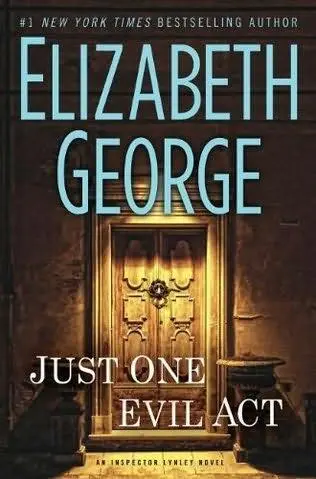
- Название:Just One Evil Act
- Автор:
- Издательство:Dutton
- Жанр:
- Год:2013
- ISBN:978-0-698-13828-5
- Рейтинг книги:5 / 5. Голосов: 1
-
Избранное:Добавить в избранное
- Отзывы:
-
Ваша оценка:
Just One Evil Act: краткое содержание, описание и аннотация
Предлагаем к чтению аннотацию, описание, краткое содержание или предисловие (зависит от того, что написал сам автор книги «Just One Evil Act»). Если вы не нашли необходимую информацию о книге — напишите в комментариях, мы постараемся отыскать её.
bestselling author Elizabeth George offers the latest in her Inspector Lynley series: a gripping child-in-danger story featuring fan favorite Barbara Havers. Detective Sergeant Barbara Havers is at a loss: The daughter of her friend Taymullah Azhar has been taken by her mother, and Barbara can't really help—Azhar had never married Angelina, and his name isn't on Hadiyyah's, their daughter's, birth certificate. He has no legal claim. Azhar and Barbara hire a private detective, but the trail goes cold.
Azhar is just beginning to accept his soul-crushing loss when Angelina reappears with shocking news: Hadiyyah is missing, kidnapped from an Italian marketplace. The Italian police are investigating, and the Yard won't get involved, until Barbara takes matters into her own hands. As she attempts to navigate the complicated waters of doing anything for the case against her superior's orders, her partner, Inspector Thomas Lynley, is dispatched to Italy as the liaison between the Italian police and Hadiyyah's distraught parents.
In time, both Barbara and Lynley discover that the case is far more complex than just a kidnapping, revealing secrets about Angelina; her new lover, Lorenzo; and even Azhar—secrets Barbara may not be willing to accept. With both her job and the life of a little girl on the line, Barbara must decide what matters most and how far she's willing to go to protect it.
Just One Evil Act — читать онлайн бесплатно полную книгу (весь текст) целиком
Ниже представлен текст книги, разбитый по страницам. Система сохранения места последней прочитанной страницы, позволяет с удобством читать онлайн бесплатно книгу «Just One Evil Act», без необходимости каждый раз заново искать на чём Вы остановились. Поставьте закладку, и сможете в любой момент перейти на страницу, на которой закончили чтение.
Интервал:
Закладка:
“I wouldn’t disagree,” Lynley told her carefully. “But the more important point now is to go back and consider what happened on the day she disappeared: where you were, where Signor Mura was, where Hadiyyah was, who was around her, who might have seen something but as of yet not come forward because they’re not even aware that they did see something . . .”
“We were all doing what we always do,” Angelina murmured numbly.
“Which is, you see, an important detail,” Lynley reassured her. “It tells the police that, if you’re creatures of habit, someone could have seen this over time and planned how and where to abduct her. It tells the police that, perhaps, this was no crime of opportunity but something considered from every angle. It also explains why no one might have noticed anything because what would have been taken into account by Hadiyyah’s abductor would be exactly that: how to carry this child off without anyone noticing.”
Angelina pressed the table napkin beneath her eyes. She nodded and said, “I see that. I do,” and she rapidly told Lynley how they’d organised the day on which Hadiyyah had disappeared: She had gone to her yoga class, Lorenzo and Hadiyyah had gone into the street market, Hadiyyah had skipped ahead as always to look at the colourful stalls and eventually to listen to the accordion player, and it was there that they all would meet to walk to the home of Lorenzo’s sister for lunch. They did this without variation on their market day in Lucca. Anyone who knew them—or who watched them and waited for an opportunity—would have learned this.
Lynley nodded. He’d heard most of this already from Lo Bianco, but he could see that it gave Angelina a sense of hope being kept alive to give him the information. Across the table from him, Lo Bianco listened to this repetition of details with apparent patience. When Angelina was finished, he said to Lynley, “ Con permesso . . . ? ” and leaned forward to ask a few questions of his own. He did so in somewhat battered English.
“I ask a question not to ask before, signora. How was Hadiyyah with Signor Mura? All this time away from her papà. How was she with your lover?”
“She was fine with Lorenzo,” Angelina said. “She likes Lorenzo.”
“This you are certain?” Lo Bianco said.
“Of course I am,” Angelina told him. “Making certain . . . It was one of the reasons . . .” She gave a glance to Lynley, then looked back at Lo Bianco. “That’s one of the reasons my sister created the emails. I thought if Hadiyyah heard from Hari, if she thought at first that this was just a visit we were making to Italy, if over time she came to believe her father wasn’t going to come for her . . .”
“Emails?” Lynley asked.
Lo Bianco quickly explained in Italian: that Angelina’s sister had manufactured emails putatively from the little girl’s father. In these he promised to come to Italy. In these he broke those promises.
“Was she able to access his email account in some way?” Lynley asked.
“She created a new account for him, through a friend of hers at University College,” Angelina told him. “I told my sister what to say in the emails. She said it.” Angelina turned to Lo Bianco. “So Hadiyyah had no reason to dislike Lorenzo, to think that he was going to stand in place of her father and to realise from this that her life was permanently altered. I made sure of that.”
“Still, there could be . . . It could be the daughter and Signor Mura . . .” Lo Bianco seemed to search for the word.
“Friction?” Lynley said. “There might have been friction between them?”
“There was no friction,” Angelina said. “There is no friction.”
“And Signor Mura, he likes your Hadiyyah?”
Angelina’s jaw loosened. If she could have gone paler than she already was, she would have done so. Lynley could see her taking in Lo Bianco’s question and drawing a conclusion from it. She said, “Renzo loves Hadiyyah. He would do nothing to harm her, if that’s what you’re thinking. Everything he’s done, everything I’ve done, it’s all been because of Hadiyyah. I wanted her back, I was so unhappy, I’d left Hari to be with Renzo here but I couldn’t do it without Hadiyyah, so I returned to Hari for those few months and waited and waited and Lorenzo waited, and it was all for Hadiyyah, because of Hadiyyah, so you can’t say Lorenzo . . .”
Lo Bianco produced the Italian version of tsk, tsk, tsk. Lynley tried to follow Angelina’s story. She’d woven, it seemed, quite a web of deceit to engineer her new life in Italy. This brought up a point of interest for him, one that might have implications from the past that reached into the present.
“When did you meet Signor Mura?” he asked her. “How did you meet him?”
She’d met him in London, she said. She’d been without an umbrella on a day with sudden rain, so she’d ducked for protection into Starbucks.
Lo Bianco made a noise of moderate disgust at this, and Lynley glanced at him. It was Starbucks, however, that was apparently garnering the Italian man’s disapproval and not the fact of Angelina Upman’s meeting someone inside the place.
The coffee house was crowded with other people having the same idea. Angelina purchased a cappuccino for herself and was drinking it on her feet by the window when Lorenzo entered with the same idea in mind: to get out of the rain. They began to chat, as people sometimes do, she explained. He’d come to London for three days’ holiday and the weather was maddening to him. In Tuscany at this time of year, he said, the sun is out, the days are warm, the flowers are blooming . . . You should come to Tuscany and see for yourself, he told her.
She could see that he looked for a wedding ring on her in that casual way that unattached people sometimes do when they meet one another. She did the same to him. She didn’t tell him about Azhar, about Hadiyyah, or about . . . other things. At the end of their time in the Starbucks when the rain had ceased, he handed her his card and said that if she ever came to Tuscany, she was to ring him and he would show her its beauties. And so, eventually, that was what she did. After a row with Hari . . . another row with Hari . . . always the nighttime rows with Hari, spoken in fierce whispers so that Hadiyyah wouldn’t know there were difficulties between her mother and father . . .
“‘Other things’?” was Lynley’s question at the end of her story. In his peripheral vision, he saw Lo Bianco’s sharp nod of approval.
“What?” she asked.
“You said that at that first meeting you didn’t tell Signor Mura about Hadiyyah, Azhar, or other things. I’m wondering what those other things were?”
Clearly, she didn’t want to go further, as her gaze moved away from Lynley and dropped to the table and the computer printouts upon it. She made a poor show of inauthentic concentration upon Lynley’s question. He finally said to her, “Every detail is important, you know,” and waited in silence. Lo Bianco did likewise. Water dripped in the enormous kitchen sink, and a clock ticked loudly. And she finally spoke.
“At that time, I didn’t tell Lorenzo about my lover,” she said.
Lo Bianco released a nearly silent whistle of air. Lynley glanced at him. Le donne, le donne , his expression said. Le cose che fanno .
“D’you mean another man?” Lynley clarified. “Other than Azhar.”
Yes, she said. One of the teachers at the dancing school where she took classes. A choreographer and an instructor. At the time of her meeting Lorenzo Mura, this man had been her lover for some years. When she left Azhar to take up life with Lorenzo, she also left this man.
“His name?” Lynley asked.
Читать дальшеИнтервал:
Закладка:
Похожие книги на «Just One Evil Act»
Представляем Вашему вниманию похожие книги на «Just One Evil Act» списком для выбора. Мы отобрали схожую по названию и смыслу литературу в надежде предоставить читателям больше вариантов отыскать новые, интересные, ещё непрочитанные произведения.









Обсуждение, отзывы о книге «Just One Evil Act» и просто собственные мнения читателей. Оставьте ваши комментарии, напишите, что Вы думаете о произведении, его смысле или главных героях. Укажите что конкретно понравилось, а что нет, и почему Вы так считаете.