Elizabeth George - Just One Evil Act
Здесь есть возможность читать онлайн «Elizabeth George - Just One Evil Act» весь текст электронной книги совершенно бесплатно (целиком полную версию без сокращений). В некоторых случаях можно слушать аудио, скачать через торрент в формате fb2 и присутствует краткое содержание. Год выпуска: 2013, ISBN: 2013, Издательство: Dutton, Жанр: Детектив, на английском языке. Описание произведения, (предисловие) а так же отзывы посетителей доступны на портале библиотеки ЛибКат.
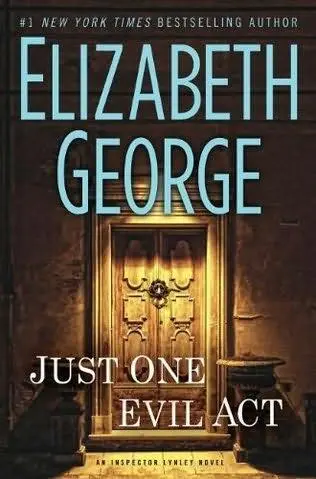
- Название:Just One Evil Act
- Автор:
- Издательство:Dutton
- Жанр:
- Год:2013
- ISBN:978-0-698-13828-5
- Рейтинг книги:5 / 5. Голосов: 1
-
Избранное:Добавить в избранное
- Отзывы:
-
Ваша оценка:
Just One Evil Act: краткое содержание, описание и аннотация
Предлагаем к чтению аннотацию, описание, краткое содержание или предисловие (зависит от того, что написал сам автор книги «Just One Evil Act»). Если вы не нашли необходимую информацию о книге — напишите в комментариях, мы постараемся отыскать её.
bestselling author Elizabeth George offers the latest in her Inspector Lynley series: a gripping child-in-danger story featuring fan favorite Barbara Havers. Detective Sergeant Barbara Havers is at a loss: The daughter of her friend Taymullah Azhar has been taken by her mother, and Barbara can't really help—Azhar had never married Angelina, and his name isn't on Hadiyyah's, their daughter's, birth certificate. He has no legal claim. Azhar and Barbara hire a private detective, but the trail goes cold.
Azhar is just beginning to accept his soul-crushing loss when Angelina reappears with shocking news: Hadiyyah is missing, kidnapped from an Italian marketplace. The Italian police are investigating, and the Yard won't get involved, until Barbara takes matters into her own hands. As she attempts to navigate the complicated waters of doing anything for the case against her superior's orders, her partner, Inspector Thomas Lynley, is dispatched to Italy as the liaison between the Italian police and Hadiyyah's distraught parents.
In time, both Barbara and Lynley discover that the case is far more complex than just a kidnapping, revealing secrets about Angelina; her new lover, Lorenzo; and even Azhar—secrets Barbara may not be willing to accept. With both her job and the life of a little girl on the line, Barbara must decide what matters most and how far she's willing to go to protect it.
Just One Evil Act — читать онлайн бесплатно полную книгу (весь текст) целиком
Ниже представлен текст книги, разбитый по страницам. Система сохранения места последней прочитанной страницы, позволяет с удобством читать онлайн бесплатно книгу «Just One Evil Act», без необходимости каждый раз заново искать на чём Вы остановились. Поставьте закладку, и сможете в любой момент перейти на страницу, на которой закончили чтение.
Интервал:
Закладка:
He said, “The Muras, Ispettore , they are an ancient family here in Lucca. They were merchants of silk, very rich, and this place in the hills was their summer home. It has been theirs—the summer home of the Mura family—for . . . I would say three hundred years, perhaps? The older brother of Lorenzo did not wish to have it pass to him. He lives in Milano and practises psychiatry there and for him this place was a burden. The sister of Lorenzo lives within the city wall of Lucca and she, too, found the old place a burden. So it fell to Lorenzo to keep it, to sell it, or to make something of it . . .” Salvatore indicated the land and its emerging buildings. “You will see,” he said. “I think it is not so much different in your own country with these ancient places.”
They swung past a barn that Lorenzo had converted into a winery and tasting room. Here, he bottled both the complex Chianti and the simpler Sangiovese for which the fattoria was known. Beyond it, a farmhouse was undergoing reconstruction for its future as an accommodation for travellers interested in staying in an agriturismo . And then, beyond this, two rusting gates stood open in an enormous and wildly overgrown hedge. Salvatore drove through these gates, a route that took them up to the villa that had long been part of the Mura family’s history. This building, too, was undergoing work. Scaffolding was being constructed on its sides.
He allowed Lynley a moment to take the villa in, idling the police car on the gravel driveway that swept up to the structure. It was an impressive sight, especially if one did not look too closely at all the spots in which the poor place was about to crumble into pieces. Two sets of stairs—perfectly proportioned on the front of the building—led up to a loggia where a jumble of outdoor furniture stood scattered about as if someone kept moving it to follow the sunlight. A door—its panels painted in faded depictions of the cinghiali that roamed the hills—was set at the precise centre of the loggia, and on either side of it old sculptures depicted the seasons in human form, with Inverno , unfortunately, having lost his poor head and the basket of flowers carried by Primavera having been chopped in half at some time in the past. There were three floors to the villa and a cellar as well, and there were rows of windows, all of them shuttered.
After a moment of looking all this over, Inspector Lynley nodded. He glanced at Salvatore and said, “As you said, in England, we have places not unlike this: old distinguished homes belonging to old, distinguished families. They are at once a burden and a privilege. It is easy to understand why Signor Mura would wish to save this place.”
Salvatore took the inspector at his word. He himself knew there were great houses aplenty in Lynley’s country. Whether Lynley himself actually understood the passion of the Italians for their family homes . . . ? That was another matter, of course.
He drove them along the lawn on the gravel that encircled it. He parked near the steps up to the first floor of the place. Between these two sets of stairs, wisteria grew abundantly on the front of the building, nearly hiding another doorway, this one leading into the piano terra of the home. As they got out of the car, this smaller doorway opened, and Angelina Upman came out from what Salvatore knew was the part of the house where the kitchen and the other quotidian rooms were situated. She looked far worse than she had looked earlier that day. Lorenzo had not been exaggerating the truth of the matter. She was very thin, and beneath her eyes the flesh looked bruised.
At once, she became emotional at the sight of the English policeman. Her eyes altered from dull to luminous with tears. She said in English, “Thank you, thank you for coming, Inspector Lynley.” To Salvatore she said in Italian, “I must speak English with this man, for my own Italian is not quite . . . It will be easier for me. You understand why I must speak English, Chief Inspector?”
“ Certo ,” Salvatore said. His own English was somewhat serviceable, as she knew. If they spoke slowly, he would be able to follow what they said.
“ Grazie ,” she said to him. “Please come inside.”
So they entered into the bowels of the place where the light was dim and the atmosphere sombre. It was odd to Salvatore that she had chosen to lead them here. The soggiorno on the primo piano would have been more pleasant. The loggia outside also would have been welcoming. But she seemed to prefer the darkness and the shadows, which would make her less easy to read, of course.
Another interesting detail, Salvatore thought. Indeed, in this matter of the missing child, there were interesting details aplenty.
FATTORIA DI SANTA ZITA
TUSCANY
Angelina took them into a cavernous kitchen within the villa, a room that was hovering between centuries. It was outfitted with both the conveniences of a cooker and refrigerator and the curiosities of an enormous wood-burning oven, a vast fireplace, and a large stone sink in which one could bathe two Alsatians simultaneously. At the room’s centre, a scarred table held a pile of newspapers, magazines, daily crockery, and faded kitchen linens, and at this table Lynley and Lo Bianco sat while Angelina brought to them a bottle of the wine produced there on the farm, along with cheese, fruit, Italian meats, and some freshly baked bread. She poured them each a glass of Chianti but had none herself, choosing water instead.
When she sat, she took up one of the linen table napkins and held it like a form of talisman. She repeated what she had said upon greeting Lynley: “Thank you so much for coming, Inspector.”
“It’s mostly Barbara’s doing,” Lynley told her. “Frankly, she may have gone a bit too far this time to get her way in matters, but that remains to be seen. Hadiyyah’s quite important to her.”
Angelina pressed her lips together for a moment. “I did a terrible thing. I know that. But what I can’t accept is that this—what’s happened to Hadiyyah—is to be my punishment. Because if that’s the case . . .” Her fingers tightened on the piece of linen she held.
Lo Bianco made a noise in his throat that seemed to indicate his understanding of the concept: that there was always a connection between the forms of temporal punishment one suffered and the crimes of the heart one committed against other people. To Lynley’s way of thinking, this was a less than useful way of looking at what had happened.
He said, “I’d try not to think like that. It’s normal—believe me, I do understand—but it’s not helpful.” He smiled at her kindly and added, “‘That way madness lies’ is a good way to put it. Madness—clouded thinking, if you will—isn’t useful to anyone just now.”
“It’s been a week,” she said. “Can you tell me what it means that it’s been a week without a sign or a word? There’s been no request for a ransom and Renzo’s family would pay. I know they would. And people are kidnapped for ransoms in this country. All over the world they’re kidnapped for ransoms. Aren’t they? Isn’t it true? I’ve been trying to discover how many children are kidnapped in Italy every year. See—” Here she dug into the pile of newspapers and magazines and brought out information she’d printed from the Internet. “I’ve been looking and searching and trying to see how long it usually is before kidnappers . . . before there’s something to tell the parents . . .” She fell into silence. In this silence, tears tracked down her cheeks.
Lynley glanced at Lo Bianco. As police they both knew that Angelina was grasping at straws, that in this day kidnapping for ransom was far less likely than kidnapping for sale, for sex, for sick recreational murder, especially when it came to the disappearance of a child. Lo Bianco’s fingers rose and fell against the base of his wineglass. It was a gesture saying, Tell her what you will at this point as it is important only to give her a moment’s peace of mind.
Читать дальшеИнтервал:
Закладка:
Похожие книги на «Just One Evil Act»
Представляем Вашему вниманию похожие книги на «Just One Evil Act» списком для выбора. Мы отобрали схожую по названию и смыслу литературу в надежде предоставить читателям больше вариантов отыскать новые, интересные, ещё непрочитанные произведения.










Обсуждение, отзывы о книге «Just One Evil Act» и просто собственные мнения читателей. Оставьте ваши комментарии, напишите, что Вы думаете о произведении, его смысле или главных героях. Укажите что конкретно понравилось, а что нет, и почему Вы так считаете.