Elizabeth George - Just One Evil Act
Здесь есть возможность читать онлайн «Elizabeth George - Just One Evil Act» весь текст электронной книги совершенно бесплатно (целиком полную версию без сокращений). В некоторых случаях можно слушать аудио, скачать через торрент в формате fb2 и присутствует краткое содержание. Год выпуска: 2013, ISBN: 2013, Издательство: Dutton, Жанр: Детектив, на английском языке. Описание произведения, (предисловие) а так же отзывы посетителей доступны на портале библиотеки ЛибКат.
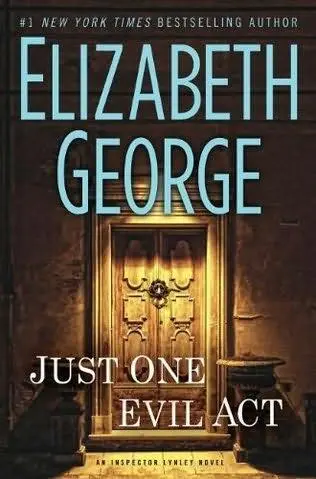
- Название:Just One Evil Act
- Автор:
- Издательство:Dutton
- Жанр:
- Год:2013
- ISBN:978-0-698-13828-5
- Рейтинг книги:5 / 5. Голосов: 1
-
Избранное:Добавить в избранное
- Отзывы:
-
Ваша оценка:
Just One Evil Act: краткое содержание, описание и аннотация
Предлагаем к чтению аннотацию, описание, краткое содержание или предисловие (зависит от того, что написал сам автор книги «Just One Evil Act»). Если вы не нашли необходимую информацию о книге — напишите в комментариях, мы постараемся отыскать её.
bestselling author Elizabeth George offers the latest in her Inspector Lynley series: a gripping child-in-danger story featuring fan favorite Barbara Havers. Detective Sergeant Barbara Havers is at a loss: The daughter of her friend Taymullah Azhar has been taken by her mother, and Barbara can't really help—Azhar had never married Angelina, and his name isn't on Hadiyyah's, their daughter's, birth certificate. He has no legal claim. Azhar and Barbara hire a private detective, but the trail goes cold.
Azhar is just beginning to accept his soul-crushing loss when Angelina reappears with shocking news: Hadiyyah is missing, kidnapped from an Italian marketplace. The Italian police are investigating, and the Yard won't get involved, until Barbara takes matters into her own hands. As she attempts to navigate the complicated waters of doing anything for the case against her superior's orders, her partner, Inspector Thomas Lynley, is dispatched to Italy as the liaison between the Italian police and Hadiyyah's distraught parents.
In time, both Barbara and Lynley discover that the case is far more complex than just a kidnapping, revealing secrets about Angelina; her new lover, Lorenzo; and even Azhar—secrets Barbara may not be willing to accept. With both her job and the life of a little girl on the line, Barbara must decide what matters most and how far she's willing to go to protect it.
Just One Evil Act — читать онлайн бесплатно полную книгу (весь текст) целиком
Ниже представлен текст книги, разбитый по страницам. Система сохранения места последней прочитанной страницы, позволяет с удобством читать онлайн бесплатно книгу «Just One Evil Act», без необходимости каждый раз заново искать на чём Вы остановились. Поставьте закладку, и сможете в любой момент перейти на страницу, на которой закончили чтение.
Интервал:
Закладка:
“Then why did someone wipe it clean?”
“Perhaps to muddy the waters, to make it look as if there was something on it that needed to be removed. But there wasn’t. Now.” Doughty had been sitting but he got to his feet and his intention was clear: Farewells were in order and hers was the job of making them. “You’ve had your five minutes. I’ve a wife at home and a dinner to eat, and if you’ve a wish for a longer natter with me, it’s going to have to take place at another time.”
Barbara eyed him. There had to be something else, if not here then elsewhere. But aside from sliding burning slivers of bamboo beneath Dwayne Doughty’s fingernails, she reckoned she’d got all she could from the man. She took a Biro from her bag and opened her chequebook.
At this, Doughty held up his hand. “Please. It’s on the house,” he said.
15 April
LUCCA
TUSCANY
He decided that the encounter between them could happen most easily in a mercato . There were enough of them in and around Lucca, and the best took place inside the colossal wall that encircled the oldest part of the town. Piazza San Michele’s mercato was a now-and-then occurrence, mad with Lucchese from neighbourhoods beyond the wall who wandered in through one of the great gates for a day of browsing through stalls selling everything from scarves to wheels of cheese. But Piazza San Michele was also the central point of the walled city, making an escape from the place fraught with problems. That left him with a choice between either the mercato in Corso Giuseppe Garibaldi not more than a stone’s throw from escape through Porta San Pietro, or the decided insanity of the mercato that stretched the distance from Porta Elisa to Porta San Jacopo.
When he thought about these latter two mercati , his final decision had to do with the atmosphere and with what sort of people tended to frequent each of them. Corso Giuseppe Garibaldi attracted tourists, along with a more well-heeled kind of shopper, and its offerings appealed to those with ready cash to hand over for its delicacies. Because of this, he found that the family did not shop often in this place. So he was left with the other.
This other mercato stretched along the narrow, curving lane of Passeggiata delle Mura Urbane, which backed right up to the looming mass of the city’s wall. Frequenters of the place had to elbow between one another, and in doing so they had to avoid stepping on barking dogs and encountering beggars at the same time as they attempted to make their demands of lo venderebbe a meno? heard above the din of conversations, arguments, musicians playing for a handout, and people shouting into their mobile phones. Indeed, the more he thought about it, the more he realised that this mercato in Passeggiata delle Mura Urbane was actually perfect. Anything could happen unnoticed in the place, and it had the additional advantage of being quite close to the home on Via Santa Gemma Galgani, where every Saturday the family met for lunch. On nice days, such as this one, that lunch was served in the garden just a portion of which he’d been able to glimpse from the street.
It was to this place—to this house and garden—that everyone would assume at first that the child had gone. It was a natural conclusion for people to reach, and he could easily imagine how things would play out. Papà would turn round and see she wasn’t immediately within sight, but he would actually think nothing of it. For the house was close, and in that house standing within its beautiful garden lived a boy just the age of the child. She called him Cugino Gugli, which she pronounced Goo-lee because her Italian was limited and she could not yet say Guglielmo. But the boy did not seem to mind since he could not pronounce her name either, and anyway their bond was of calcio only. And one did not need a real language for bonding over calcio . One only needed the willingness to kick a football towards a goal.
She wouldn’t fear him when he approached her. She didn’t know him, but she would have been taught that the strangers to fear were the ones with lost animals in need of finding, the ones with kittens in a box—just behind that parked car, cara bambina —the ones who gave off the stench of lust and longing, the ill-dressed, the foul-breathed, the unbathed, the ones with something to show you or give you or a special place to take you where a very special treat was waiting for you . . . But he was none of this, and he had none of this. What he did have was his looks— la faccia d’un angelo , as his mamma liked to say—along with a message. Plus, he was to say a single word and that word was going to seal the deal. It was a word he’d never heard before in any of the three languages he spoke, but he’d been told it would convince the child of the veracity of the tale he would tell her. Hearing it, she would understand him perfectly. This was why he—and not someone else—had been chosen for the job at hand.
Because he was good at his job, he’d taken time to gather the information he needed to carry off the assignment. Most families, he knew, kept to routines. It made life easier for them. So a month of careful watching, surreptitious following, and copious note-taking had told him what was required of him. Once he’d been given the date for action, he was ready.
They would park their Lancia outside the city wall, in the parcheggio near Piazzale Don Aldo Mei. From there, they would part ways for two hours. Mamma would head towards Via della Cittadella, where the yoga studio was. Papà and Bambina would stroll towards and through Porta Elisa. Mamma’s walk was the longer one, but she carried only her yoga mat and she liked the exercise. Papà and Bambina each carried one borsa della spesa , indicating that at the end of their time in the mercato , they’d be burdened with their purchases within those bags.
At this point, he knew them all so well that he could have described the likely clothes that Mamma would wear and he could have named the colours of the borse that Papà and Bambina would carry. His would be green and made of webbing. Hers would be orange and of solid material. They were nothing if not creatures of habit.
On the day set for everything to happen, he established himself in the parcheggio early. This was his eighth time following the family, and he was assured that nothing was going to disrupt their normal routine. He was in no hurry. For when the job was done, it had to be done perfectly and in such a way that several hours would pass before anyone had the slightest idea that something might be wrong.
He’d left his own vehicle in the parcheggio in Viale Guglielmo Marconi. He’d arrived several hours before the mercato opened in order to capture a parking bay that gave him quick access to the exit. He’d bought a large piece of focaccia alle cipolle on his way to Piazzale Don Aldo Mei. After he ate, he chewed on breath mints to rid his mouth of the scent of the onions. He took a pianta stradale from the shoulder bag he carried, and he unfolded this on the boot of a car, ostensibly looking for a route. He would be just another tourist in Lucca to anyone who saw him.
The family arrived ten minutes behind schedule, but he didn’t consider this a problem. They parted as always just inside the gate, with Mamma walking off to her yoga experience and Papà and Bambina heading inside the tourist office where there was a WC. They were innately practical people as well as being utterly consistent. First things first and besides, there were no toilets once one began to wander through the mercato .
Читать дальшеИнтервал:
Закладка:
Похожие книги на «Just One Evil Act»
Представляем Вашему вниманию похожие книги на «Just One Evil Act» списком для выбора. Мы отобрали схожую по названию и смыслу литературу в надежде предоставить читателям больше вариантов отыскать новые, интересные, ещё непрочитанные произведения.











Обсуждение, отзывы о книге «Just One Evil Act» и просто собственные мнения читателей. Оставьте ваши комментарии, напишите, что Вы думаете о произведении, его смысле или главных героях. Укажите что конкретно понравилось, а что нет, и почему Вы так считаете.