Thomas Adcock - Brooklyn Noir 3 - Nothing but the Truth
Здесь есть возможность читать онлайн «Thomas Adcock - Brooklyn Noir 3 - Nothing but the Truth» весь текст электронной книги совершенно бесплатно (целиком полную версию без сокращений). В некоторых случаях можно слушать аудио, скачать через торрент в формате fb2 и присутствует краткое содержание. Город: New York, Год выпуска: 2008, ISBN: 2008, Издательство: Akashic Books, Жанр: Детектив, на английском языке. Описание произведения, (предисловие) а так же отзывы посетителей доступны на портале библиотеки ЛибКат.
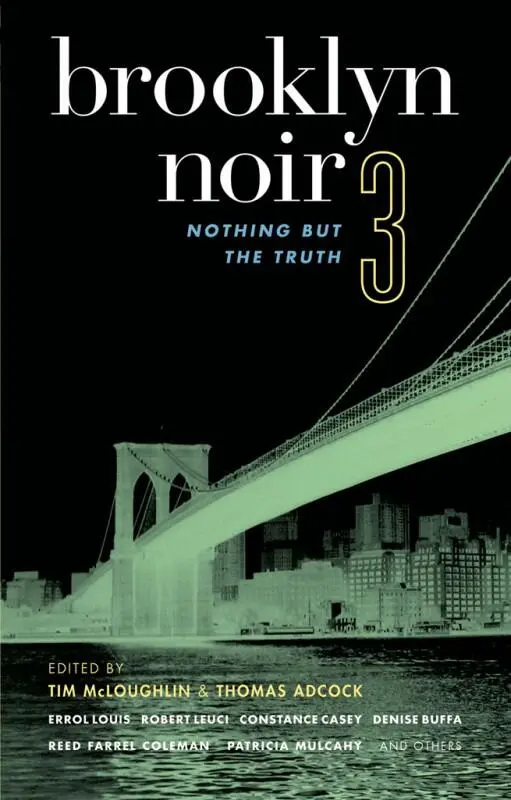
- Название:Brooklyn Noir 3: Nothing but the Truth
- Автор:
- Издательство:Akashic Books
- Жанр:
- Год:2008
- Город:New York
- ISBN:978-1-933354-14-9
- Рейтинг книги:3 / 5. Голосов: 1
-
Избранное:Добавить в избранное
- Отзывы:
-
Ваша оценка:
Brooklyn Noir 3: Nothing but the Truth: краткое содержание, описание и аннотация
Предлагаем к чтению аннотацию, описание, краткое содержание или предисловие (зависит от того, что написал сам автор книги «Brooklyn Noir 3: Nothing but the Truth»). Если вы не нашли необходимую информацию о книге — напишите в комментариях, мы постараемся отыскать её.
. This volume presents the first nonfiction collection in the series, curated by acclaimed novelists Tim McLoughlin and Thomas Adcock.
Brand-new stories by: Robert Leuci, Dennis Hawkins, Tim McLoughlin, Thomas Adcock, Errol Louis, Denise Buffa, Patricia Mulcahy, C. J. Sullivan, Reed Farrel Coleman, Aileen Gallagher, Christopher Musella, Kim Sykes, Robert Knightly, Jess Korman, Constance Casey, and Rosemarie Yu.
Brooklyn Noir 3: Nothing but the Truth — читать онлайн бесплатно полную книгу (весь текст) целиком
Ниже представлен текст книги, разбитый по страницам. Система сохранения места последней прочитанной страницы, позволяет с удобством читать онлайн бесплатно книгу «Brooklyn Noir 3: Nothing but the Truth», без необходимости каждый раз заново искать на чём Вы остановились. Поставьте закладку, и сможете в любой момент перейти на страницу, на которой закончили чтение.
Интервал:
Закладка:
Thank God I’m out of it.
The body in the doorway
by Patricia Mulcahy
Fort Greene
I never saw the body. I found out that Vladimir the antiques dealer, a.k.a. Bobby from Russia, had been shot in the head at point-blank range in the doorway of his shop at Vanderbilt and DeKalb because the drums were talking. This is how it went in Fort Greene, Brooklyn, in the mid-1990s.
Friends called friends to alert them to the fact that there’d been another mugging in Fort Greene Park, or gunshots heard from an unknown source on Adelphi at 3 a.m. A mention of Fort Greene on the news usually meant that another four-year-old had been shot tragically in drug-related violence in the Walt Whitman Houses. Myrtle Avenue was referred to as “Murder Avenue” by all and sundry. The local citizenry protected each other with all-points alerts about crime in an area labeled up-and-coming, yet still on its way to that elusive goal, whatever it meant to anyone who wasn’t a real estate broker.
Burnt out on tourists, nonstop street spectacle, and rising prices in Greenwich Village, I’d moved to Brooklyn in 1990, thrilled by the beautiful architecture, the wide, treelined streets, and the warm and generous spirit of the people who lived here. Hell, I got a free dessert the week I moved in. Christine, a Caribbean woman who ran a bakery at the corner of Carlton and DeKalb, told me, “Watch out going by the park after dark,” as she welcomed me with a delicious rum pudding. No one had given me free anything in the twelve years I’d lived in Manhattan. This was Fort Greene in a nutshell: Welcome, and watch your back .
Taxi drivers told me I was crazy to live in a neighborhood like this. Unspoken was the fact that I was white and the area was predominantly African American. Perhaps I was naïve, but I didn’t worry. In the nine years I’d lived on Jones Street between West 4th and Bleecker, I’d been mugged in broad daylight in the lobby, burglarized by a guy who called on the phone a week later to let me know he could come back anytime he wanted, and terrorized by a drug-and-booze-addled jazz musician neighbor whose friends I passed shooting up in the hallway on my way to work. How much worse could it be in Brooklyn?
It was tough in New York then, and things could happen anywhere: This was the common wisdom passed from one nervous neighbor to another. Watching your back was a way of living, the price of being in the big city, with all it had to offer. The worst thing that happened to me in Fort Greene was being labeled “white meat” by a bunch of teenaged boys eager to look tough for their cohorts. But if I stayed out late I hoped and prayed I would find a parking spot close to my apartment. Muggers exercised equal opportunity in their choice of targets.
In truth, I learned that for all its tough-talk swagger and reputation, Brooklyn had a big, warm heart. Living in Fort Greene and Clinton Hill felt like being in a village where everyone knows your name and people stop on the street to exchange pleasantries along with the latest news on tire slashings. We even had a plant thief on Washington Avenue who was fencing window boxes somewhere in South Brooklyn. My next-door neighbor, a divorcée with a BMW, a very active social life, and no visible means of support, left town one day and never came back, taking with her a baby who’d arrived under mysterious circumstances. Later, I found out that she had tried to sell the child back to the doctor who delivered her. There was never a dull moment.
Which brings us back to Bobby, shot dead in the doorway of an emporium crammed to the rafters with lovely chests of drawers and old Tiffany-style lamps and antique dining tables. The tall, rangy Russian, who was in fact from the Republic of Georgia and usually wore a broad-brimmed leather hat, à la Crocodile Dundee, was one of the many “gentlemen friends” who’d been seen coming and going to the house next to ours. I doubted that he was the one who threw a rock through the window at 6 a.m., necessitating a visit from a patrolman, or the one who set the fire in the foyer. But who knew?
At the time of the murder, rumors flew up and down the streets of Fort Greene and Clinton Hill: Bobby had been shot by his former brother-in-law, with whom he’d been in business until recently; it was someone from the Russian mob in Brighton Beach, from whom he’d borrowed money; it was the husband of one of his paramours — my next-door neighbor was just one of many.
Tillie Asnis, the landlady, had discovered the body in the doorway of the store. I met her when she was selling furniture, emptying the place for a new tenant. As I recall, she said little about the murder itself that day, and instead gossiped about the Russian’s way with the local ladies. That, too, was typical of the neighborhood then: Once a crime had been broadcast on the local grapevine, it was rarely discussed further. Better to keep a lid on things.
A frizzy-haired woman of Russian Jewish ancestry who’d moved to Brooklyn from the Bronx, Tillie lived above the shop with her children and grandchildren. A two-pack-a-day smoker, she reminded me of the characters on The Honeymooners , with her husky voice and no-nonsense demeanor. After running a dry cleaning store on the premises with her late husband for many years, she’d let the space to her son-in-law for a bike shop and a locksmith’s business before leasing it to Vladimir. Given his untimely departure, she was back to square one. Life went on, as did the need to pay the bills.
Though horrified by the manner in which the store had been vacated, I asked Tillie about the rent on the space after buying two chairs for fifteen dollars. At the time, I was a book publisher with no experience running restaurants, though I’d worked as a waitress in a country club, a truck stop, an icecream parlor, and an Italian restaurant in high school and college. The oldest in an Irish Catholic family with six children, I was as chronically overscheduled as the West Indian characters in the old Saturday Night Live skits.
In an effort to meet people in my new neighborhood, I’d volunteered as a writer and editor for a local quarterly called The Hill . A look at back issues alerted me to the previous existence of an espresso place in an old carriage house on Waverly Avenue run by students at Pratt, an art school situated in the neighborhood. What a brilliant idea for a shop in an area full of graphic and fashion designers, architects, and other people who worked at home and had no place to hang out other than the local Greek diners. And the corner of Vanderbilt and DeKalb was just three blocks from the Pratt campus. Didn’t art students and their teachers need cappuccino to fuel their creative efforts?
Though I loved working with writers, I was becoming increasingly disenchanted with corporate publishing, which had its own version of sword-and-knife play. In addition, I had come to relish my involvement in the Fort Greene community, and wanted to make a contribution to a place I felt had a bright future in so many ways, with its diverse population, its proximity to Manhattan, and its history-filled beauty. And if I didn’t take the space, it might become yet another real estate office, of which we had a plethora already.
I put my nest egg where my heart was: Hands shaking, I wrote Tillie Asnis a check for a security deposit and set out to convert an old antiques store into a cozy neighborhood café named in her honor. While I was out of town on a publishing trip, the Jamaican contractor and his Trinidadian crew performed a ceremony involving white rum and chicken feathers to purge the space of any bad spirits left over from the murder of the previous tenant. Despite the Caribbean version of an exorcism, predictions of failure were as common as rain in April. Word on the street was that no one in this neighborhood would pay $1.50 for a cup of coffee when they could buy it across the street at the diner for sixty cents. At the time, DeKalb Avenue had just one restaurant, the beloved Cino’s, a red-sauce fixture since the 1950s, and Starbucks was just beginning its retail march from sea to shining sea.
Читать дальшеИнтервал:
Закладка:
Похожие книги на «Brooklyn Noir 3: Nothing but the Truth»
Представляем Вашему вниманию похожие книги на «Brooklyn Noir 3: Nothing but the Truth» списком для выбора. Мы отобрали схожую по названию и смыслу литературу в надежде предоставить читателям больше вариантов отыскать новые, интересные, ещё непрочитанные произведения.



Обсуждение, отзывы о книге «Brooklyn Noir 3: Nothing but the Truth» и просто собственные мнения читателей. Оставьте ваши комментарии, напишите, что Вы думаете о произведении, его смысле или главных героях. Укажите что конкретно понравилось, а что нет, и почему Вы так считаете.