Thomas Adcock - Brooklyn Noir 3 - Nothing but the Truth
Здесь есть возможность читать онлайн «Thomas Adcock - Brooklyn Noir 3 - Nothing but the Truth» весь текст электронной книги совершенно бесплатно (целиком полную версию без сокращений). В некоторых случаях можно слушать аудио, скачать через торрент в формате fb2 и присутствует краткое содержание. Город: New York, Год выпуска: 2008, ISBN: 2008, Издательство: Akashic Books, Жанр: Детектив, на английском языке. Описание произведения, (предисловие) а так же отзывы посетителей доступны на портале библиотеки ЛибКат.
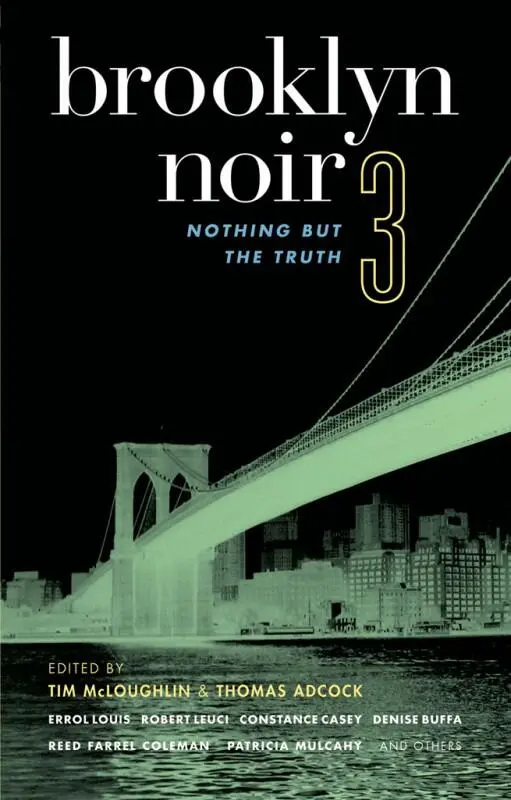
- Название:Brooklyn Noir 3: Nothing but the Truth
- Автор:
- Издательство:Akashic Books
- Жанр:
- Год:2008
- Город:New York
- ISBN:978-1-933354-14-9
- Рейтинг книги:3 / 5. Голосов: 1
-
Избранное:Добавить в избранное
- Отзывы:
-
Ваша оценка:
Brooklyn Noir 3: Nothing but the Truth: краткое содержание, описание и аннотация
Предлагаем к чтению аннотацию, описание, краткое содержание или предисловие (зависит от того, что написал сам автор книги «Brooklyn Noir 3: Nothing but the Truth»). Если вы не нашли необходимую информацию о книге — напишите в комментариях, мы постараемся отыскать её.
. This volume presents the first nonfiction collection in the series, curated by acclaimed novelists Tim McLoughlin and Thomas Adcock.
Brand-new stories by: Robert Leuci, Dennis Hawkins, Tim McLoughlin, Thomas Adcock, Errol Louis, Denise Buffa, Patricia Mulcahy, C. J. Sullivan, Reed Farrel Coleman, Aileen Gallagher, Christopher Musella, Kim Sykes, Robert Knightly, Jess Korman, Constance Casey, and Rosemarie Yu.
Brooklyn Noir 3: Nothing but the Truth — читать онлайн бесплатно полную книгу (весь текст) целиком
Ниже представлен текст книги, разбитый по страницам. Система сохранения места последней прочитанной страницы, позволяет с удобством читать онлайн бесплатно книгу «Brooklyn Noir 3: Nothing but the Truth», без необходимости каждый раз заново искать на чём Вы остановились. Поставьте закладку, и сможете в любой момент перейти на страницу, на которой закончили чтение.
Интервал:
Закладка:
True enough for the tube, most prosecutors “catch” cases brought to them by the police. Which is interesting, but nowhere near the excitement of building the case yourself. Investigative attorneys are thought to be wannabe cops. While there might be some truth to that, it’s too simple a notion. A good investigative attorney is always thinking about how the evidence gathered can be used at trial. Unlike the cops, our work is not over when the arrest goes down.
And so, as an investigative attorney for the New York State Special Prosecutor’s Office, I got to shape the investigation that would lead to the indictments and trials. Perhaps that is why I went astray in the 77th Precinct case. Chief John Guido, legendary head of the NYPD’s Internal Affairs Division, used to say, “Don’t fall in love with your investigation.”
But I thought the investigation was so good. I thought the sum total of the evidence would overwhelm even the least culpable defendants.
Soon after Henry Winter and his partner, Anthony Magno, agreed to cooperate with my office and NYPD Internal Affairs, we sent them back into the sewer of the 77th Precinct to catch more corrupt cops. As part of the investigative team of prosecutors and Internal Affairs detectives, I met with Henry and Tony at least once a week for the next four months, and almost every day listened to the hours of tapes they secretly recorded while on duty in the 77th.
I got to know them more through these tapes than from our personal meetings: Henry, the smooth talker, full of fun and credible to cops, crooks, and the community; Tony, a man of few words, direct, tough, and angry. Henry delivered the evidence right from the start, Tony dragged his heels. Henry understood he had to work off his time in jail, Tony was reluctant. In time, I realized that Henry was a natural undercover operative and investigator. He was inventive and helped create scenarios that captured other corrupt cops on tape.
I have often wondered since those heady days of the investigation whether we were too much like the scientists who go out into the field to make objective observations but “contaminate” the environment by our mere presence.
Did we make it too easy to be corrupt by providing a convenient way to dispose of illegally seized drugs and guns, though our undercover buy-back program?
And was it the flagrant, seemingly undetected corruption of Henry and Tony that inspired Gil Ortiz to spend too much time with them? Was it unreasonable for him to consider them the true leaders of the precinct?
When the investigation abruptly ended due to a leak that we never traced with certainty (though we had our suspicions), I would spend hours with Henry and Tony going over the tapes, refining the transcripts, getting a better understanding of the crimes. We were never buddy-boys, but I did respect their work.
And my respect for Henry increased when he agreed to testify in this one last trial, even though the police department had told him he would be terminated after it was over. Henry always held the hope that the department would let him and Tony stay on the job long enough to retire with a pension. Fat chance.
Henry could have walked away from the trial and not testified, and I could have subpoenaed him. But how would that have looked to the jury, and what kind of testimony would he have delivered? The time for threats had passed. Henry had been the star witness in three previous trials and I, for one, did not believe we should send him to jail for his failure this last time to live up to his agreement.
But it never came to that. When I called Henry to tell him about the trial date, he came in and got down to business. He told me that he was pissed that the department had decided to cut him loose.
I told him, “You know, Henry, we have no control over what the department does.”
I started to remind him of our deal: Cooperate fully and he would never see the inside of a prison because we would make the extent of his cooperation known to the department. But he stopped me.
“I know what the deal is,” Henry said. “I promised to see this through till the end and I’m keeping my word.”
The “Thanks, Henry” that followed was difficult because I had learned that he had worn a wire against me and another prosecutor during preparation for an earlier trial in order to try and get us on the record making a better deal than the one we had actually made. We had restated our understanding of the deal and Henry thereby got no additional leverage. So it was hard to accept that the ultimate rat was doing the right thing. But that appeared to be the case.
With jury selection out of the way, I would have a chance to tell the panel just what the People planned to prove — a conspiracy involving Henry, the defendant, and another cop to “hit” a known drug location, steal the drugs and money, and divide the proceeds of the crime. I told the jury that they would hear the testimony of a corrupt cop who had agreed to cooperate, and that, most importantly, they would hear “with your own ears” the money being split after the hit — where no drugs were found. This was the core of my case.
Barry underscored the weakness of my position — the ambivalent taped conversation, called a “conspiracy” by the prosecutors, and the failure of the tape to demonstrate that his client had accepted any share of money at all.
No one wins a case during opening arguments. But the stage is set and the jury is given a road map of where it will be going. We all agree that the burden of proof is on the prosecutor to prove each and every element of the crime beyond a reasonable doubt — a heavy burden indeed.
After openings, I began with an Internal Affairs witness who could tell the jury that he met with Henry Winter on the day of the crime, provided him with a fresh tape, and put the appropriate “header” on it — identifying himself and Henry, as well as date, time, and place. Also that soon thereafter, he retrieved the tape from Henry, and that the money was taken from the location. He testified that he vouchered both tape and money and had brought the very same tape and money to court today to be introduced into evidence as People’s exhibits.
Another police officer provided the basis for the introduction of evidence that Ortiz was on duty that day in the same sector where the hit occurred. I had a police witness introduce a map drawing of the location in question so that Henry could show where the defendant and he had been during the incident. All this testimony went smoothly and, I hoped, showed the jury the competence of our investigation. But as we used to say in those days, Where’s the beef?
Henry was the beef — or sacrificial lamb, I should say, given my experience watching him cross-examined at previous trials. But Henry was no lamb. In fact, it was open season on rats who testified against those presumed to be innocent.
Henry and I had agreed that I would do an abbreviated direct examination of his past crimes and bad acts. Having seen Henry subjected to an all-day direct examination of his entire oeuvre of bad acts — dating back to when he worked in a Modell’s sporting goods shop as a teenager and marked down the price of baseball gloves for his friends — I decided to spare him the double-dose of confessing first to me and then to Barry. No matter, Henry still faced days of withering cross-examination by defense counsel to show him for a liar, a cheat, and a thief beyond compare.
When Henry took the stand, I quickly established that he had been a crooked cop, that he’d stolen money and drugs, that he’d resold the drugs, protected some drug dealers and extorted others, that he was not beneath stealing from the dead, and, significantly, that he’d been caught and had made a deal with prosecutors to avoid jail. Barry did not raise any objections to this testimony. After all, I was doing his job — undermining the credibility of my own witness. The theory here is that it’s better for the jury to hear it from the prosecutor, who is hiding nothing, than for the defense counsel to expose a cover-up by the prosecution.
Читать дальшеИнтервал:
Закладка:
Похожие книги на «Brooklyn Noir 3: Nothing but the Truth»
Представляем Вашему вниманию похожие книги на «Brooklyn Noir 3: Nothing but the Truth» списком для выбора. Мы отобрали схожую по названию и смыслу литературу в надежде предоставить читателям больше вариантов отыскать новые, интересные, ещё непрочитанные произведения.



Обсуждение, отзывы о книге «Brooklyn Noir 3: Nothing but the Truth» и просто собственные мнения читателей. Оставьте ваши комментарии, напишите, что Вы думаете о произведении, его смысле или главных героях. Укажите что конкретно понравилось, а что нет, и почему Вы так считаете.