Thomas Adcock - Brooklyn Noir 3 - Nothing but the Truth
Здесь есть возможность читать онлайн «Thomas Adcock - Brooklyn Noir 3 - Nothing but the Truth» весь текст электронной книги совершенно бесплатно (целиком полную версию без сокращений). В некоторых случаях можно слушать аудио, скачать через торрент в формате fb2 и присутствует краткое содержание. Город: New York, Год выпуска: 2008, ISBN: 2008, Издательство: Akashic Books, Жанр: Детектив, на английском языке. Описание произведения, (предисловие) а так же отзывы посетителей доступны на портале библиотеки ЛибКат.
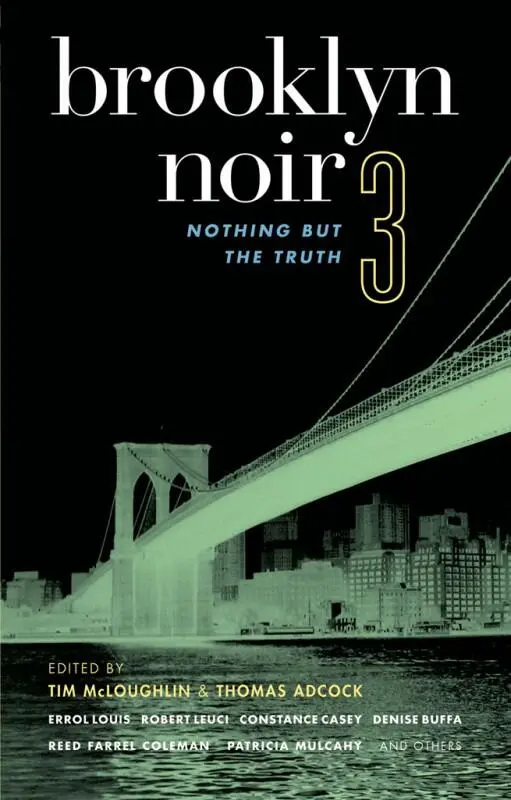
- Название:Brooklyn Noir 3: Nothing but the Truth
- Автор:
- Издательство:Akashic Books
- Жанр:
- Год:2008
- Город:New York
- ISBN:978-1-933354-14-9
- Рейтинг книги:3 / 5. Голосов: 1
-
Избранное:Добавить в избранное
- Отзывы:
-
Ваша оценка:
Brooklyn Noir 3: Nothing but the Truth: краткое содержание, описание и аннотация
Предлагаем к чтению аннотацию, описание, краткое содержание или предисловие (зависит от того, что написал сам автор книги «Brooklyn Noir 3: Nothing but the Truth»). Если вы не нашли необходимую информацию о книге — напишите в комментариях, мы постараемся отыскать её.
. This volume presents the first nonfiction collection in the series, curated by acclaimed novelists Tim McLoughlin and Thomas Adcock.
Brand-new stories by: Robert Leuci, Dennis Hawkins, Tim McLoughlin, Thomas Adcock, Errol Louis, Denise Buffa, Patricia Mulcahy, C. J. Sullivan, Reed Farrel Coleman, Aileen Gallagher, Christopher Musella, Kim Sykes, Robert Knightly, Jess Korman, Constance Casey, and Rosemarie Yu.
Brooklyn Noir 3: Nothing but the Truth — читать онлайн бесплатно полную книгу (весь текст) целиком
Ниже представлен текст книги, разбитый по страницам. Система сохранения места последней прочитанной страницы, позволяет с удобством читать онлайн бесплатно книгу «Brooklyn Noir 3: Nothing but the Truth», без необходимости каждый раз заново искать на чём Вы остановились. Поставьте закладку, и сможете в любой момент перейти на страницу, на которой закончили чтение.
Интервал:
Закладка:
Fast-forward to the new century. I’d left publishing for freelance life. We’ll move right through the years of light foot traffic, employee theft and subterfuge, and near-bankruptcy at the store. Nothing I’d done in my life had elicited such an honestly enthusiastic and truly grateful response: Area residents stopped me on the corner, in line at the grocery store, and in the post office to tell me how much they loved my shop. Even in Manhattan, people I’d never met called across subway cars, “Hello, Tillie!” By the time we celebrated our tenth year in business in 2007, Tillie’s was considered a neighborhood institution, which made me feel both proud and definitely older.
Though friends and family members saw me as a Pollyanna when I opened the store, the survival of my risky venture validated my view of the neighborhood as a place filled with genuine potential, despite its dicey reputation. I wasn’t getting rich, but nor was I spending my days listening to my boss cavil about so-called “big books.”
By then, many more restaurants and coffee joints had opened not just on DeKalb, but all over the area, and real estate prices in Fort Greene had increased by such leaps and bounds that the New York Times real estate section could barely keep up. In 2006, a photo of the side of Tillie’s illustrated an article in the New York Times magazine about the death of bohemia and the invasion of the stroller brigade. How far we’d come from the days of Bobby the Russian’s sad demise.
Fears of rapid change — of the Manhattanization of Brooklyn by condo and office tower — now fuel the local rumor mill. Friends call friends to discuss not the latest shooting, but the sale prices of houses and coop apartments, and whether or not the area will change irrevocably for the worse when the Atlantic Yards development is built. After years of peace and quiet, there’s been a recent blip upward in the local crime rate, as the “have-nots” eye this newly fertile hunting ground of “haves.” Still, the neighborhood remains positively bucolic in comparison to the bad old days, which some longtime residents refer to with a sense of rueful regret. Though no one condoned burglary or car theft, there was a sense then that we were in it together, battling for a better future. Now that it has arrived, we aren’t all sure we like the way it looks. Fairy tales don’t start with bodies sprawled in doorways.
References to the Borough of Kings now connote not working-class pride or even street style, but a certain kind of city life that is artistically astute, relatively well-off, politically correct, and, yes, self-satisfied. For a taste of the old ways, you have to go further into what friends call “deepest Brooklyn,” where even in an era of drastically reduced crime all over the metropolis, there are still bodies on the ground, almost all dark-skinned.
At the funeral of one of our first customers, Frank Giaco, who sat in front each morning sipping coffee and smoking a smelly cigar, I nearly lost it when I saw a Tillie’s card in his coffin: Buy ten, get one free . In the best Brooklyn tradition, we hang on.
In which players who are not faint of heart assemble atop a structure of any sort — a fence, low building, rock, etc. One by one, they step forward to the edge and close their eyes while those behind give a sudden shove. As the game continues by round, the ultimate winner is the one player no longer afraid to take a blind leap.
Snapshots
by Tim McLoughlin
Kings County Supreme Court
I have worked in the New York City courts for more than twenty years. All of that time in Brooklyn. All but one year in Criminal Court or the Criminal Term of Supreme Court.
My coworkers and I have borne witness to a generational slice-of-life of the criminal underclass. One of the things we have learned is that siphoning the antisocial actions of any individual through the filter of a government bureaucracy — however well-intentioned — turns even the most evil behavior into mundane drama.
Most of the defendants I’ve encountered are life’s losers: lost souls who, through bad choices, bad company, or just bad luck, are destined to spend their unhappy lives in courthouses, social service offices, rehab facilities, homeless shelters, and Rikers Island — in such an overlapping, dizzying whirl that I’m certain they often can’t remember which building they’re in on a given day, or why.
Then there are the bad guys: predators whose casual cruelty is too often mistaken for cool in their communities and emulated by kids a few years younger. But their stories, even the worst of them, are drained of passion in the halls of justice. The antiseptic nature of ritual proceedings will inevitably do that. Think of weddings, graduations, religious services, or oaths of office. Even being inducted into the Mafia is probably boring.
But what still gets to me are the snapshots — suckerpunches, facial expressions, snippets of conversation. The snapshots will catch you off guard. Sometimes they will shock and enrage you. Sometimes the snapshots will break your heart.
It can be the look on a mother’s face when her son is denied bail, or on a father’s face when his daughter’s rapist is released on a technicality. It can be the tense moment an innocent man spends in front of the bench pleading guilty to a crime he did not commit, knowing that he cannot roll the dice in hope of an acquittal because of his past record.
There are the elevator stories — complete novels played out in thirty or forty seconds while traveling from courtroom to lobby and back. I’ve made copious notes on them in the tiny spiral-bound journals I’ve always kept tucked in my jacket pockets. As I flip through them now some are meaningless, the memories lost. Others are so vivid I don’t need the prompt. These are the earliest and latest entries.
My fourth day of work:
Still unsure where most courtrooms and offices are, riding to the lobby to meet the kid who is delivering lunch for a deliberating jury. There is one other occupant, a young woman in a business suit with an attaché case. The elevator stops and she greets another young woman who steps in, similarly dressed.
“Hey, how are you?”
“Great! I just got a rape and kidnapping knocked down to unlawful imprisonment.”
“You’re kidding.”
“Nope. Thank God I had a brand-new A.D.A. who didn’t know his ass from a hole in the ground. My guy was guilty as sin. No way I thought he was walking out of that room.”
The elevator doors open. They give each other a high-five and walk off in different directions.
Last month:
Riding down to get a cup of coffee. Two women and a toddler on the elevator with me. The women stand silently and the toddler cries. One of the women looks down suddenly and screams, “Shut up! Shut the fuck up!”
The little boy looks like he’s been struck open-handed, and is immediately quiet.
“He’s just hungry,” the other woman says.
“I know,” the first woman says. She looks down at the child. “We gonna go get dollar pizza,” she says to him. He is looking at the elevator floor.
After several seconds of silence, the first woman says, “I pray Jesus, Jesus, Jesus, Jesus, Jesus; pray that lady can’t identify him.”
“Thought he said he wasn’t there,” the second woman says.
“He wasn’t,” the first woman replies. “Fuckin’ cops lie. Besides,” she adds as the doors open, “he say it was dark and she old.”
Both women laugh as they walk away.
I am reminded of my first few years on this job when I worked in uniform, searching members of the public as they entered the building. I was shocked at the number of young women with infants, and remarked about it one day to an old-timer.
Читать дальшеИнтервал:
Закладка:
Похожие книги на «Brooklyn Noir 3: Nothing but the Truth»
Представляем Вашему вниманию похожие книги на «Brooklyn Noir 3: Nothing but the Truth» списком для выбора. Мы отобрали схожую по названию и смыслу литературу в надежде предоставить читателям больше вариантов отыскать новые, интересные, ещё непрочитанные произведения.




Обсуждение, отзывы о книге «Brooklyn Noir 3: Nothing but the Truth» и просто собственные мнения читателей. Оставьте ваши комментарии, напишите, что Вы думаете о произведении, его смысле или главных героях. Укажите что конкретно понравилось, а что нет, и почему Вы так считаете.