Thomas Adcock - Brooklyn Noir 3 - Nothing but the Truth
Здесь есть возможность читать онлайн «Thomas Adcock - Brooklyn Noir 3 - Nothing but the Truth» весь текст электронной книги совершенно бесплатно (целиком полную версию без сокращений). В некоторых случаях можно слушать аудио, скачать через торрент в формате fb2 и присутствует краткое содержание. Город: New York, Год выпуска: 2008, ISBN: 2008, Издательство: Akashic Books, Жанр: Детектив, на английском языке. Описание произведения, (предисловие) а так же отзывы посетителей доступны на портале библиотеки ЛибКат.
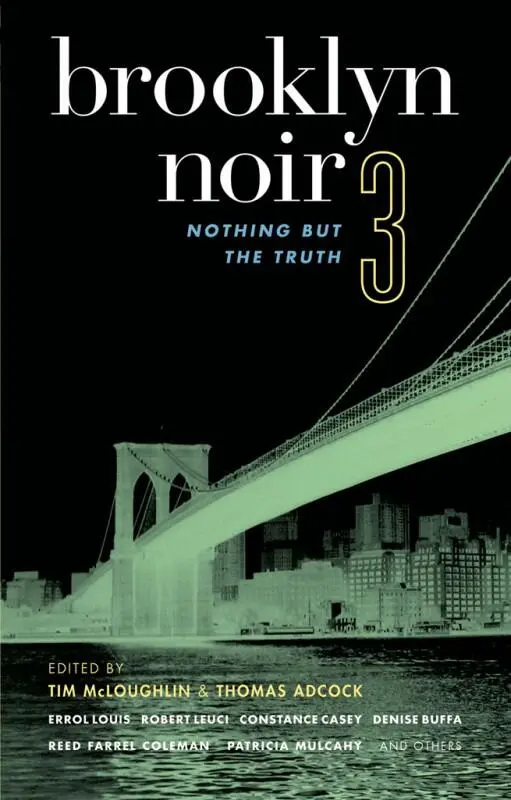
- Название:Brooklyn Noir 3: Nothing but the Truth
- Автор:
- Издательство:Akashic Books
- Жанр:
- Год:2008
- Город:New York
- ISBN:978-1-933354-14-9
- Рейтинг книги:3 / 5. Голосов: 1
-
Избранное:Добавить в избранное
- Отзывы:
-
Ваша оценка:
Brooklyn Noir 3: Nothing but the Truth: краткое содержание, описание и аннотация
Предлагаем к чтению аннотацию, описание, краткое содержание или предисловие (зависит от того, что написал сам автор книги «Brooklyn Noir 3: Nothing but the Truth»). Если вы не нашли необходимую информацию о книге — напишите в комментариях, мы постараемся отыскать её.
. This volume presents the first nonfiction collection in the series, curated by acclaimed novelists Tim McLoughlin and Thomas Adcock.
Brand-new stories by: Robert Leuci, Dennis Hawkins, Tim McLoughlin, Thomas Adcock, Errol Louis, Denise Buffa, Patricia Mulcahy, C. J. Sullivan, Reed Farrel Coleman, Aileen Gallagher, Christopher Musella, Kim Sykes, Robert Knightly, Jess Korman, Constance Casey, and Rosemarie Yu.
Brooklyn Noir 3: Nothing but the Truth — читать онлайн бесплатно полную книгу (весь текст) целиком
Ниже представлен текст книги, разбитый по страницам. Система сохранения места последней прочитанной страницы, позволяет с удобством читать онлайн бесплатно книгу «Brooklyn Noir 3: Nothing but the Truth», без необходимости каждый раз заново искать на чём Вы остановились. Поставьте закладку, и сможете в любой момент перейти на страницу, на которой закончили чтение.
Интервал:
Закладка:
Anyway, yeah, I was fifteen or sixteen. Like I said, things fade. We still had troops in Vietnam. I was working my second real job; my first with legitimate working papers. The year before I had gotten a job at the Carvel on Coney Island Avenue and Avenue Y by forging stolen working papers. So the next summer, the one I’m talking about now, I was working at Baskin-Robbins on Sheepshead Bay Road. I think I was making a buck seventy-five an hour, but in those days, one hour’s pay would’ve purchased at least three gallons of gas. A pity I wasn’t yet driving.
It was one of those scary gorgeous Brooklyn days when the sky is cloudless and endlessly blue. There was little humidity. A breeze was blowing in off the Atlantic and I could smell the ocean in the air, almost taste the salt on my tongue as I walked up Avenue Z from our tiny garden apartment on Ocean Parkway. I was at the age when a boy begins to notice the beauty in things: in the shape of a woman’s mouth, in the structure of an iris, in the way your father smiles. On most days I rode my bike to work, but that day I walked.
It’s odd now when I think of it, how walking up Avenue Z was like tracing a timeline of my early life. Although I wasn’t born there, Coney Island Hospital loomed large over the neighborhood. I tried not to notice. I hated hospitals. When I was four, my dad was diagnosed with bone cancer. He was in and out of hospitals so much that I thought the revolving door was invented to accommodate him. Next, there was the basement apartment on Z between East 6th and Hubbard Streets. It was the first place I remember. We moved three blocks away to the garden apartment when I was, like, three.
A few blocks up, there was P.S. 209 and the Avenue Z Jewish Center. P.S. 209 was built in the ’20s or ’30s, one of those beige brick behemoths that dotted the landscape of the borough. Unlike today’s user-friendly, welcoming school buildings, 209’s institutional look lent it a certain gravitas. Besides, its light brick walls were perfect for chalk stickball boxes and its prisonlike cyclone fencing made hitting a home run somewhat challenging. Though I couldn’t swear to it, I’m sure there were kids playing stickball and softball with Clinchers when I walked by that day. It was 1972 or ’73, before Metal Gear Solid 3 had replaced street games and made ghost towns of schoolyards.
Across the street was the Avenue Z Jewish Center. My zaydeh — yeah, the Ukrainian grocer from Hell’s Kitchen who had long since moved his family and business to Brooklyn — was one of the temple’s founding members, though there’s no plaque with his name on it. God, how I hated Hebrew school. During my bar mitzvah ceremony, I did my section of the Torah from memory. Judo Jack — that’s what we called our rabbi for the marshal art — like hand gestures he made during his sermons — had some sage advice for me that day.
“Coleman,” he whispered, “look at the back of my head when I speak. This way you won’t look like so much of an idiot.”
Nice, huh?
Next up was Coney Island Avenue, the unofficial borderline between Brighton Beach and Sheepshead Bay. On my side of Coney Island Avenue, the kids went to Lincoln High. Across the street, you went to Sheepshead. On my side, you went to Goody’s Luncheonette. On the other, you went to Z Cozy Corner Luncheonette. On this side of Coney Island Avenue, I had one group of friends. On the other, a different group of friends. Even at fifteen or sixteen, I thought it was weird how arbitrary and artificial borders can have such a profound effect on our lives.
So, what’s any of this got to do with anything? What does where I went to elementary school or my rabbi’s nickname or bone cancer or blue skies or roses for Bubbeh have to do with the point of this essay? Well, everything. On this day, something would happen to someone else that would change me forever, recolor my perceptions. I would have to relearn whole sections of what I thought I already knew. I would have to reexamine assumptions and presumptions and question where the borderlines were really drawn.
It happened across the border. When I headed beneath the shadow of the el, past the newsstand that had the best vanilla egg creams in Brooklyn, and I reached the bend in Sheepshead Bay Road where it turned to the water, I heard something. There was a pop, a crackle, like a firecracker, but not a firecracker. A gunshot! The wind carried it to me, a siren’s song. I followed it to its source.
Never the fastest guy in my neighborhood, it took me ten seconds to get to the post office on Jerome Avenue. At least I think it was Jerome Avenue. Like I said, things fade. A few years later, as I recall, the post office moved around the corner. But that day, in front of the old post office, there was a man. He lay on his back, head nearly in the gutter, his chest heaving, his arms and legs unmoving. I was about three feet from him, frozen.
Let me tell you what I remember about him. He wore heavy-rimmed glasses and his hair was stringy and unkempt. He was a thick man with a fat belly. He wore a short-sleeve shirt. It might have had stripes on it. I know for sure the shirt had a red spot on it where the bullet had bored into his gut. I recall thinking that there wasn’t much blood, that such a little hole couldn’t kill a human being. I was wrong. For a time, the world was deafeningly, torturously silent. I was not alone in my inability to move. The crowd around me was inert. I think we were trying to read his eyes through his glasses. Does he know he’s dying ? Or maybe we just wanted him to ask for help. It was as if we were waiting for permission to move. Simon says, help the dying man.
Finally, someone came to him, propped a sweater or newspaper — I can’t remember — under his head.
“Call a fucking ambulance, for chrissakes!”
The fat man’s chest was still heaving when the ambulance from Coney Island Hospital got there. It seemed to have taken hours. That deadly silence long broken, the crowd buzzed in my ears. I strung together a narrative out of loose bits and pieces of conversation.
The man on his back was the manager of Wolfe Motors, the Ford dealership on Coney Island Avenue and Gravesend Neck Road. He had picked up payroll cash at the bank across the street and then gone to the post office. When he emerged from the post office, a white guy, or maybe Spanish — that’s what people called Puerto Ricans then, when spic seemed inappropriate — ran up to the fat man, shot him in the belly, grabbed the mail and the money, and ran. Sometimes when I think about that day, I imagine that I caught a glimpse of him or heard his frantic footfalls as he fled. But I didn’t.
The guy’s chest stopped heaving. The ambulance men — I don’t think anyone had yet coined the term Emergency Medical Technician — tried all sorts of things to revive him, to get his chest to move even a little bit. The ambulance men lifted the fat guy onto a gurney. One put a stethoscope to his chest. The other did something that is so ingrained in my memory that I can’t imagine forgetting it, ever. He removed the fat man’s left sock.
The sock was black Banlon and thoroughly worn, most of elasticity gone. With the sock removed, the ambulance man ran a tongue depressor along the naked sole of the fat guy’s pale foot. Even in the midst of it all, I thought that tongue depressor thing was bizarre, almost medieval. I’ve since learned he was checking for something called a Babinski reflex. As it happens, newborns and dead men don’t have them. To the ambulance men, the fat guy, once declared dead, was an object, no more worthy of their attention than the crumpled sock on the sidewalk.
He lay on the stretcher wearing one sock, his shirt with the little red dot, torn open. The entrance wound, now clear to see, was tiny still. There just had to be more blood, I thought, for a man to die. But the fact remained unchanged: The man was dead. I didn’t yet have an understanding of internal bleeding or of how bullets, as they slow, chew up human tissue. When, in a daze, I left to go to work, I noticed it was still a beautiful day. The world had not stopped turning. Yet everything was different.
Читать дальшеИнтервал:
Закладка:
Похожие книги на «Brooklyn Noir 3: Nothing but the Truth»
Представляем Вашему вниманию похожие книги на «Brooklyn Noir 3: Nothing but the Truth» списком для выбора. Мы отобрали схожую по названию и смыслу литературу в надежде предоставить читателям больше вариантов отыскать новые, интересные, ещё непрочитанные произведения.



Обсуждение, отзывы о книге «Brooklyn Noir 3: Nothing but the Truth» и просто собственные мнения читателей. Оставьте ваши комментарии, напишите, что Вы думаете о произведении, его смысле или главных героях. Укажите что конкретно понравилось, а что нет, и почему Вы так считаете.