John Ruskin - The Stones of Venice, Volume 2 (of 3)
Здесь есть возможность читать онлайн «John Ruskin - The Stones of Venice, Volume 2 (of 3)» — ознакомительный отрывок электронной книги совершенно бесплатно, а после прочтения отрывка купить полную версию. В некоторых случаях можно слушать аудио, скачать через торрент в формате fb2 и присутствует краткое содержание. Жанр: foreign_antique, foreign_home, architecture_book, literature_19, visual_arts, на английском языке. Описание произведения, (предисловие) а так же отзывы посетителей доступны на портале библиотеки ЛибКат.
- Название:The Stones of Venice, Volume 2 (of 3)
- Автор:
- Жанр:
- Год:неизвестен
- ISBN:нет данных
- Рейтинг книги:5 / 5. Голосов: 1
-
Избранное:Добавить в избранное
- Отзывы:
-
Ваша оценка:
The Stones of Venice, Volume 2 (of 3): краткое содержание, описание и аннотация
Предлагаем к чтению аннотацию, описание, краткое содержание или предисловие (зависит от того, что написал сам автор книги «The Stones of Venice, Volume 2 (of 3)»). Если вы не нашли необходимую информацию о книге — напишите в комментариях, мы постараемся отыскать её.
The Stones of Venice, Volume 2 (of 3) — читать онлайн ознакомительный отрывок
Ниже представлен текст книги, разбитый по страницам. Система сохранения места последней прочитанной страницы, позволяет с удобством читать онлайн бесплатно книгу «The Stones of Venice, Volume 2 (of 3)», без необходимости каждый раз заново искать на чём Вы остановились. Поставьте закладку, и сможете в любой момент перейти на страницу, на которой закончили чтение.
Интервал:
Закладка:
§ XXIV. I said the trefoil was five or six hundred times repeated. It is so, but observe, it is hardly ever twice of the same size; and this law is studiously and resolutely observed. In the carvings a and b of the upper series, Plate III., the diminution of the leaves might indeed seem merely representative of the growth of the plant. But look at the lower: the triangles of inlaid purple marble are made much more nearly equilateral than those of white marble, into whose centres they are set, so that the leaves may continually diminish in size as the ornament descends at the sides. The reader may perhaps doubt the accuracy of the drawing on the smaller scale, but in that given larger, fig. 3, Plate IV., the angles are all measured, and the purposeful variation of width in the border therefore admits of no dispute. 14Remember how absolutely this principle is that of nature; the same leaf continually repeated, but never twice of the same size. Look at the clover under your feet, and then you will see what this Murano builder meant, and that he was not altogether a barbarian.
§ XXV. Another point I wish the reader to observe is, the importance attached to color in the mind of the designer. Note especially—for it is of the highest importance to see how the great principles of art are carried out through the whole building—that, as only the white capitals are sculptured below, only the white triangles are sculptured above. No colored triangle is touched with sculpture; note also, that in the two principal groups of the apse, given in Plate III., the centre of the group is color, not sculpture, and the eye is evidently intended to be drawn as much to the chequers of the stone, as to the intricacies of the chiselling. It will be noticed also how much more precious the lower series, which is central in the apse, is rendered, than the one above it in the plate, which flanks it: there is no brick in the lower one, and three kinds of variegated marble are used in it, whereas the upper is composed of brick, with black and white marble only; and lastly—for this is especially delightful—see how the workman made his chiselling finer where it was to go with the variegated marbles, and used a bolder pattern with the coarser brick and dark stone. The subtlety and perfection of artistical feeling in all this are so redundant, that in the building itself the eye can rest upon this colored chain with the same kind of delight that it has in a piece of the embroidery of Paul Veronese.
Fig. II.
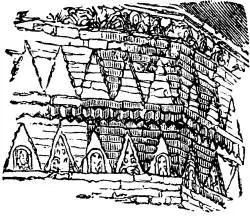
§ XXVI. Such being the construction of the lower band, that of the upper is remarkable only for the curious change in its proportions. The two are separated, as seen in the little woodcut here at the side, by a string-course composed of two layers of red bricks, of which the uppermost projects as a cornice, and is sustained by an intermediate course of irregular brackets, obtained by setting the thick yellow bricks edgeways, in the manner common to this day. But the wall above is carried up perpendicularly from this projection, so that the whole upper band is advanced to the thickness of a brick over the lower one. The result of this is, of course, that each side of the apse is four or five inches broader above than below; so that the same number of triangles which filled a whole side of the lower band, leave an inch or two blank at each angle in the upper. This would have looked awkward, if there had been the least appearance of its being an accidental error; so that, in order to draw the eye to it, and show that it is done on purpose, the upper triangles are made about two inches higher than the lower ones, so as to be much more acute in proportion and effect, and actually to look considerably narrower, though of the same width at the base. By this means they are made lighter in effect, and subordinated to the richly decorated series of the lower band, and the two courses, instead of repeating, unite with each other, and become a harmonious whole.
V.
Archivolt in the Duomo of Murano.
In order, however, to make still more sure that this difference in the height of the triangles should not escape the eye, another course of plain bricks is added above their points, increasing the width of the band by another two inches. There are five courses of bricks in the lower band, and it measures 1 ft. 6 in. in height: there are seven courses in the upper (of which six fall between the triangles), and it measures 1 ft. 10 in. in height, except at the extremity of the northern aisle, where for some mysterious reason the intermediate cornice is sloped upwards so as to reduce the upper triangles to the same height as those below. And here, finally, observe how determined the builder was that the one series should not be a mere imitation of the other; he could not now make them acute by additional height—so he here, and here only, narrowed their bases , and we have seven of them above, to six below.
§ XXVII. We come now to the most interesting portion of the whole east end, the archivolt at the end of the northern aisle.
It was above stated, that the band of triangles was broken by two higher arches at the ends of the aisles. That, however, on the northern side of the apse does not entirely interrupt, but lifts it, and thus forms a beautiful and curious archivolt, drawn opposite, in Plate V.The upper band of triangles cannot rise together with the lower, as it would otherwise break the cornice prepared to receive the second story; and the curious zigzag with which its triangles die away against the sides of the arch, exactly as waves break upon the sand, is one of the most curious features in the structure.
It will be also seen that there is a new feature in the treatment of the band itself when it turns the arch. Instead of leaving the bricks projecting between the sculptured or colored stones, reversed triangles of marble are used, inlaid to an equal depth with the others in the brickwork, but projecting beyond them so as to produce a sharp dark line of zigzag at their junctions. Three of these supplementary stones have unhappily fallen out, so that it is now impossible to determine the full harmony of color in which they were originally arranged. The central one, corresponding to the keystone in a common arch, is, however, most fortunately left, with two lateral ones on the right hand, and one on the left.
§ XXVIII. The keystone, if it may be so called, is of white marble, the lateral voussoirs of purple; and these are the only colored stones in the whole building which are sculptured; but they are sculptured in a way which, more satisfactorily proves that the principle above stated was understood by the builders, than if they had been left blank. The object, observe, was to make the archivolt as rich as possible; eight of the white sculptured marbles were used upon it in juxtaposition. Had the purple marbles been left altogether plain, they would have been out of harmony with the elaboration of the rest. It became necessary to touch them with sculpture as a mere sign of carefulness and finish, but at the same time destroying their colored surface as little as possible. The ornament is merely outlined upon them with a fine incision , as if it had been etched out on their surface preparatory to being carved. In two of them it is composed merely of three concentric lines, parallel with the sides of the triangle; in the third, it is a wreath of beautiful design, which I have drawn of larger size in fig. 2, Plate V., that the reader may see how completely the surface is left undestroyed by the delicate incisions of the chisel, and may compare the method of working with that employed on the white stones, two of which are given in that plate, figs. 4 and 5. The keystone, of which we have not yet spoken, is the only white stone worked with the light incision; its design not being capable of the kind of workmanship given to the floral ornaments, and requiring either to be carved in complete relief, or left as we see it. It is given at fig. 1 of Plate IV.The sun and moon on each side of the cross are, as we shall see in the fifth Chapter, constantly employed on the keystones of Byzantine arches.
Читать дальшеИнтервал:
Закладка:
Похожие книги на «The Stones of Venice, Volume 2 (of 3)»
Представляем Вашему вниманию похожие книги на «The Stones of Venice, Volume 2 (of 3)» списком для выбора. Мы отобрали схожую по названию и смыслу литературу в надежде предоставить читателям больше вариантов отыскать новые, интересные, ещё непрочитанные произведения.






Обсуждение, отзывы о книге «The Stones of Venice, Volume 2 (of 3)» и просто собственные мнения читателей. Оставьте ваши комментарии, напишите, что Вы думаете о произведении, его смысле или главных героях. Укажите что конкретно понравилось, а что нет, и почему Вы так считаете.