John Ruskin - The Stones of Venice, Volume 2 (of 3)
Здесь есть возможность читать онлайн «John Ruskin - The Stones of Venice, Volume 2 (of 3)» — ознакомительный отрывок электронной книги совершенно бесплатно, а после прочтения отрывка купить полную версию. В некоторых случаях можно слушать аудио, скачать через торрент в формате fb2 и присутствует краткое содержание. Жанр: foreign_antique, foreign_home, architecture_book, literature_19, visual_arts, на английском языке. Описание произведения, (предисловие) а так же отзывы посетителей доступны на портале библиотеки ЛибКат.
- Название:The Stones of Venice, Volume 2 (of 3)
- Автор:
- Жанр:
- Год:неизвестен
- ISBN:нет данных
- Рейтинг книги:5 / 5. Голосов: 1
-
Избранное:Добавить в избранное
- Отзывы:
-
Ваша оценка:
The Stones of Venice, Volume 2 (of 3): краткое содержание, описание и аннотация
Предлагаем к чтению аннотацию, описание, краткое содержание или предисловие (зависит от того, что написал сам автор книги «The Stones of Venice, Volume 2 (of 3)»). Если вы не нашли необходимую информацию о книге — напишите в комментариях, мы постараемся отыскать её.
The Stones of Venice, Volume 2 (of 3) — читать онлайн ознакомительный отрывок
Ниже представлен текст книги, разбитый по страницам. Система сохранения места последней прочитанной страницы, позволяет с удобством читать онлайн бесплатно книгу «The Stones of Venice, Volume 2 (of 3)», без необходимости каждый раз заново искать на чём Вы остановились. Поставьте закладку, и сможете в любой момент перейти на страницу, на которой закончили чтение.
Интервал:
Закладка:
§ XVIII. But the feature which is most to be noted in this apse is a band of ornament, which runs round it like a silver girdle, composed of sharp wedges of marble, preciously inlaid, and set like jewels into the brickwork; above it there is another band of triangular recesses in the bricks, of nearly similar shape, and it seems equally strange that all the marbles should have fallen from it, or that it should have been originally destitute of them. The reader may choose his hypothesis; but there is quite enough left to interest us in the lower band, which is fortunately left in its original state, as is sufficiently proved by the curious niceties in the arrangement of its colors, which are assuredly to be attributed to the care of the first builder. A word or two, in the first place, respecting the means of color at his disposal.
§ XIX. I stated that the building was, for the most part, composed of yellow brick. This yellow is very nearly pure, much more positive and somewhat darker than that of our English light brick, and the material of the brick is very good and hard, looking, in places, almost vitrified, and so compact as to resemble stone. Together with this brick occurs another of a deep full red, and more porous substance, which is used for decoration chiefly, while all the parts requiring strength are composed of the yellow brick. Both these materials are cast into any shape and size the builder required, either into curved pieces for the arches, or flat tiles for filling the triangles; and, what is still more curious, the thickness of the yellow bricks used for the walls varies considerably, from two inches to four; and their length also, some of the larger pieces used in important positions being a foot and a half long.
With these two kinds of brick, the builder employed five or six kinds of marble: pure white, and white veined with purple; a brecciated marble of white and black; a brecciated marble of white and deep green; another, deep red, or nearly of the color of Egyptian porphyry; and a grey and black marble, in fine layers.
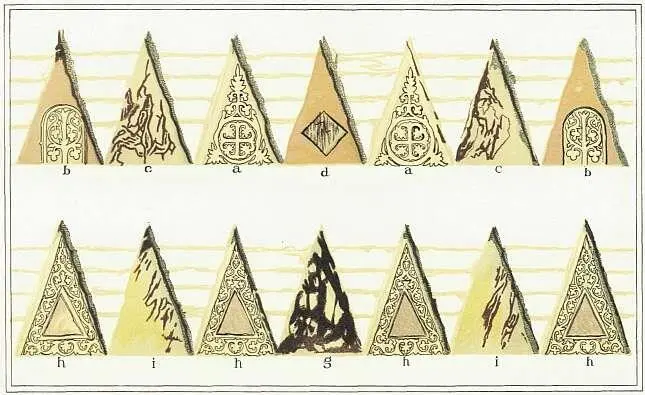
§ XX. The method of employing these materials will be understood at once by a reference to the opposite plate ( Plate III.), which represents two portions of the lower band. I could not succeed in expressing the variation and chequering of color in marble, by real tints in the print; and have been content, therefore, to give them in line engraving. The different triangles are, altogether, of ten kinds:
a. Pure white marble with sculptured surface (as the third and fifth in the upper series of Plate III.).
b. Cast triangle of red brick with a sculptured round-headed piece of white marble inlaid (as the first and seventh of the upper series, Plate III.).
c. A plain triangle of greenish black marble, now perhaps considerably paler in color than when first employed (as the second and sixth of the upper series of Plate III.).
d. Cast red brick triangle, with a diamond inlaid of the above-mentioned black marble (as the fourth in the upper series of Plate III.).
e. Cast white brick, with an inlaid round-headed piece of marble, variegated with black and yellow, or white and violet (not seen in the plate).
f. Occurs only once, a green-veined marble, forming the upper part of the triangle, with a white piece below.
g. Occurs only once. A brecciated marble of intense black and pure white, the centre of the lower range in Plate III.
h. Sculptured white marble with a triangle of veined purple marble inserted (as the first, third, fifth, and seventh of the lower range in Plate III.).
i. Yellow or white marble veined with purple (as the second and sixth of the lower range in Plate III.).
k. Pure purple marble, not seen in this plate.
III.
Inlaid Bands of Murano.
§ XXI. The band, then, composed of these triangles, set close to each other in varied but not irregular relations, is thrown, like a necklace of precious stones, round the apse and along the ends of the aisles; each side of the apse taking, of course, as many triangles as its width permits. If the reader will look back to the measures of the sides of the apse, given before, p. 42, he will see that the first and seventh of the series, being much narrower than the rest, cannot take so many triangles in their band. Accordingly, they have only six each, while the other five sides have seven. Of these groups of seven triangles each, that used for the third and fifth sides of the apse is the uppermost in Plate III.; and that used for the centre of the apse, and of the whole series, is the lowermost in the same plate; the piece of black and white marble being used to emphasize the centre of the chain , exactly as a painter would use a dark touch for a similar purpose.
§ XXII. And now, with a little trouble, we can set before the reader, at a glance, the arrangement of the groups along the entire extremity of the church.
There are thirteen recesses, indicative of thirteen arches, seen in the ground plan, fig. 2, Plate I.Of these, the second and twelfth arches rise higher than the rest; so high as to break the decorated band; and the groups of triangles we have to enumerate are, therefore, only eleven in number; one above each of the eleven low arches. And of these eleven, the first and second, tenth and eleventh, are at the ends of the aisles; while the third to the ninth, inclusive, go round the apse. Thus, in the following table, the numerals indicate the place of each entire group (counting from the south to the north side of the church, or from left to right), and the letters indicate the species of triangle of which it is composed, as described in the list given above.

The central group is put first, that it may be seen how the series on the two sides of the apse answer each other. It was a very curious freak to insert the triangle e, in the outermost place but one of both the fourth and eighth sides of the apse, and in the outermost but two in the third and ninth; in neither case having any balance to it in its own group, and the real balance being only effected on the other side of the apse, which it is impossible that any one should see at the same time. This is one of the curious pieces of system which so often occur in mediæval work, of which the key is now lost. The groups at the ends of the transepts correspond neither in number nor arrangement; we shall presently see why, but must first examine more closely the treatment of the triangles themselves, and the nature of the floral sculpture employed upon them.
IV.
SCULPTURES OF MURANO.
§ XXIII. As the scale of Plate III.is necessarily small, I have given three of the sculptured triangles on a larger scale in Plate IV.opposite. Fig. 3 is one of the four in the lower series of Plate IV., and figs. 4 and 5 from another group. The forms of the trefoils are here seen more clearly; they, and all the other portions of the design, are thrown out in low and flat relief, the intermediate spaces being cut out to the depth of about a quarter of an inch. I believe these vacant spaces were originally filled with a black composition, which is used in similar sculptures at St. Mark’s, and of which I found some remains in an archivolt moulding here, though not in the triangles. The surface of the whole would then be perfectly smooth, and the ornamental form relieved by a ground of dark grey; but, even though this ground is lost, the simplicity of the method insures the visibility of all its parts at the necessary distance (17 or 18 feet), and the quaint trefoils have a crispness and freshness of effect which I found it almost impossible to render in a drawing. Nor let us fail to note in passing how strangely delightful to the human mind the trefoil always is. We have it here repeated five or six hundred times in the space of a few yards, and yet are never weary of it. In fact, there are two mystical feelings at the root of our enjoyment of this decoration: the one is the love of trinity in unity, the other that of the sense of fulness with order; of every place being instantly filled, and yet filled with propriety and ease; the leaves do not push each other, nor put themselves out of their own way, and yet whenever there is a vacant space, a leaf is always ready to step in and occupy it.
Читать дальшеИнтервал:
Закладка:
Похожие книги на «The Stones of Venice, Volume 2 (of 3)»
Представляем Вашему вниманию похожие книги на «The Stones of Venice, Volume 2 (of 3)» списком для выбора. Мы отобрали схожую по названию и смыслу литературу в надежде предоставить читателям больше вариантов отыскать новые, интересные, ещё непрочитанные произведения.






Обсуждение, отзывы о книге «The Stones of Venice, Volume 2 (of 3)» и просто собственные мнения читателей. Оставьте ваши комментарии, напишите, что Вы думаете о произведении, его смысле или главных героях. Укажите что конкретно понравилось, а что нет, и почему Вы так считаете.