William Trevor - After Rain
Здесь есть возможность читать онлайн «William Trevor - After Rain» весь текст электронной книги совершенно бесплатно (целиком полную версию без сокращений). В некоторых случаях можно слушать аудио, скачать через торрент в формате fb2 и присутствует краткое содержание. Год выпуска: 0101, Жанр: Старинная литература, на английском языке. Описание произведения, (предисловие) а так же отзывы посетителей доступны на портале библиотеки ЛибКат.
- Название:After Rain
- Автор:
- Жанр:
- Год:0101
- ISBN:нет данных
- Рейтинг книги:3 / 5. Голосов: 1
-
Избранное:Добавить в избранное
- Отзывы:
-
Ваша оценка:
After Rain: краткое содержание, описание и аннотация
Предлагаем к чтению аннотацию, описание, краткое содержание или предисловие (зависит от того, что написал сам автор книги «After Rain»). Если вы не нашли необходимую информацию о книге — напишите в комментариях, мы постараемся отыскать её.
After Rain — читать онлайн бесплатно полную книгу (весь текст) целиком
Ниже представлен текст книги, разбитый по страницам. Система сохранения места последней прочитанной страницы, позволяет с удобством читать онлайн бесплатно книгу «After Rain», без необходимости каждый раз заново искать на чём Вы остановились. Поставьте закладку, и сможете в любой момент перейти на страницу, на которой закончили чтение.
Интервал:
Закладка:
It had been finally arranged that the marriage should take place in London, she reads in the trattoria. There were certainly many reasons which would have made a marriage from Courcy Castle more convenient. The De Courcy family were all assembled at their country family residence, and could therefore have been present at the ceremony without cost or trouble. She isn’t hungry; she has ordered risotto, hoping it will be small, and mineral water without gas.
‘C’è del pane o della farina nel piatto? Non devo mangiare della farina,’ a woman is saying, and the gaunt-faced waiter carefully listens, not understanding at first and then excitedly nodding. ‘Non c’è farina,’ he replies, pointing at items on the menu. The woman is from the pensione. She’s with a lanky young man who might be her son, and Harriet can’t identify the language they speak to one another.
‘Is fine?’ the same waiter asks Harriet as he passes, noticing that she has begun to eat her risotto. She nods and smiles and reads again. The rain outside is heavy now.
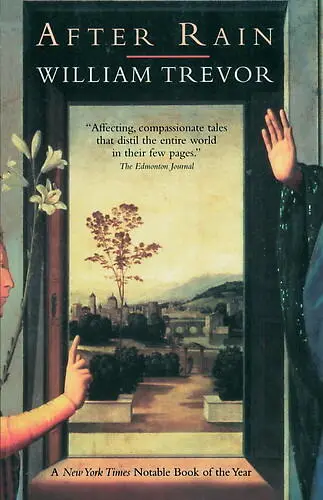
The Annunciation in the church of Santa Fabiola is by an unknown artist, perhaps of the school of Filippo Lippi, no one is certain. The angel kneels, grey wings protruding, his lily half hidden by a pillar. The floor is marble, white and green and ochre. The Virgin looks alarmed, right hand arresting her visitor’s advance. Beyond — background to the encounter — there are gracious arches, a balustrade and then the sky and hills. There is a soundlessness about the picture, the silence of a mystery: no words are spoken in this captured moment, what’s said between the two has been said already.
Harriet’s eye records the details: the green folds of the angel’s dress, the red beneath it, the mark in the sky that is a dove, the Virgin’s book, the stately pillars and the empty vase, the Virgin’s slipper, the bare feet of the angel. The distant landscape is soft, as if no heat has ever touched it. It isn’t alarm in the Virgin’s eyes, it’s wonderment. In another moment there’ll be serenity. A few tourists glide about the church, whispering now and again. A man in a black overall is mopping the floor of the central aisle and has roped it off at either end. An elderly woman prays before a statue of the Virgin, each bead of her rosary fingered, lips silently murmuring. Incense is cloying on the air.
Harriet walks slowly past flaring candles and the tomb of a local family, past the relics of the altar, and the story of Santa Fabiola flaking in a side chapel. She has not been in this church before, neither during her present visit nor in the past. Her parents didn’t bother much with churches; she might have come here on her own yesterday or on any day of her stay but she didn’t bother either. Her parents liked the sun in the garden of the pensione, the walk down to the cafés and drives into the hills or to other little towns, to the swimming-pool at Ponte Nicolo.
The woman who has been praying hobbles to light another candle, then prays again, and hobbles off. Returning to the Annunciation, Harriet sits down in the pew that’s nearest it. There is blue as well as grey in the wings of the angel, little flecks of blue you don’t notice when you look at first. The Virgin’s slipper is a shade of brown, the empty vase is bulb-shaped with a slender stem, the Virgin’s book had gold on it but only traces remain.
The rain has stopped when Harriet leaves the church, the air is fresher. Too slick and glib, to use her love affairs to restore her faith in love: that thought is there mysteriously. She has cheated in her love affairs: that comes from nowhere too.
Harriet stands a moment longer, alone on the steps of the church, bewildered by this personal revelation, aware instinctively of its truth. The dust of the piazza paving has been washed into the crevices that separate the stones. At the café where she had her cappuccino the waiter is wiping dry the plastic of the chairs.
The sun is still reluctant in the watery sky. On her walk back to the Pensione Cesarina it seems to Harriet that in this respite from the brash smother of heat a different life has crept out of the foliage and stone. A coolness emanates from the road she walks on. Unseen, among the wild geraniums, one bird sings.
Tomorrow, when the sun is again in charge at its time of year, a few midday minutes will wipe away what lingers of this softness. New dust will settle, marble will be warm to touch. Weeks it may be, months perhaps, before rain coaxes out these fragrances that are tender now.
The sun is always pitiless when it returns, harsh in its punishment. In the dried-out garden of the Pensione Cesarina they made her wear a hat she didn’t like but they could take the sun themselves, both of them skulking behind dark glasses and high-factor cream. Skyros’s sun is its attraction. ‘What I need is sun,’ he said, and Harriet wonders if he went there after all, if he’s there today, not left behind in London, if he even found someone to go with. She sees him in Skyros, windsurfing in Atsitsa Bay, which he has talked about. She sees him with a companion who is uncomplicated and happy in Atsitsa Bay, who tries out a therapy just to see what it’s like.
The deck-chairs are sodden at the Pensione Cesarina, rose petals glisten. A glass left on a terrace table has gathered an inch of water. The umbrellas in the outer hall have all been used. Windows, closed for a while, are opened; on the vineyard slopes the sprinklers are turned on again.
Not wanting to be inside, Harriet walks in the garden and among the vines, her shoes drenched. From the town comes the chiming of bells: six o’clock at Santa Fabiola, six o’clock a minute later somewhere else. While she stands alone among the dripping vines she cannot make a connection that she knows is there. There
is a blankness in her thoughts, a density that feels like muddle also, until she realizes: the Annunciation was painted after rain. Its distant landscape, glimpsed through arches, has the temporary look that she is seeing now. It was after rain that the angel came: those first cool moments were a chosen time.
In the dining-room the table where the man with the garish shirts sat has been joined to a family table to allow for a party of seven. There is a different woman where the smart Frenchwoman sat, and no one at the table of the old man. The woman who was explaining in the trattoria that she must not eat food containing flour is given consommé instead of ravioli. New faces are dotted everywhere.
‘Buona sera,’ the rust-haired waitress greets Harriet, and the waitress with glasses brings her salad.
‘Grazie,’ Harriet murmurs.
‘Prego, signora.’
She pours her wine, breaks off a crust of bread. It’s noisy in the dining-room now, dishes clattering, the babble of voices. It felt like noise in the foyer of the Rembrandt Cinema when he told her: the uproar of shock, although in fact it was quite silent there. Bright, harsh colours flashed through her consciousness, as if some rush of blood exploded in a kaleidoscope of distress. For a moment in the foyer of the cinema she closed her eyes, as she had when they told her they weren’t to be a family any more.
She might have sent them postcards, but she hasn’t. She might have reported that breakfast at the pensione is more than coffee and rolls since the Germans and the Dutch and the Swiss have begun to come: cheese and cold meats, fruit and cereals, fresh sponge cake, a buffet on the terrace. Each morning she has sat there reading The Small House at Allington, wondering if they would like to know of the breakfast-time improvement. She wondered today if it would interest them to learn that the abandoned petrol pumps are still there on the road to the town, or that she sat in the deserted park beneath the chestnut trees. She thought of sending him a postcard too, but in the end she didn’t. His predecessor it was who encouraged her to bring long novels on holiday, The Tenant of Wildfell Hall, The Mill on the Floss.
Читать дальшеИнтервал:
Закладка:
Похожие книги на «After Rain»
Представляем Вашему вниманию похожие книги на «After Rain» списком для выбора. Мы отобрали схожую по названию и смыслу литературу в надежде предоставить читателям больше вариантов отыскать новые, интересные, ещё непрочитанные произведения.




Обсуждение, отзывы о книге «After Rain» и просто собственные мнения читателей. Оставьте ваши комментарии, напишите, что Вы думаете о произведении, его смысле или главных героях. Укажите что конкретно понравилось, а что нет, и почему Вы так считаете.