William Trevor - After Rain
Здесь есть возможность читать онлайн «William Trevor - After Rain» весь текст электронной книги совершенно бесплатно (целиком полную версию без сокращений). В некоторых случаях можно слушать аудио, скачать через торрент в формате fb2 и присутствует краткое содержание. Год выпуска: 0101, Жанр: Старинная литература, на английском языке. Описание произведения, (предисловие) а так же отзывы посетителей доступны на портале библиотеки ЛибКат.
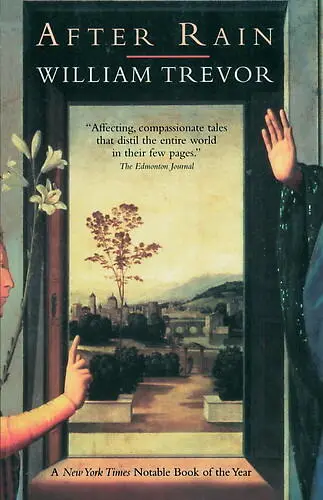
- Название:After Rain
- Автор:
- Жанр:
- Год:0101
- ISBN:нет данных
- Рейтинг книги:3 / 5. Голосов: 1
-
Избранное:Добавить в избранное
- Отзывы:
-
Ваша оценка:
After Rain: краткое содержание, описание и аннотация
Предлагаем к чтению аннотацию, описание, краткое содержание или предисловие (зависит от того, что написал сам автор книги «After Rain»). Если вы не нашли необходимую информацию о книге — напишите в комментариях, мы постараемся отыскать её.
After Rain — читать онлайн бесплатно полную книгу (весь текст) целиком
Ниже представлен текст книги, разбитый по страницам. Система сохранения места последней прочитанной страницы, позволяет с удобством читать онлайн бесплатно книгу «After Rain», без необходимости каждый раз заново искать на чём Вы остановились. Поставьте закладку, и сможете в любой момент перейти на страницу, на которой закончили чтение.
Интервал:
Закладка:
‘This is disgusting!’ Rebecca cried, bursting into the room again.
Gerard sat up. He asked her what she was doing here.
‘A cleaner let me in. She said I’d find you on the office floor.’
‘You’d better go,’ Gerard muttered quietly to his pretend companion, pushing himself to his feet.
‘I’ve known for ages.’ Real tears spread on Rebecca’s rounded cheeks. Quite a gush she managed. She’d always been good at real tears.
‘I’m sorry.’
‘Sorry, my God!’
‘I know.’
‘She forgot her panties. She left her panties by the wastepaper basket when she scurried out.’
‘Look -’
‘She’s on the street without her panties. Some man on the tube -’
‘Look, don’t be bitter.’
‘Why not? Why shouldn’t I be whatever I want to be? Isn’t anything my due? You were down there on the floor with a second-class tart and you expect me to be like the Virgin Mary.’
‘I do not expect you to be like anyone.’
‘You want me to share you with her, is that it? What a jolliness!’
‘Look -’
‘Oh, don’t keep saying look.’
Rebecca’s real tears came in a torrent now, dribbling on to a grey cardigan, reddening her eyes.
‘I’d better go after her,’ Gerard said, picking up, in pantomime, a garment from the floor.
The baby was born, a girl. The black-haired Frenchwoman moved in with Gerard’s father. One Sunday evening Rebecca said:
‘She wants me back.’
That day had been spent trailing round flats that were to rent. Each time they entered one Rebecca’s mother told whoever was showing them around that she worked in the theatre, and mentioned actresses and actors by name. Afterwards, in the bedsitting-room, she said her new life in the theatre had helped her to pull herself together. She said she felt a strength returning. She intended to take the alimony. She saw it differently now: the alimony was her due.
‘So are you, dear,’ she said. If there was difficulty, a court of law would put the matter right, no doubt about that: a child goes to the mother if the mother’s fit and well.
‘What did you say?’ Gerard asked.
‘Nothing.’
‘Not that you’d rather be here?’
‘No.’
‘Would you rather be here, Rebecca?’
‘Yes.’
Gerard was silent. He looked away.
‘I couldn’t say it,’ Rebecca said.
‘I see you couldn’t.’
‘She’s my mother,’ Rebecca said.
‘Yes, I know.’
A week ago they had been angry together because unhappiness had made her mother foolish. A week ago Gerard said his father had reverted to something like his old self, his legs stuck out while he read the newspaper. But it was far from being the same as it had been. His father reading the newspaper like that was only a reminder.
Rebecca’s real tears began, and when the sound of sobbing ceased there was silence in the room they had made their own. Gerard wanted to comfort her, as once his father had comforted his mother, saying he forgave her, saying they would try again. But their game wouldn’t stretch to that.
They sat on the virgin floor, some distance away from one another, while the white shafts of sunlight faded and the washed-out yellow of the walls dimmed to nothing. Their thoughts were similar and they knew they were. The house that had been Rebecca’s would be Gerard’s because that was laid down now. Rebecca would come to it at weekends because her father was there, but she would not bring with her her mother’s sad tales of the theatre, nor would Gerard relate the latest from his father’s new relation ship. The easy companionship that had allowed them to sip cocktails and sign the register of the Hotel Grand Splendide had been theirs by chance, a gift thrown out from other people’s circumstances. Helplessness was their natural state.
A Bit of Business
On a warm Saturday morning the city was deserted. Its suburbs dozed, its streets had acquired a tranquillity that did not belong to the hour. Shops and cafés were unexpectedly closed. Where there were people, they sat in front of television sets, or listened to transistors.
In Westmoreland Street two youths hurried, their progress marked by a businesslike air. They did not speak until they reached St Stephen’s Green. ‘No. On ahead,’ one said when his companion paused. ‘Off to the left in Harcourt Street.’ His companion did not argue.
They had been friends since childhood; and today, their purpose being what it was, they knew better than to argue. Argument wasted time, and would distract them. The one who’d given the instruction, the older and taller of the two, was Mangan. The other was a pock-marked, sallow youth known as Lout Gallagher, the sobriquet an expression of scorn on the part of a Christian Brother ten or so years ago. Mangan had gelled short hair, nondescript as to colour, and small eyes that squinted slightly, and a flat, broad nose. ‘Here,’ he commanded at the end of Harcourt Street, and the two veered off in the direction he indicated.
A marmalade cat sauntered across the street they were in now; no one was about. ‘The blue Ford,’ Mangan said. Gallagher, within seconds, forced open the driver’s door. As swiftly, the bonnet of the car was raised. Work was done with wire; the engine started easily.
In the suburb of Rathgar, in Cavendish Road, Mr. Livingston watched the red helicopter touch down behind the vesting tents in Phoenix Park. Earlier, at the airport, the Pope’s right hand had been raised in blessing, lowered, and then raised again and again, a benign smile accompanying each gesture. In Phoenix Park the crowds knelt in their corrals, and sang ‘Holy God, We Praise Thy Name’. Now and again the cameras caught the black dress of clergymen and nuns, but for the most part the crowds were composed of the kind of people Mr. Livingston met every day on the streets or noticed going to Mass on a Sunday. The crowds were orderly, awed by the occasion. The yellow and white papal flags fluttered everywhere; occasionally a degree of shoving developed in an effort to gain a better view. Four times already the cameras had shown women fainting — from marvelling, so Mr. Livingston was given to understand, rather than heat or congestion. Somewhere in Phoenix Park were the Herlihys, but so far Mr. Livingston had failed to identify them. ‘I’ll wave,’ the Herlihy twins had promised, speaking in unison as they always did. Mr. Livingston knew they’d forget; in all the excitement they wouldn’t even know that a camera had skimmed over them. It was Herlihy himself who would be noticeable, being so big and his red hair easy to pick out. Monica, of course, you could miss.
Mr. Livingston, attired now in a dark-blue suit, was a thin man in his sixties, only just beginning to go grey. His lean features, handsome in youth, were affected by wrinkles, his cheeks a little flushed. He had been a widower for a year.
Preceded by Cardinal Ó Fiaich and Archbishop Ryan, the Pope emerged from the papal vesting chamber under the podium. Cheering began in the corrals. Twice the Pope stopped and extended his arms. There was cheering then such as Mr. Livingston had never in his life heard before. The Pope approached the altar. Mangan and Gallagher worked quickly, though with no great skill. They pulled open drawers and scattered their contents. They rooted among clothes, and wrenched at the locks of cupboards. Jewellery was not examined, since its worth could not be even roughly estimated. All they found they pocketed, with loose change and notes. A transistor radio was secreted beneath Gallagher’s jacket.
‘Nothing else,’ Mangan said. ‘Useless damn place.’
They left the house that they had entered, through a kitchen window. They strolled towards the parked blue Ford, Mangan shaking his head as though, having arrived at the house on legitimate business, they disappointedly failed to find anyone at home. Gallagher drove, slowly in the road where the house was, and then more rapidly. ‘Off to the left,’ Mangan said, and when the opportunity came Gallagher did as he was bidden. The car drew up again; the two remained seated, both their glances fixed on the driving mirror. ‘OK,’ Mangan said.
Читать дальшеИнтервал:
Закладка:
Похожие книги на «After Rain»
Представляем Вашему вниманию похожие книги на «After Rain» списком для выбора. Мы отобрали схожую по названию и смыслу литературу в надежде предоставить читателям больше вариантов отыскать новые, интересные, ещё непрочитанные произведения.







Обсуждение, отзывы о книге «After Rain» и просто собственные мнения читателей. Оставьте ваши комментарии, напишите, что Вы думаете о произведении, его смысле или главных героях. Укажите что конкретно понравилось, а что нет, и почему Вы так считаете.