Doreen Tovey - Donkey Work
Здесь есть возможность читать онлайн «Doreen Tovey - Donkey Work» весь текст электронной книги совершенно бесплатно (целиком полную версию без сокращений). В некоторых случаях можно слушать аудио, скачать через торрент в формате fb2 и присутствует краткое содержание. Год выпуска: 2013, Издательство: Summersdale Publishers Ltd, Жанр: Старинная литература, на английском языке. Описание произведения, (предисловие) а так же отзывы посетителей доступны на портале библиотеки ЛибКат.
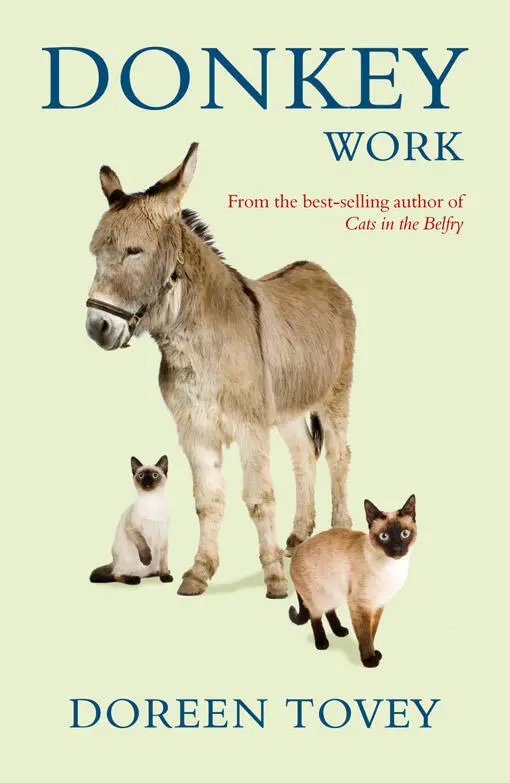
- Название:Donkey Work
- Автор:
- Издательство:Summersdale Publishers Ltd
- Жанр:
- Год:2013
- ISBN:нет данных
- Рейтинг книги:3 / 5. Голосов: 1
-
Избранное:Добавить в избранное
- Отзывы:
-
Ваша оценка:
Donkey Work: краткое содержание, описание и аннотация
Предлагаем к чтению аннотацию, описание, краткое содержание или предисловие (зависит от того, что написал сам автор книги «Donkey Work»). Если вы не нашли необходимую информацию о книге — напишите в комментариях, мы постараемся отыскать её.
Donkey Work — читать онлайн бесплатно полную книгу (весь текст) целиком
Ниже представлен текст книги, разбитый по страницам. Система сохранения места последней прочитанной страницы, позволяет с удобством читать онлайн бесплатно книгу «Donkey Work», без необходимости каждый раз заново искать на чём Вы остановились. Поставьте закладку, и сможете в любой момент перейти на страницу, на которой закончили чтение.
Интервал:
Закладка:
It was a good thing she was one of the family. What anyone else would have said – to be turned out of bed at daybreak on Boxing Morning while we marched in with an earth-box and Solomon seated himself with a reproachful wail that it was all her fault and how'd she like it if somebody slept in her bathroom when she wanted to use it – I cannot think. As it was, we all went down for a cup of tea, ten minutes later there was a howl at which we leapt for the hall thinking that at the very least Solomon had turned himself inside out – and there he was coming down the stairs. All Right Now, he advised us, with a lighthearted spring at Sheba by way of celebration. Anybody for Breakfast? he roared, taking up position by the refrigerator.
Which was all very well, but after that we were exhausted. We lay in chairs most of the morning recovering our nerves. By the time the van came to take Annabel and us to the entertainment Charles hadn't done any practising at all at being an Arab and we were still half asleep on our feet. Which was how Charles came to be kicked.
I held our little donkey at the guest house while Charles put on his costume. Annabel, when Charles strode billowingly from the changing room looking like the Red Shadow, got the wind up and said – too late I remembered she didn't like white things – that he was a Ghost. Charles said Come on, Annabel, not to be silly. Annabel said she wasn't silly, he was a Ghost and she was going to kick him. Charles, half asleep and incommoded by the trailing sheets, didn't jump fast enough. And when she caught him on the shinbone he yelled louder than Solomon.
We let her go after that. She roamed amiably around the room among the guests. Ate enough tea for six. Stood winsomely at the foot of the maypole with mistletoe behind her ears while the children danced around it and everybody sighed and wished for cameras. Wonderfully tame, our little donkey, said a visitor, coming over to where, with Charles still soulfully rubbing his shin, we waited by the sideline. He expected we were fond of her. What, he enquired, gazing interestedly at Charles's get-up, was he supposed to be? A Druid?
Our major Christmas adventure was yet to come, however. Two nights later, with a mist lying low over the valley and the trees dripping wetly in the darkness, we woke around four o'clock in the morning to hear a car outside our gate. It stopped, waited for a while, turned and went back up again. An unusual occurrence at that hour in our isolated part of the world, and doubly so when half an hour later what was apparently the same car drove at top speed down the hill, passed the cottage, and jolted on up the lane. When a few minutes later there was a thud as the car went into the ditch, followed immediately by a frantic whirring of the back wheels as somebody tried to get it out again, we were even more perturbed.
I, quite frankly, was scared practically rigid. Charles was for going up to see what it was – armed, he assured me, with a tyre lever – but I wasn't having any. Supposing it was a desperado, I said. Somebody having committed a bank robbery, for instance. Trying to get away into the hills, for nobody would go rattling up an isolated track at four in the morning for any normal reason. The man wasn't injured otherwise he wouldn't be trying to get the car out. On the other hand, why was he trying so frantically to get it out himself instead of coming to ask for help? I, I said determinedly, was going to call the police.
It is surprising how clearly one's mind works in an emergency. Like a member of MI5 I felt, creeping down the stairs in the darkness (better not to show a light); sitting with the telephone on the hall floor (sometimes they shoot at one through windows); dialling 999. That was a bit difficult because I couldn't, what with the darkness and my trembling like an aspen, remember which end of the dial the 9 was, but I got it in the end. Whispered my message into the mouthpiece and received instructions not to go out of doors on any account; they'd be with us as soon as possible...
The driver was still reversing hysterically when I went back to the window. It was a nerve-racking business, keeping watch through the swirling mist. I jumped like a grasshopper when there was a scuffling sound from the spare room but it was only the cats, disturbed by the noise, getting up to look out of their window. My heart nearly stopped entirely when a second or two later Annabel, whom I'd quite forgotten, let out a mighty blast complaining that she, too, had been disturbed. It frightened me, used to her as I was. What it did to the driver goodness knew, except after that there was no more revving.
When the police car arrived, sweeping silently down the hill with its roof-light flashing, there was no man either. Only a car tilted into the ditch; our assurance that the driver hadn't come back past the cottage; and a report from a second patrol car which arrived a short while later that there was no sign of him around the village.
We gathered, from snatches of conversation, that they knew who they were looking for. We gathered so even more when we got up next morning and there outside the cottage were three police cars, an Inspector and two Sergeants conferring over a map, a couple of men with walkie-talkie outfits and a handler with a tracker dog.
Excitement followed excitement. Footprints were found under a tree up the lane and, while the police slapped chagrinedly at their helmets, turned out to be ours, where we'd taken the cats for a walk the previous evening. The cats, unable to go out on account of the dog, sat rubbernecking at him from the hall window with ears stuck up like radar aerials. Annabel paraded importantly back and forth along her fence – ten paces, right wheel; ten paces, left wheel – till a constable said she looked like a top-cop on patrol duty. Half the village gathered outside our gate, including Miss Wellington who pushed worriedly through the crowd to ask the Inspector who was missing, was it Annabel?
We weren't a bit surprised when we heard on the one o'clock news that some men were missing from a local prison. It was a bit of an anti-climax, however, when it transpired that our man wasn't one of them. That someone in the village had given a party. The first car we'd heard, at four in the morning, was bringing home a girl who'd helped at the party. The second car, a short while later, had contained a guest from town who, mistaking his way in the fog, had landed in our lane instead of on the main road. He'd tried – probably being a little merrier than he should have been – to get the car out of the ditch himself and had failed. He'd been frightened clean out of his wits when Annabel brayed at him, had gone haring back by a track through the woods to his friend's house and then, feeling a little braver by that time and not liking on second thoughts to disturb him, had found a nearby barn and slept it off till lunchtime.
Might have been a criminal though, said Father Adams sagely. Nice to know we knew our onions and the police were so quick off the mark. It was indeed. Except that Charles, after that, got the idea of keeping a tyre-lever permanently under the bedroom carpet in case we ever needed to know our onions again.
There, he assured me, it was invisible but handy. There it clonked hollowly under my feet every time I made the bed. And there, going up to repair a floorboard and me not remembering to remove it first, Sidney incredulously discovered it one morning and a fresh bit of news went round the village. That we kept tyre levers for burglar protection under our carpets.
FIFTEEN
To Be or Not to Be
One might have expected life to be a little humdrum after that, but we had our diversions. A tile blowing off the roof in a gale, for instance, and Charles going up in the dark to replace it and coming resignedly down with the cause. A marsh tit's nest. Built under the roof in the previous spring. Swollen with winter rain, which was why it had pushed up the tiles. Made, Charles pointed out, of donkey hair, and he bet we were the only people in England who adopted a donkey and got their tiles blown off as a result.
Читать дальшеИнтервал:
Закладка:
Похожие книги на «Donkey Work»
Представляем Вашему вниманию похожие книги на «Donkey Work» списком для выбора. Мы отобрали схожую по названию и смыслу литературу в надежде предоставить читателям больше вариантов отыскать новые, интересные, ещё непрочитанные произведения.







Обсуждение, отзывы о книге «Donkey Work» и просто собственные мнения читателей. Оставьте ваши комментарии, напишите, что Вы думаете о произведении, его смысле или главных героях. Укажите что конкретно понравилось, а что нет, и почему Вы так считаете.