Richard Patterson - Conviction
Здесь есть возможность читать онлайн «Richard Patterson - Conviction» весь текст электронной книги совершенно бесплатно (целиком полную версию без сокращений). В некоторых случаях можно слушать аудио, скачать через торрент в формате fb2 и присутствует краткое содержание. Жанр: Старинная литература, на английском языке. Описание произведения, (предисловие) а так же отзывы посетителей доступны на портале библиотеки ЛибКат.
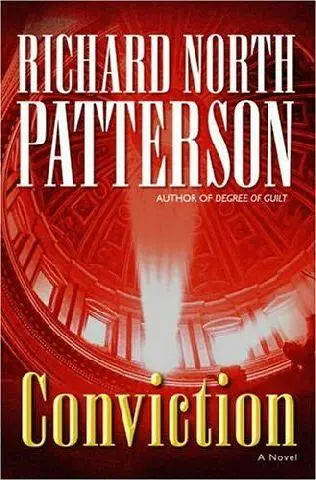
- Название:Conviction
- Автор:
- Жанр:
- Год:неизвестен
- ISBN:нет данных
- Рейтинг книги:3 / 5. Голосов: 1
-
Избранное:Добавить в избранное
- Отзывы:
-
Ваша оценка:
Conviction: краткое содержание, описание и аннотация
Предлагаем к чтению аннотацию, описание, краткое содержание или предисловие (зависит от того, что написал сам автор книги «Conviction»). Если вы не нашли необходимую информацию о книге — напишите в комментариях, мы постараемся отыскать её.
Conviction — читать онлайн бесплатно полную книгу (весь текст) целиком
Ниже представлен текст книги, разбитый по страницам. Система сохранения места последней прочитанной страницы, позволяет с удобством читать онлайн бесплатно книгу «Conviction», без необходимости каждый раз заново искать на чём Вы остановились. Поставьте закладку, и сможете в любой момент перейти на страницу, на которой закончили чтение.
Интервал:
Закладка:
At once, Terri understood what she had not fully grasped before: that what made the devastation of Payton's death unbearable was not only loss but guilt. Rennell would never comprehend the depth of Payton's betrayal.
"Payton wants you to live," she told him. "He asked me to help you, and help take care of you."
For the first time Rennell looked up at her, as though struggling to believe this. With painful vividness, Terri imagined the retarded boy standing by the desk of his third-grade teacher, then his only solace besides Payton.
"Please don't hurt yourself, Rennell. For my sake."
Hearing her own words, Terri felt the full weight of her responsibility, far greater now than just a lawyer's. "I'll come see you every day," she promised, "no matter what. Until you don't have to live here anymore."
Rennell began to sob, clasping the hand of his lawyer, his last protector.
THREE
READING THE OPINION OF THE CALIFORNIA SUPREME COURT in response to Rennell's petition, Terri experienced the jolt familiar to death penalty lawyers. Even though she had tried to steel herself against disappointment, the cold reality of the judicial approval of a death warrant, set forth in typed print on a single page, made her feel queasy.
"One sentence," Carlo said from over her shoulder. "A man's life, and all these issues, and they blow it off with 'each claim is denied on the merits.' "
A few words of legal shorthand, Terri thought, a concise staccato that did not reveal the Court's reasoning or suggest the seriousness of its decision. Only the swiftness of its issuance bespoke the fact that Rennell's execution was days away.
Contemptuously, Chris tossed the page toward a corner of the room. "At least our clemency petition is in."
Terri gazed out the window of the conference room. Through a dense fog, rain spattered on the glass, droplets zigzagging down the ten-foot panes. "Okay," she said emphatically. "They've given us what we needed to file in federal court—today. All we have to do is fill in the part of our brief reserved for their considered wisdom."
"That shouldn't take long," Carlo said.
* * *
Within two hours all that remained was to photocopy their revised habeas corpus petition and their application to the Ninth Circuit Court of Appeals for permission to file the petition before Judge Gardner Bond of the United States District Court. The most important part of which—and all that stood between Rennell Price and lethal injection—was his plea for a stay of execution.
This knowledge, Terri supposed, accounted for Carlo's unwonted silence. "I can't believe it's down to this," he finally said. "That if the same Ninth Circuit panel which turned down Rennell's first petition refuses to let us file this one, it's over. No recourse—no petition for rehearing or to the U.S. Supreme Court."
"That's because AEDPA bars them," Terri answered. "Another of its unique efficiencies, intended solely to end matters: if the same three judges turn Rennell down again, they can't be reviewed by anyone. Their word is literally final."
"Do we have a chance with them?"
"One judge is hopeless, I think—Viet Nhu. He's young, brilliant, a hard-line conservative, and a potential Republican appointment to the Supreme Court. He's also a former clerk for Justice Fini." Terri sipped her coffee. "Fini got him a key job in the Criminal Division of the Justice Department when he was barely thirty. That pretty much tells you where he stands on the death penalty."
"What about the other two?"
"Iffy. Judge Sanders is a moderate. If he thinks we've made a reasonable showing that we might succeed on the merits, he may not be comfortable consigning Rennell to death without some type of proceeding before Judge Bond. Especially on retardation, which wasn't before them last time around." Terri paused, rubbing her temples. "A lot may depend on the third member of the panel."
"Who is?"
"Dead." As her legal assistant rushed into the room with a stack of pleadings, Terri picked up her pen. "Judge Olinger died of a heart attack three days after ruling on Rennell's last habeas petition. Too bad—both in itself and because he was another middle-of-the-roader who might have been persuadable this time."
"So we don't know who the third judge will be."
"No. And won't until the day they rule." Swiftly, Terri signed her name to the original pleading to be filed with the Court, feeling, as she did, the weight these papers carried, Rennell's last chance at life. "Believe it or not, whether Rennell lives or dies this Friday will be settled by computer. That's how they pick the final judge."
Carlo shook his head, silent again.
FOUR
ON THE MORNING OF THE HEARING WHICH WOULD DETERMINE whether Rennell Price died in three days' time, Terri, Carlo, and Chris gathered around a speakerphone in the Pagets' conference room. Across the table were Laurence Pell and his cocounsel, Janice Terrell, a cool, angular blonde in her early thirties whom Terri had come to think of as death's understudy.
All five lawyers gazed at the speakerphone, waiting for the three-judge panel of the Ninth Circuit Court of Appeals—hastily assembled in their own conference room in Pasadena—to announce themselves. There was no time for a formal hearing. But the prospect of pleading with disembodied voices struck Terri as the judicial equivalent of imploring three Wizards of Oz, hidden behind the screen of the squawk box. Perhaps they found the distance prophylactic, she thought sardonically—a safe execution, where no one saw Rennell, or even the faces of his lawyers. She still did not know who would replace Judge Olinger.
"Good morning." The voice abruptly issuing from the box was rough with age. "Are the lawyers for the parties there?"
Swiftly, Terri glanced at Chris and Carlo. The man speaking was clearly older than either Judge Nhu or Judge Sanders. Eyes narrowing, Larry Pell stared at the box.
"We are," he answered.
"This is Judge Blair Montgomery," the aged voice responded. "With me are Judges Harry Sanders and Viet Nhu. As fate and random selection would have it, I've replaced Judge Olinger as the presiding member of the panel."
Pell shot Janice Terrell a look of concern. "We've read your papers," Montgomery continued, "as well as the ruling of the California Supreme Court. The first issue we'd like to hear about is mental retardation. In light of the United States Supreme Court's recent decision in Atkins, barring execution of the retarded, why should this man die on Friday?"
"The answer is that he shouldn't," Terri said swiftly. "If shown, mental retardation now bars his execution. The California legislature has adopted no definition for retardation. The California Supreme Court offers none."
Pell began furiously scribbling notes. "At most," Terri continued, "the Court seems to accept that an IQ of seventy-two—despite a standard deviation of plus or minus five—means that Rennell Price is fit to execute. If so, the Court is measuring retardation as though Rennell were taking the college boards—by applying an arbitrary numerical standard of seventy IQ points, which ignores all the evidence of his lifelong inability to learn or cope on his own."
Pell shook his head. "Mr. Price's IQ is above seventy. Under AEDPA, state court rulings are presumptively correct, and the petitioner must rebut this presumption by clear and convincing evidence." Pell leaned toward the box, as if to speak past Montgomery to Judges Nhu and Sanders. "Plainly, the Court did not find the evidence convincing. AEDPA does not allow this Court to second-guess them."
"Indeed." The Asian-accented voice, sibilant and precise, was Judge Nhu's. "But does Atkins even apply to Mr. Price? For a new ruling such as Atkins to be retroactive—that is, applicable to defendants on habeas corpus, like Mr. Price—the Supreme Court must expressly say so in the ruling itself. Atkins contains no such statement. Why then, Mr. Pell, should this Court even allow Mr. Price to raise it?"
Читать дальшеИнтервал:
Закладка:
Похожие книги на «Conviction»
Представляем Вашему вниманию похожие книги на «Conviction» списком для выбора. Мы отобрали схожую по названию и смыслу литературу в надежде предоставить читателям больше вариантов отыскать новые, интересные, ещё непрочитанные произведения.











Обсуждение, отзывы о книге «Conviction» и просто собственные мнения читателей. Оставьте ваши комментарии, напишите, что Вы думаете о произведении, его смысле или главных героях. Укажите что конкретно понравилось, а что нет, и почему Вы так считаете.