Richard Patterson - Conviction
Здесь есть возможность читать онлайн «Richard Patterson - Conviction» весь текст электронной книги совершенно бесплатно (целиком полную версию без сокращений). В некоторых случаях можно слушать аудио, скачать через торрент в формате fb2 и присутствует краткое содержание. Жанр: Старинная литература, на английском языке. Описание произведения, (предисловие) а так же отзывы посетителей доступны на портале библиотеки ЛибКат.
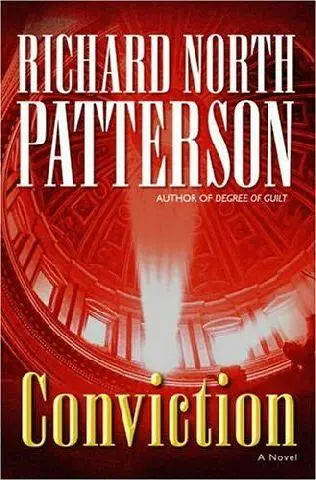
- Название:Conviction
- Автор:
- Жанр:
- Год:неизвестен
- ISBN:нет данных
- Рейтинг книги:3 / 5. Голосов: 1
-
Избранное:Добавить в избранное
- Отзывы:
-
Ваша оценка:
Conviction: краткое содержание, описание и аннотация
Предлагаем к чтению аннотацию, описание, краткое содержание или предисловие (зависит от того, что написал сам автор книги «Conviction»). Если вы не нашли необходимую информацию о книге — напишите в комментариях, мы постараемся отыскать её.
Conviction — читать онлайн бесплатно полную книгу (весь текст) целиком
Ниже представлен текст книги, разбитый по страницам. Система сохранения места последней прочитанной страницы, позволяет с удобством читать онлайн бесплатно книгу «Conviction», без необходимости каждый раз заново искать на чём Вы остановились. Поставьте закладку, и сможете в любой момент перейти на страницу, на которой закончили чтение.
Интервал:
Закладка:
"What was their reasoning?"
"They gave none." Montgomery shook his head in remembered disbelief. "Both opinions were one-pagers.
"But that was only the beginning. A federal district judge reversed the condemned man's conviction, ruling that his spectacularly inept lawyer had, by failing to contest the prosecution's dubious evidence, denied him effective assistance of counsel. Three of my conservative colleagues reversed that. So the man's new lawyers filed a petition for rehearing to be ruled upon by the Ninth Circuit as a whole."
"Which, I assume, was granted."
"Not quite. As you know, a vote for a rehearing requires, as a first step, that one of us suggest it be reheard in such a fashion." Montgomery's speech became weary, drained of all vigor. "Through an administrative error by a law clerk, none of us—including me—did so in the time required by our circuit's rules.
"I requested my three conservative colleagues to grant an extension. Shockingly, they refused. But our Chief Judge ordered the extension granted. A week before the defendant was to die, eleven judges voted seven to four to reverse the conviction and set aside the condemned man's execution.
"The California Attorney General petitioned the Bannon Court for review." Montgomery paused, breathing more heavily. "The sole ground for review, the United States Supreme Court decided, was not whether the man had received a fair trial but whether our Court had the authority to act—"
"Just because you'd violated your own internal rules?"
Montgomery stopped walking. He stood, appearing stooped and old, looking not at Caroline but at the patch of earth beside her. "It never occurred to me that a procedural error, committed not by a defendant's lawyer but by our own Court, would condemn a man to death. And I'll never forget Justice Fini's opinion for the majority." Montgomery looked up at her. "I can give you the last two sentences verbatim. 'A mishandled law clerk transaction in one judge's chambers constitutes the slightest of grounds for setting aside the deep-rooted policy in favor of the finality of justice. And it would be the rarest of cases where the negligent delay of that single judge in expressing his views is sufficient grounds to frustrate the interests of a state of some thirty-four million persons in enforcing a final judgment in its favor.'
"I was the judge, Caroline. The man died eight days later."
In that moment, Caroline understood the weight Montgomery carried, and the passion of his warnings. "It's the world we live in," he continued. "Clemency's become a joke. State supreme court judges are frightened or indifferent. The Ninth Circuit is a target. And Tony Fini and his allies are armed with a law that safeguards unfair convictions, and guarantees that innocent people will be executed.
"That's the world you preside over, Caroline. Counting his own, Tony Fini's got four votes out of nine for any interpretation of AEDPA he desires. All he needs is the right case, and a single vote, and the Masters Court will turn its back on judicial murder for at least another generation, and perhaps for good."
Caroline faced him. "All I can tell you," she said finally, "is that I don't intend to preside over a Court which sanctions the execution of the innocent."
Montgomery laughed softly. "You already do," he answered. "The only question is how many, and who they'll turn out to be."
TWO
TWO DAYS AFTER PAYTON'S DEATH, TERRI AND CARLO PREPARED a habeas corpus petition for the California Supreme Court, asking the Court to set aside Rennell's death sentence because he was retarded, and to order a new trial on the question of guilt.
Sitting at the conference table, Terri reviewed their final draft. "They'll turn us down, of course. But we're required by AEDPA to 'exhaust' Rennell's state court remedies before we can go to federal court."
"What's the point?" Carlo asked.
"In Rennell's case? None. But Pell won't agree to let us skip that step, and the federal courts won't consider our petition until the California Supreme Court denies it."
"Even this close to his date of execution?"
Terri shrugged. "Maybe that's the point," she answered and resumed her review of Rennell's petition.
To Carlo, her new flatness of affect and laconic manner had begun with her return from Payton's execution. Terri spoke little about that night, deflecting questions about what she had seen or felt. She seemed to prefer—or, perhaps, need—to lose herself in their mission of saving Rennell Price.
The thought spurred her stepson to ask a related but, he hoped, safer question. "Was Rennell any better this morning?"
Terri remained silent, seeming to scrutinize the page before her, and Carlo was uncertain that she had heard him. At last she looked up from the petition. "He barely speaks. It's like his soul has left his body.
"After they killed Payton, Rennell tore up his cell—his first violent behavior in fifteen years. Once they'd subdued him, it was as though he went into a coma—he won't shower, or eat. Just lies in his bed." She paused, adding softly, "For all his life, Payton was all he had, in the Bayview or prison. I think Rennell can't comprehend a life without his brother. He's in a depression too deep for me to imagine."
"Doesn't the prison provide mental health care?"
"Sometimes. But even that's a mess. As his lawyer, I have to worry about the State using a psychiatrist to undermine Rennell's claim of retardation. As far as Pell is concerned, treatment might raise whether Rennell's mentally competent to be executed. Although they can—and sometimes do—give an inmate psychotropic drugs to make him fully aware that he's being killed."
The last comment, delivered factually and without the outrage Carlo would have expected, made him wonder if she, too, was depressed—both from what she had seen and from sheer exhaustion. After a moment, he asked bluntly, "Are you okay, Terri?"
She mustered a faint smile. "I'm just not feeling very festive. But nothing like Rennell." Her smile vanished. "Even if Pell and I could work it out, Rennell refuses to talk with a prison psychologist. I think Payton's death feels too enormous to get over, or even put into words.
"From his perspective, I understand. But it scares me. The next worst thing to being executed is being dead inside."
With that, she returned to her work.
Carlo went out for sandwiches. When he returned, Terri was standing in a corner with the telephone pressed to her ear, a stricken expression frozen on a face far paler than Carlo had ever seen it.
"I'll be right out," Terri said swiftly and hung up.
She folded her arms, hugging herself as though to ward off cold. "Rennell tried to hang himself."
"How?" Carlo asked and then realized how stupid the question must sound to her.
But Terri did not seem to notice. "A bedsheet," she answered. "It's all he's got left."
* * *
After they brought him to her, Rennell slumped, staring at the table—though whether from shame or indifference or complete dissociation Terri could not tell. A purple bruise smudged his throat.
"What were you trying to do, Rennell?"
He did not answer, or even look up. In her own sadness, Terri heard her question as a futile inquiry into what was, at bottom, a rational response to a fathomless loss, which would be followed—unless she could succeed—by fourteen more days of misery before Rennell met Payton's fate.
She took his hand, holding it in silent commiseration.
Still he did not look at her. But she felt his hand begin to grasp hers, the slightest increase of pressure. In a husky near-whisper, he said, "Payton's gone. Never gonna be with me no more."
"He's in heaven, Rennell. He still loves you, and cares about you. Just like I do."
His eyes tightened to fight back tears. "That's why he's dead."
Читать дальшеИнтервал:
Закладка:
Похожие книги на «Conviction»
Представляем Вашему вниманию похожие книги на «Conviction» списком для выбора. Мы отобрали схожую по названию и смыслу литературу в надежде предоставить читателям больше вариантов отыскать новые, интересные, ещё непрочитанные произведения.












Обсуждение, отзывы о книге «Conviction» и просто собственные мнения читателей. Оставьте ваши комментарии, напишите, что Вы думаете о произведении, его смысле или главных героях. Укажите что конкретно понравилось, а что нет, и почему Вы так считаете.