Diane Davidson - Prime Cut
Здесь есть возможность читать онлайн «Diane Davidson - Prime Cut» весь текст электронной книги совершенно бесплатно (целиком полную версию без сокращений). В некоторых случаях можно слушать аудио, скачать через торрент в формате fb2 и присутствует краткое содержание. Жанр: Старинная литература, на английском языке. Описание произведения, (предисловие) а так же отзывы посетителей доступны на портале библиотеки ЛибКат.
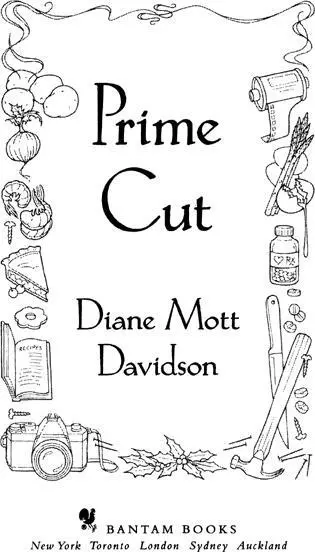
- Название:Prime Cut
- Автор:
- Жанр:
- Год:неизвестен
- ISBN:нет данных
- Рейтинг книги:5 / 5. Голосов: 1
-
Избранное:Добавить в избранное
- Отзывы:
-
Ваша оценка:
Prime Cut: краткое содержание, описание и аннотация
Предлагаем к чтению аннотацию, описание, краткое содержание или предисловие (зависит от того, что написал сам автор книги «Prime Cut»). Если вы не нашли необходимую информацию о книге — напишите в комментариях, мы постараемся отыскать её.
Caterer Goldy Schulz is convinced things couldn't get worse. An unscrupulous rival is driving her out of business. An incompetent contractor has left her precious kitchen in shambles. And she has just agreed to cater a fashion shoot at a nineteenth-century mountain cabin with her mentor and old friend, French chef André Hibbard.
A dash of cold-blooded murder...
Together Goldy and André struggle in a hopelessly outdated kitchen to cater to a vacuous crowd of beautiful people whose personal dramas climax when a camera is pitched through a window...into the buffet. Then Goldy's contractor is found hanging in the house of one of her best friends. A second murder follows and Goldy must somehow solve a mystery and prepare for a society soirée that could make--or break--her career.
A recipe for disaster...
It's a mystery that involves the dead contractor's unwholesome past, a food saboteur, the theft of four historical cookbooks, and an overzealous D.A. who has suspended Goldy's detective husband, Tom, from the force. What Goldy discovers is the perfect recipe for murder. And she may be dessert!
From the Paperback edition. Amazon.com Review
You could die from reading one of Diane Mott Davidson's culinary mysteries: this one includes recipes for Jailbreak Potatoes (butter, whipping cream, freshly grated Parmesan cheese) and Labor Day Flourless Chocolate Cake with Berries, Melba Sauce, and White Chocolate Cream (butter, chocolate, eggs, sugar, whipping cream). So you might want to take both the recipes and Davidson's pinball machine-like plots in small bites. This time, caterer Goldy Schulz careens between the worlds of contracting and high fashion models, with bodies from both camps falling into the food. It's all in fun, and readers have been lapping up Davidson's merry mélanges with increasing appetite.
,
,
,
,
, and
are available on the paperback menu.
Prime Cut — читать онлайн бесплатно полную книгу (весь текст) целиком
Ниже представлен текст книги, разбитый по страницам. Система сохранения места последней прочитанной страницы, позволяет с удобством читать онлайн бесплатно книгу «Prime Cut», без необходимости каждый раз заново искать на чём Вы остановились. Поставьте закладку, и сможете в любой момент перейти на страницу, на которой закончили чтение.
Интервал:
Закладка:
André went on: “And so I ask you. What is the message of this Christmas catalog?” He raised his voice. “‘Look like this and you will be happy.’ But this is not true. You can only be insecure. You can only be hungry.” He sighed and finished his coffee.
“They won’t be hungry with you around,” Julian supplied.
“Yes, young man.” André slid off the stool and began to lay out the platters.
“Goldy told me that before you were a chef, you were in the Resistance in the Second World War.” Julian’s voice was filled with awe. “Can you tell me about it?”
Mercy! Now André would love Julian forever . I dropped an egg into the batter. André launched into his tale of the secret network he’d helped build to keep Jews from being deported from Clermont-Ferrand during the Vichy régime. I did not disbelieve my teacher when he talked about this work he claimed to have done fifty-some years before. But if you did the math, André was only eleven while he was helping to build the network he referred to. Still, I would not dare interrupt him.
“They had to avoid contact with police,” André said matter-of-factly. “They had to have places to hide, and our network would send messages when the deportation trains were arriving.” His tone turned boastful. “The Nazis would come expecting to get two hundred Jews for a work camp. They would leave with a handful, very angry.”
Listening attentively, Julian trimmed fresh pineapple, papaya, banana, kiwi, and grapes for the fruit bowl. While I stirred together the thick cake batter and prayed that I’d remembered all the ingredients from my experimentation earlier in the week, André cast appraising glances at Julian’s prep job. Mindful of the stories of French chefs lashing the fingers of kitchen helpers who did not slice, dice, and julienne properly, I felt a bit nervous. But Julian, precision-slicing the fruit, appeared to take no notice of André’s scrutiny.
Within twenty minutes, a delicious aroma completely filled the room. We made coffee, arranged the muffins in pyramids, and filled the bowls. I iced the apple cake with a creamy citrus frosting, and dubbed the creation Blondes’ Blondies—in honor of the models. The treats weren’t truly blondies, but then again, some of the models weren’t truly blondes.
“Are you really feeling all right?” I asked André as we prepared to serve the food.
“Goldy!” he admonished me. “When will you learn to believe me? My doctor says I am fine, much improved now that I have begun to work again. What am I always telling you?”
“Let the mood fit the food,” I replied promptly.
“All right, then,” my mentor fumed as he readjusted his tray. “Stop thinking all the time about death.”
Chapter 9
Just before ten, we carried the frosted blondies, the platter of Andre’s sour cream muffins, the tureen of yogurt, and a silver bowl piled with fresh kiwi, pineapple, cantaloupe, and a variety of berries to the mahogany table in the Homestead dining room. The dining room was a high-ceilinged space that had been added to the original 1866 ranch house by later occupants. Bright sunlight filtered through the row of wavy-glassed windows and shone on polished dark wood paneling. Along the opposite wall, light glinted off glass-fronted hutches displaying Old West artifacts. Unfortunately, the shelves of two battered cabinets lacked their glass and had gaps where the missing cookbooks had been displayed. Yellow police ribbons cordoned off the space.
This room, I thought with a shudder, was where Gerald Eliot had been attacked and probably killed.
“Won’t it bother the Ian’s Images folk to be eating in here?” I asked André in a low whisper. “It seems sort of, well, macabre.”
Blondes’ Blondies
2 cups peeled and diced Granny Smith apples
1 cup firmly packed dark brown sugar
½ cup (1 stick) unsalted butter
1 egg
1½ cups cake flour (high altitude: add 1 tablespoon)
1 teaspoon baking soda
½ teaspoon salt
1 teaspoon ground cinnamon
½ teaspoon ground nutmeg
½ teaspoon allspice
½ cup chopped pecans or walnuts
½ cup raisins
Creamy Citrus Frosting (recipe follows)
Preheat the oven to 325°F. Butter a 9 × 13-inch metal (not glass) pan.
In a large mixing bowl, mix the chopped apples with the brown sugar. Set it aside while you prepare the other ingredients. In a small pan, melt the butter and set it aside to cool. In a small mixing bowl, beat the egg slightly. Sift together the flour, baking soda, salt, cinnamon, nutmeg, and allspice.
Whisk the melted and cooled butter into the egg; stir this mixture into the apple mixture. Stir the flour mixture into the apple mixture, mixing just until incorporated. Stir in the nuts and raisins. (The batter will be thick.) Spread the batter in the prepared pan.
Bake for 18 to 22 minutes, or until the blondies test done with a toothpick. Cool in the pan, then frost with Creamy Citrus Frosting. Slice and serve.
Makes 32 servings
Creamy Citrus Frosting
2 tablespoons (¼ stick) unsalted butter, softened
2 tablespoons orange juice
1 to 1½ cups confectioners’ sugar, sifted
Beat the butter with the orange juice until the butter is very soft (they will not mix completely). Add the sugar until the desired consistency is reached. Spread on the cooled blondies.
“I asked Hanna myself,” he replied with a sniff. “She said the contract with the models says she has to provide the coffee break food in a suitable area and this is what suits her. She also said the models today probably do not know about Gerald Eliot’s death, and they most certainly will not care.”
“Nice folks,” commented Julian with a wry smile. “Shall we do the coffee, Chef André?”
On the far side of the dining room, Julian and André carefully poured steaming coffee into the gleaming silver urn. I inched up to the cordoned area and looked at the cabinets that I had shown to so many Homestead visitors during my docent days. The shelves of the undamaged display cases were chockfull of holsters, knives, and cowboy hats, as well as photographs of early cabins, camp stoves, and other utensils brought across in covered wagons. The cookbooks had occupied the top shelves of the two vandalized cabinets.
I leaned in close to the first cabinet and read the forlorn, skewed label showing the former placement of American Cookery . Hanna had put the exhibit together with great care, coupling the cookbooks with old letters that mentioned them or their use. A letter next to the empty spot for American Cookery was from a founding member of the German-American Foundation of Colorado, who rhapsodized about his great-grandmother using the book when she first came to Colorado. Dear Great-gran had struggled more with the language than she had with the recipes.
I moved several inches along the police ribbon and winced: The second cabinet had been dented in several places. I could imagine the police report: signs of a struggle . On the shelf was the label for The Practical Cook Book and a letter from Charlie Smythe, one of the earliest landowners in Aspen Meadow and grandfather to Leah Smythe and Weezie Smythe Harrington, my clients. Old, hapless Charlie had died in Leavenworth Prison. It was from Leavenworth that he had written to his wife, Winnie, and remorsefully recalled her “cookery book” and the bread she used to make in their cabin.
I smiled: Visitors had always relished hearing the tale of a thief who had robbed for the fun of it, although Smythe’s life had not ended nearly as romantically as it sounded. The label summed up Charlie Smythe’s beginnings as a signalman who’d come west after the Civil War, bought land, become bored with ranching and timbering in Aspen Meadow, and taken up thieving for amusement. He’d apparently robbed successfully until he’d reached his late sixties. Unfortunately, in his last outing, Charlie’s gun had discharged unexpectedly—at least he’d so maintained in court—and he’d killed a bank teller before the robbery had even gotten off the ground. He’d died of flu in prison in 1918, at the age of seventy.
Читать дальшеИнтервал:
Закладка:
Похожие книги на «Prime Cut»
Представляем Вашему вниманию похожие книги на «Prime Cut» списком для выбора. Мы отобрали схожую по названию и смыслу литературу в надежде предоставить читателям больше вариантов отыскать новые, интересные, ещё непрочитанные произведения.





Обсуждение, отзывы о книге «Prime Cut» и просто собственные мнения читателей. Оставьте ваши комментарии, напишите, что Вы думаете о произведении, его смысле или главных героях. Укажите что конкретно понравилось, а что нет, и почему Вы так считаете.