Deon Meyer - Dead at Daybreak
Здесь есть возможность читать онлайн «Deon Meyer - Dead at Daybreak» весь текст электронной книги совершенно бесплатно (целиком полную версию без сокращений). В некоторых случаях можно слушать аудио, скачать через торрент в формате fb2 и присутствует краткое содержание. Жанр: Старинная литература, на английском языке. Описание произведения, (предисловие) а так же отзывы посетителей доступны на портале библиотеки ЛибКат.
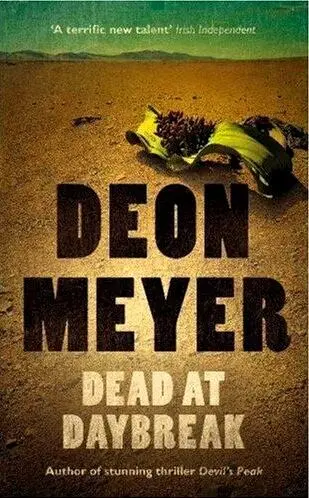
- Название:Dead at Daybreak
- Автор:
- Жанр:
- Год:неизвестен
- ISBN:нет данных
- Рейтинг книги:4 / 5. Голосов: 1
-
Избранное:Добавить в избранное
- Отзывы:
-
Ваша оценка:
Dead at Daybreak: краткое содержание, описание и аннотация
Предлагаем к чтению аннотацию, описание, краткое содержание или предисловие (зависит от того, что написал сам автор книги «Dead at Daybreak»). Если вы не нашли необходимую информацию о книге — напишите в комментариях, мы постараемся отыскать её.
An antiques dealer is burned with a blow torch, before being executed with a single M16 bullet in the back of the head. The contents of the safe are missing and the only clues are a scrap of paper and the murder weapon. Ex-cop Zatopek “Zed” van Heerden has 14 days in which to fill the blanks.
Dead at Daybreak — читать онлайн бесплатно полную книгу (весь текст) целиком
Ниже представлен текст книги, разбитый по страницам. Система сохранения места последней прочитанной страницы, позволяет с удобством читать онлайн бесплатно книгу «Dead at Daybreak», без необходимости каждый раз заново искать на чём Вы остановились. Поставьте закладку, и сможете в любой момент перейти на страницу, на которой закончили чтение.
Интервал:
Закладка:
“Morape went to negotiate. First suggested soccer as an alternative because we knew we could beat their Soviet asses hollow, but the OC wouldn’t hear of it. Then Morape said they would play rugby but that Mpayipheli must be freed. And the South African team must get the same equipment as the Russians.
“ ‘But Mpayipheli is a murderer,’ the OC said, and Morape argued that it had been a fair fight and the OC shook his head and said justice had to take its course and Morape said then there wouldn’t be a warm-up match, and for two weeks there was coming and going until the OC agreed, but there were two conditions. You have to win. And Mpayipheli must play, otherwise his troops wouldn’t accept the deal, and Morape said okay.
“I didn’t want to know. I said I’d rather go back to the cells, but the chief indunas explained the choices: either I play, or they would send me to Zambia, where I could be a pencil pusher in a supply store for the rest of the Struggle – if the Soviet army’s justice system had finished with me. They were sick and tired of me. I had to choose.
“Two days later we had our first practice. Two teams chosen according to size and height and potential talent. It was chaos. Like grade-one kids who gather around the ball and yell and run all over the place. The Russians who stood at the side of the practice field laughed so much that we couldn’t hear what Moosa was saying and we were so stupid that the writing was on the wall. Three weeks was far too little. We were cannon fodder.
“But Moosa was clever. And patient. The night after the first practice he spent in deep thought. Changed his strategy. Decided to shift the front to the classroom for starters, and for four long days we learned the theory of rugby on a blackboard, the rules, the involved, inexplicable, never-ending shower of rules, then analyzed every position, memorized every strategy, and on the fifth morning at six o’clock we were on the field, before the Russians got going. Moosa drilled us: the back line on one side, the forwards on another, line-outs, scrums, loose scrums, rucking, running, walking us through each step painfully slowly, quite literally at first.
“It got better but it was still pathetic. It was as if the guys couldn’t get their heads around this whitey game. You should’ve heard the remarks. All in the line of ‘It’s only the Boers who would be foolish enough to exchange a round ball and two nets for this stupidity.’ We wanted to dribble and kick, not pick up and pass. It seemed as if our whole nature was against the strange game. Not to mention the offside rule. But Moosa kept his head and Morape gave us courage, and on the Saturday one week before the match, we went out before sunrise for a secret practice in town, the two black teams against each other on an open piece of land next to the river, a kind of test game to choose the A team.
“Pretty it wasn’t. Moosa lost his temper for the first time that day, threw his hands into the air, and said it was an impossible task – it simply wasn’t possible to change a crowd of black idiots from soccer fans to rugby winners. He stormed off the field and went to sit under a large tree, his head in his hands, and we stood there, our bodies steaming in the cold, and we knew he was right. It wasn’t as if we hadn’t tried. It was simply – the handicap. And our hearts. If you know you’re going to be beaten, it’s difficult to get your heart in the right positive spirit.
“Morape went to sit next to Moosa and they talked for an hour or longer. And then they walked back to where we were sitting in a heap and Morape began to speak to us.
“He was a Tswana. A man with a face like an eagle, not tall or big, not very clever, but there was something in Morape that made you listen. And that morning, at the ass end of the world, we listened. Morape spoke softly. Said the match wasn’t about keeping Mpayipheli out of jail. Which got me a few dirty looks. He said the match was about the Struggle. The match had come our way in a country that didn’t want us there, from people who didn’t think we were good enough. Just like at home. And even though we couldn’t choose the battleground and the strategy there to suit us, we could do it here. Must we look at our country and say no, the whiteys have more weapons, more money, better comforts, better technology, they hold the high ground, but should we surrender? If we surrendered, here in Holy Mother Russia, we could give up the Struggle, because then we would’ve lost before we started. It was about character. It was about the fighting spirit. It was about daring, about focus, about concentration, the unshakable belief that you could do anything if you believed in yourself and in the cause.
“Sport, he said, is the poor man’s war. With the same principles. Us against them. Standing together against superior forces. Solidarity. Tactics and strategy and the same deep emotion. And just like war, sport eventually teaches us about ourselves. To test ourselves and our capabilities and our individual and collective character…
“He wouldn’t mind if we lost the battle. It happened in war, it happened in sport, and it happened in life. But if we lost because we hadn’t done our best, then we weren’t the kind of people with whom he wanted to go to war. Then Morape got up and walked away across the green grass and left us there to think.
“That Monday, Morape pinned the names of his first team against the notice board and my name was there as lock forward and my knees shook. But I wasn’t ‘Thobela’ any longer. Moosa had made me ‘Tiny’ Mpayipheli.
“For the rest of the week we practiced every day. With Morape on the sideline as a silent reminder of his words, and Moosa, fly half and coach, who drilled us, and then the jerseys came on Thursday. The OC of the base had had them made in Moscow, green and gold with a Springbok on the chest, and Morape said, ‘Now you’re playing for your country,’ and the whole thing took on a dimension for which we weren’t prepared. We wanted to complain about the jersey of the oppressor when Morape asked, ‘What are the colors of the ANC?’
“That Saturday the soccer stadium in Saraktash was packed with so many Soviet soldiers you couldn’t credit it. Each weekend pass had been withdrawn, every military soul had been called up to support their men, and when their team came out of the tunnel, it was a sea of red jerseys with a yellow hammer and sickle on the chest and the crowd went wild and for most of the game our small group of supporters were too scared to open their mouths.
“It probably wasn’t the greatest rugby to watch, especially the first half. To our great surprise the Russians weren’t masters of the game. More experienced than we were, but no oiled machine. At half time they were ahead by eighteen to six after Moosa had kicked two drop goals, and then he said to us, ‘Guys, these Reds can be beaten, I can feel it. Can you feel it?’ Perhaps we were no longer intimidated. Maybe we thought it was going to be a superior force that would grind us, bleeding, into the grass, and when it didn’t happen, we had to admit that he was right. These guys could be beaten…
“ ‘They’re slow,’ Moosa had said. ‘Get the ball to Zuma, doesn’t matter how. Get the ball to Zuma.’ Napoleon Zuma was our left wing, he was only nineteen, a Zulu, he was short, but he had a pair of thighs each of which you couldn’t encircle with two hands and he could run like the wind.
“It took us fifteen minutes to get him away for the first time and then he scored a try, and then it was as if something happened on that field, as if those fifteen South Africans from the townships and the small-town locations and the villages of the Bantustans suddenly had insight into this strange, wonderful game. And we played. And the better we played, the quieter the Red Army crowd became and the louder our small band of supporters shouted on the pavilion steps, and Napoleon Zuma scored two more tries and suddenly the score was equal with only ten minutes of play left and then we wanted to win, we knew we were going to win. You should’ve seen those guys, Van Heerden, you should’ve seen them play – it was wonderful, it was indescribably beautiful.”
Читать дальшеИнтервал:
Закладка:
Похожие книги на «Dead at Daybreak»
Представляем Вашему вниманию похожие книги на «Dead at Daybreak» списком для выбора. Мы отобрали схожую по названию и смыслу литературу в надежде предоставить читателям больше вариантов отыскать новые, интересные, ещё непрочитанные произведения.



Обсуждение, отзывы о книге «Dead at Daybreak» и просто собственные мнения читателей. Оставьте ваши комментарии, напишите, что Вы думаете о произведении, его смысле или главных героях. Укажите что конкретно понравилось, а что нет, и почему Вы так считаете.