Conn Iggulden - Conqueror (2011)
Здесь есть возможность читать онлайн «Conn Iggulden - Conqueror (2011)» — ознакомительный отрывок электронной книги совершенно бесплатно, а после прочтения отрывка купить полную версию. В некоторых случаях можно слушать аудио, скачать через торрент в формате fb2 и присутствует краткое содержание. Жанр: Старинная литература, на английском языке. Описание произведения, (предисловие) а так же отзывы посетителей доступны на портале библиотеки ЛибКат.
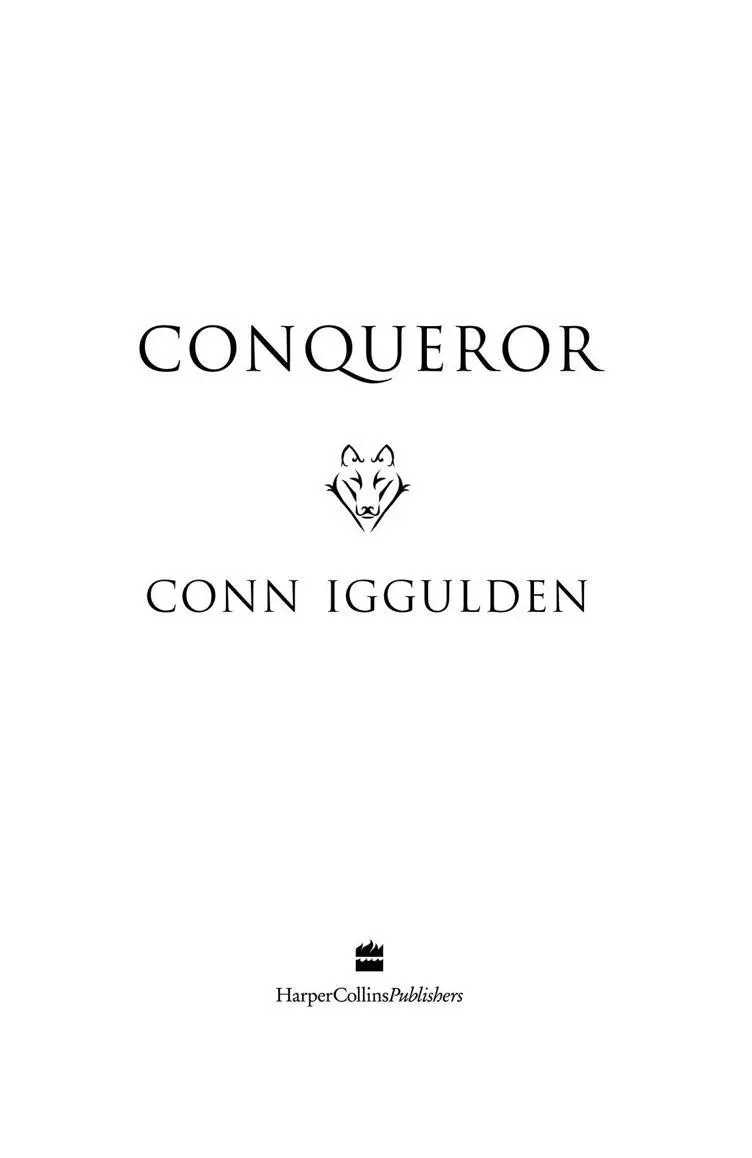
- Название:Conqueror (2011)
- Автор:
- Жанр:
- Год:неизвестен
- ISBN:нет данных
- Рейтинг книги:4 / 5. Голосов: 1
-
Избранное:Добавить в избранное
- Отзывы:
-
Ваша оценка:
Conqueror (2011): краткое содержание, описание и аннотация
Предлагаем к чтению аннотацию, описание, краткое содержание или предисловие (зависит от того, что написал сам автор книги «Conqueror (2011)»). Если вы не нашли необходимую информацию о книге — напишите в комментариях, мы постараемся отыскать её.
Conqueror (2011) — читать онлайн ознакомительный отрывок
Ниже представлен текст книги, разбитый по страницам. Система сохранения места последней прочитанной страницы, позволяет с удобством читать онлайн бесплатно книгу «Conqueror (2011)», без необходимости каждый раз заново искать на чём Вы остановились. Поставьте закладку, и сможете в любой момент перейти на страницу, на которой закончили чтение.
Интервал:
Закладка:
CHAPTER TWENTY-SIX

Kublai and Bayar sat with their backs against the same massive boulder of whitish grey stone. Uriang-Khadai watched them, his face unreadable. The twin of the huge stone loomed nearby, so that between them was a sheltered area that local sheep must have used every time it rained. The ground there was so thick with droppings that no grass showed at all and everyone who walked through it found their boots getting heavier and heavier as they went.
The sheep had gone, of course. Kublai’s tumans had rounded up eighty or so, and for some lucky warriors there would be hot meat that night. The rest would have to make do with blood from their spare mounts, along with a little mare’s milk or cheese, whatever they had.
Ponies grazed all around them, whickering and snorting as they cropped grass that grew in clumps so thick that it made progress slow over the hills. They could not even trot on such an uneven surface. The horses had to be walked slowly, their heads drooping with weariness.
‘We could circle back to the last site,’ Bayar said. ‘They won’t expect that and we need those arrows.’
Uriang-Khadai nodded wearily. Though he had gone with Tsubodai into the west, he had never known such a constant run of battles before. There had been a time when he had scorned reports of swarming Sung cities, but the reality was every bit as bad as he had been told. Kublai’s tumans had run out of gunpowder, shot and arrows, the sheer numbers of the enemy overwhelming them. Uriang-Khadai could still hardly believe they had been forced to retreat, but he had lost track of the armies they had beaten, and the one struggling to reach them was fresh and well armed. The tumans were down to swords for the most part, with even their lances broken and thrown away. Faced with new regiments racing towards them, Kublai had withdrawn at speed, seeking out the high ground.
‘Are they still there?’ Kublai asked.
Bayar stood up with a groan on aching legs, peering past the boulder. Below, he could see Sung regiments in ragged squares, seeming to inch their way up the slopes of the mountain.
‘Still coming,’ Bayar said, slumping back. Kublai swore, though it was no more than he had expected. ‘We can’t fight on this ground, you know that?’
‘I know, but we can stay ahead of them,’ Kublai said. ‘We’ll find a way out of the hills and when it’s dark, we’ll ride clear of them. They won’t catch up, not today anyway.’
‘I don’t like leaving the main camp unprotected for this long,’ Uriang-Khadai said. ‘If one of those armies comes across them, they’ll be slaughtered.’
Kublai tensed his jaw, irritated at Uriang-Khadai for reminding him. Chabi and Zhenjin were safe, he told himself again. His scouts had found a forest that stretched for hundreds of miles. The families and camp followers would have headed for the deepest part of it, as far from a road as they could get. Yet it only took one enemy tracker to spot smoke from a fire or hear the bleating of the herds. They would fight, of course. Chabi’s calm courage made his chest grow tight in memory, but he agreed with Uriang-Khadai about the outcome. A small voice within him worried as much about the stocks of arrows held in the camp. Without them, his tumans were a wolf whose teeth had been drawn.
‘You find me a way to make this Sung bastard vanish and I’ll ride back and see how they are getting on,’ Kublai said irritably. ‘Until then, we’ll just stay ahead of them and hope we aren’t riding into the arms of another noble out hunting for us.’
‘I would like to send a small, fast group for arrows,’ Uriang-Khadai said. ‘Even a few thousand shafts would make a difference at this point. Twenty scouts riding fast should be able to get past the Sung forces.’
Kublai multiplied numbers in his head and blew air out slowly. He didn’t doubt his scouts could survive the ride out, but coming back, with a quiver under each arm, one on their back, two tied to the saddle? They would be defenceless, easy prey for the first Sung cavalry to spot them. He needed more than two thousand arrows. He needed half a million at a minimum. The best stocks of fletched birch shafts lay on battle-fields for fifty miles behind them, already warping from damp and exposure. It was infuriating. He had prided himself on his organisation, but the Sung armies had just kept coming, giving his men no time to rest.
‘We need to find another city, one with an imperial barracks,’ he said. ‘They have what we need. Where are the maps?’
Bayar reached inside his tunic and pulled out a sweat-stained sheet of goatskin, dark yellow and folded many times, so that whitish lines showed as he opened it out. There were dozens of cities shown on the map, marked in characters painted by some long-dead scribe. Bayar pointed to one that lay beyond the range of mountains where the tumans sprawled in exhaustion.
‘Shaoyang,’ he said, jabbing a finger at it. Sweat dripped as he leaned over, so that dark spots appeared on the material. With a curse, he wiped his face with both hands.
‘That’s clear then,’ Kublai said. ‘We need to reach this city, overcome their garrison and somehow get to their stores of weaponry before the army behind catches up, or the population turns out and finishes us.’ He laughed bitterly to himself.
Uriang-Khadai spoke as Kublai leaned back. ‘There is a chance the garrison is already out,’ he said thoughtfully. ‘For all we know, we may have already beaten them. Or they could be out looking for us, like every other Sung soldier in the region.’
Kublai sat up, struggling to think through his exhaustion.
‘If they’re in place, we could draw them away. If we sent a few men into the markets with information to sell, maybe. Rumours of a Mongol army fifty miles in the wrong direction would surely bring the garrison out. We know by now there are standing orders to attack us on sight. They could not remain in the city with the right bait.’
‘If they are there at all,’ Uriang-Khadai agreed.
‘If they ignore the news, we will be waiting to enter a hostile city, with another army coming up fast behind us,’ Bayar pointed out. He was surprised to be the one urging caution, but Uriang-Khadai seemed to be caught up in the idea.
Kublai stood up, stretching his aching legs and looking down the mountain to the Sung regiments plodding after them. The ground was so broken with its clumps and hillocks of grass that they could not move any faster than those they chased. He could be thankful for that at least. He felt his head clear with the movement and gave a low whistle to the closest minghaan officers, jerking his head in the direction of travel. It was time to move on again.
‘You know I’d love to get into their stores,’ he said, ‘but even if the garrison is already out, the prefect of the city won’t let us just walk in and take what we need.’
‘The citizens of Shaoyang won’t know how the war is going,’ Uriang-Khadai said. ‘If you gave them the chance, he might surrender to you.’
Kublai looked closely for some sign of mockery, but Uriang-Khadai’s face was like stone. Kublai grinned for a moment.
‘He might,’ he agreed. ‘I’ll think about it as we go. Come on, the ones following are getting too close. What do you say to a fast ten miles over the peak to put some distance between us?’
All those who heard made some groaning noise at the prospect, but they lurched to their feet. With the ground so broken, it was all they could do to stop the Sung regiments below snapping at their heels.
Mongke hated sieges, but without a massive force of catapults and cannon, he faced the same problems Genghis had once known. Cities were designed to keep out marauding armies such as his, though for once they were not his main objective. Somewhere to the south, Kublai was engaging the Sung armies. Mongke would have liked to smash down the walls of the cities he passed, but his primary aim was to reach Kublai. It suited his purposes well enough if every city barred its gates against him - and the garrisons stayed safely inside. His problem lay in the supply line, which grew more and more vulnerable with every mile he rode south. Cities who hid from a quarter of a million warriors would not mind sallying out against a long line of carts, guarded by just a few thousand. When the line broke somewhere behind him, he had been forced to reduce the rations. He had sent scouts out for well over a hundred miles to report any herds he might snap up. It was one resource the Sung cities could not protect behind their walls, and as he entered a region of rich grassland Mongke saw so many cattle that his supply lines became unnecessary. For a glorious few days, his men feasted on charred beef still dripping with blood, putting back some of the body fat they had lost in hard riding. In its way, the problems of a campaign were equal to anything Mongke had dealt with in Karakorum, but he took more satisfaction in simple obstacles he could face and overcome.
Читать дальшеИнтервал:
Закладка:
Похожие книги на «Conqueror (2011)»
Представляем Вашему вниманию похожие книги на «Conqueror (2011)» списком для выбора. Мы отобрали схожую по названию и смыслу литературу в надежде предоставить читателям больше вариантов отыскать новые, интересные, ещё непрочитанные произведения.



Обсуждение, отзывы о книге «Conqueror (2011)» и просто собственные мнения читателей. Оставьте ваши комментарии, напишите, что Вы думаете о произведении, его смысле или главных героях. Укажите что конкретно понравилось, а что нет, и почему Вы так считаете.