Dennis Wheatley - Vendetta in Spain
Здесь есть возможность читать онлайн «Dennis Wheatley - Vendetta in Spain» весь текст электронной книги совершенно бесплатно (целиком полную версию без сокращений). В некоторых случаях можно слушать аудио, скачать через торрент в формате fb2 и присутствует краткое содержание. Жанр: Старинная литература, на английском языке. Описание произведения, (предисловие) а так же отзывы посетителей доступны на портале библиотеки ЛибКат.
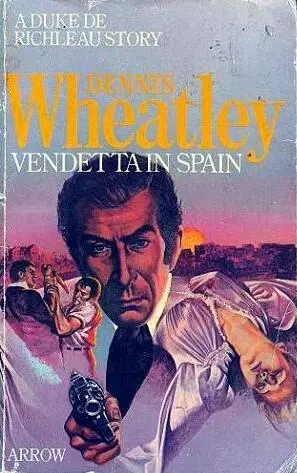
- Название:Vendetta in Spain
- Автор:
- Жанр:
- Год:неизвестен
- ISBN:нет данных
- Рейтинг книги:4 / 5. Голосов: 1
-
Избранное:Добавить в избранное
- Отзывы:
-
Ваша оценка:
Vendetta in Spain: краткое содержание, описание и аннотация
Предлагаем к чтению аннотацию, описание, краткое содержание или предисловие (зависит от того, что написал сам автор книги «Vendetta in Spain»). Если вы не нашли необходимую информацию о книге — напишите в комментариях, мы постараемся отыскать её.
Readers of
and other books in which the glamorous Lucretia-Jose appears with the Duke de Richleau may recall that her parentage was surrounded by mystery. Over the years many people have written, asking for an account of the great romance that led to her birth.
The story takes us back to Spain, in 1906, when the Duke had not yet succeeded his father, and was still the Count de Quesnoy. In these days it is not easy for us to realize that, less than fifty years ago, there was hardly a Monarch or President who could leave his bed in the morning with any certainty that he would live through the day. Anarchism permeated every country in Europe. Not a night passed without groups of fanatics meeting in cellars to plan attempts with knives, pistols or bombs against the representatives of law and order; not a month passed without some royalty or high official falling a victim to their plots.
In Spain, an historic bomb outrage that led to scores of innocent people being killed or injured, gave de Quesnoy ample cause to vow vengeance on the assassins. His attempt to penetrate anarchist circles in Barcelona nearly cost him his life. In San Sebastian, Granada and Cadiz he hunted and was hunted by them in a ruthless vendetta. Only after two years did it end in a final desperate gamble with death.
It is against this background of true history, subtle intrigue, sudden violence, terrorism, blackmail and suspense that there develops the bitter-sweet romance between the gallant young de Quesnoy and the beautiful Condesa Gulia, the wife of a friend he loves and honours. Their frustrated passion leads to a denouement that rivals in surprise and breath-taking effect the outcome of his vendetta against the anarchists.
Vendetta in Spain — читать онлайн бесплатно полную книгу (весь текст) целиком
Ниже представлен текст книги, разбитый по страницам. Система сохранения места последней прочитанной страницы, позволяет с удобством читать онлайн бесплатно книгу «Vendetta in Spain», без необходимости каждый раз заново искать на чём Вы остановились. Поставьте закладку, и сможете в любой момент перейти на страницу, на которой закончили чтение.
Интервал:
Закладка:
The news of the assassination had brought back to him vivid memories of Angela, and the way in which their happiness had been terminated with such appalling suddenness. For some days, he was afflicted with periods of bitter brooding, as he thought of what his life might have been were she still alive, and what it had become owing to her death. He would have had a permanent home with the woman who had been his earliest and greatest love, a child now two years old to cherish, the enjoyment of a circle of friends with whom to pass their time in civilized surroundings. As it was, he had been forced to become a soldier of fortune, rootless, without family, and only circles of acquaintances which changed every month as he moved from one appointment to another, engaged in jungle warfare or countering the intrigues of unscrupulous Central American politicians.
Thinking back, it gave him some consolation to recall that, by undertaking his secret mission to Barcelona, he had succeeded in ensuring that Ferrer and his vile crew had been brought to book for the backstage part they had played in Angela's murder, and had been put out of the way for good; but that did not alter the fact that the hydra-headed monster, militant anarchism, was still taking its toll almost daily of innocent victims, and that his father's life had been cut short by Russians of the poisonous Ferrer breed.
For a while he had contemplated offering to serve the Tsar in the same way as he had Don Alfonso, and under an alias seeking to penetrate the inner circles of the Russian Nihilists. But on consideration, he had recalled that the circumstances in Spain and Russia were very different. Don Alfonso had been anxious to employ him because the strongly Liberal element in his own police, especially in Catalonia, made them unreliable. To the Tsar's Secret Police, the Ocrana , that did not apply. Far too many of them had fallen victims to the bombs, pistols and knives of the Nihilists for them to have the least scruple about retaliating whenever the opportunity offered. They were already waging a relentless war against the terrorists, and had hundreds of spies constantly endeavouring to penetrate the cells of the assassins; so one more, and especially a man like himself who had not lived in Russia since his boyhood, could make no material difference.
By the time he reached New Orleans, he had decided that there was no place for him in the secret war that the Ocrana was waging; so his thoughts instinctively reverted to the type of war which was his own province, and the possibilities of future outbreaks of hostilities in various parts of the world. With that in mind, he looked through all the more serious English, French and German magazines, and read many articles in them to get an unbiased view of what diplomats termed The Concert of Europe'.
The standard of the music had certainly not improved while the Duke had been in America, and in the past year the players, large and small, had got so out of tune that for a while it had looked as if they meant to break their instruments over one another's heads.
The Entente Cordiale still held, in spite of some discordant notes. between the Anglo-French partners, and Russia, largely owing to a visit by King Edward to the Tsar at Revel in the summer of 1908, had since been drawn away from Germany into what was now a triple Entente. Germany and Austria-Hungary, with Italy as an unenthusiastic third, formed the Triple Alliance, which led by the bellicose Kaiser, was opposing the Entente countries on every major issue.
For the past quarter of a century the ancient sprawling Turkish Empire had been falling to pieces, and it was a further stage in its disintegration which had nearly set the Great Powers at one another's throats. Early in the previous year the Young Turks had deposed the Sultan. Recent memories of the massacre of the Armenians and other horrors perpetrated by the ancien regime had secured for the Young Turks general approval of their seizure of power. But it had soon had dangerous repercussions.
Crete, Greece, Serbia and Montenegro had already thrown off the Turkish yoke. Now Bulgaria also proclaimed her independence and Austria, without consultation with the other powers, annexed the Turkish provinces of Bosnia and Herzegovina. As the two provinces were mainly populated by Serbs, Serbia had hoped to absorb them and demanded compensation. Russia, as the natural protector of the Slav races in the Balkans, backed her up, while Germany backed her ally Austria. All through the autumn and winter heated notes had volleyed back and forth between the Great Powers; but a month ago the Kaiser had openly declared his intention of supporting Austria by force of arms if the matter of her annexation of the provinces was further questioned, and Russia had climbed down.
Now, the 'Concert' was playing in reasonably fair harmony again, but in view of the violently nationalistic ambitions animating the several newly-created Balkan States, de Richleau found himself wondering for how long it would continue to do so. He was far too conscious of the appalling consequences which would result from a major war to wish to see all Europe go up in flames; but as a soldier of fortune he regarded with speculative interest the possibility of a war in the Balkans, and that another might break out either in North Africa, owing to Italian ambitions in Tripoli, or North-West Africa, where France had recently seized the Casablanca territories in the teeth of German opposition.
At the moment he was definitely looking forward to taking over and administering the great estate that had been left to him; but instinct told him that his new form of occupation would not satisfy him for very long, and that in a year or so he would once more feel a compelling urge again to use his talents as a soldier. If so, perhaps, after all, he might yet achieve his ambition to command a Cavalry Division in Tripoli, Morocco or the Balkans.
On April 2nd he sailed for Europe, to reach Hamburg after a pleasant but uneventful voyage. From Hamburg he went straight to Vienna and there, in his favourite city, he broke his journey for a week to get the feel of Europe again into his bones.
Frau Sacher, who had known him since his boyhood, received him with delight. In the lofty rooms of her exclusive hotel, with their tall double doors of baize that shut out all sound, he put from him the last unpleasant memories of his time in Latin America - the greedy half-breed politicians and generals, the sweltering heat of the jungle, the constant danger from disease and snake or tarantula bite, the stench of unwashed humanity, and the incessant pestering by flies and mosquitoes - while luxuriating in a huge bed or in the vast marble bath, as big as a Roman sarcophagus.
No sooner had he made known his presence in Vienna than he received a dozen callers and a score of invitations. Friends made in his youth, now Majors and Colonels in crack cavalry regiments, delighted to receive him again into the joyous carefree life of 'wine, women and song' that formed the very heart of Vienna's existence. He was thirty-four years old, strikingly handsome, a lean, bronzed soldier with a ready smile and dark, slightly wavy hair flecked with grey, a Duke who had now also inherited the Austrian title of Count Konigstein, rich, unmarried, intelligent, travelled and with decorations that testified to his personal valour. It was not to be wondered at that in the days that followed the most noble families in Vienna unostentatiously put their eligible daughters in his way, and that half a dozen lovely married women indicated very clearly that they would be delighted to enter on an affaire with him.
At the end of the week he reluctantly tore himself away and, resisting the temptation to break his journey again for a few nights to see old friends in gay Budapest, crossed the frontier into Russia on the 26th. The* following day he reached Jvanets, where he learned to his considerable satisfaction that the nihilist who had thrown the bomb that had killed his father had already been caught and executed.
Читать дальшеИнтервал:
Закладка:
Похожие книги на «Vendetta in Spain»
Представляем Вашему вниманию похожие книги на «Vendetta in Spain» списком для выбора. Мы отобрали схожую по названию и смыслу литературу в надежде предоставить читателям больше вариантов отыскать новые, интересные, ещё непрочитанные произведения.





Обсуждение, отзывы о книге «Vendetta in Spain» и просто собственные мнения читателей. Оставьте ваши комментарии, напишите, что Вы думаете о произведении, его смысле или главных героях. Укажите что конкретно понравилось, а что нет, и почему Вы так считаете.