Dennis Wheatley - Vendetta in Spain
Здесь есть возможность читать онлайн «Dennis Wheatley - Vendetta in Spain» весь текст электронной книги совершенно бесплатно (целиком полную версию без сокращений). В некоторых случаях можно слушать аудио, скачать через торрент в формате fb2 и присутствует краткое содержание. Жанр: Старинная литература, на английском языке. Описание произведения, (предисловие) а так же отзывы посетителей доступны на портале библиотеки ЛибКат.
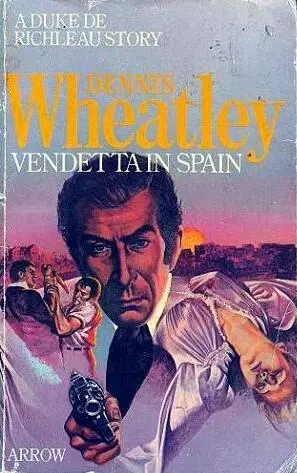
- Название:Vendetta in Spain
- Автор:
- Жанр:
- Год:неизвестен
- ISBN:нет данных
- Рейтинг книги:4 / 5. Голосов: 1
-
Избранное:Добавить в избранное
- Отзывы:
-
Ваша оценка:
Vendetta in Spain: краткое содержание, описание и аннотация
Предлагаем к чтению аннотацию, описание, краткое содержание или предисловие (зависит от того, что написал сам автор книги «Vendetta in Spain»). Если вы не нашли необходимую информацию о книге — напишите в комментариях, мы постараемся отыскать её.
Readers of
and other books in which the glamorous Lucretia-Jose appears with the Duke de Richleau may recall that her parentage was surrounded by mystery. Over the years many people have written, asking for an account of the great romance that led to her birth.
The story takes us back to Spain, in 1906, when the Duke had not yet succeeded his father, and was still the Count de Quesnoy. In these days it is not easy for us to realize that, less than fifty years ago, there was hardly a Monarch or President who could leave his bed in the morning with any certainty that he would live through the day. Anarchism permeated every country in Europe. Not a night passed without groups of fanatics meeting in cellars to plan attempts with knives, pistols or bombs against the representatives of law and order; not a month passed without some royalty or high official falling a victim to their plots.
In Spain, an historic bomb outrage that led to scores of innocent people being killed or injured, gave de Quesnoy ample cause to vow vengeance on the assassins. His attempt to penetrate anarchist circles in Barcelona nearly cost him his life. In San Sebastian, Granada and Cadiz he hunted and was hunted by them in a ruthless vendetta. Only after two years did it end in a final desperate gamble with death.
It is against this background of true history, subtle intrigue, sudden violence, terrorism, blackmail and suspense that there develops the bitter-sweet romance between the gallant young de Quesnoy and the beautiful Condesa Gulia, the wife of a friend he loves and honours. Their frustrated passion leads to a denouement that rivals in surprise and breath-taking effect the outcome of his vendetta against the anarchists.
Vendetta in Spain — читать онлайн бесплатно полную книгу (весь текст) целиком
Ниже представлен текст книги, разбитый по страницам. Система сохранения места последней прочитанной страницы, позволяет с удобством читать онлайн бесплатно книгу «Vendetta in Spain», без необходимости каждый раз заново искать на чём Вы остановились. Поставьте закладку, и сможете в любой момент перейти на страницу, на которой закончили чтение.
Интервал:
Закладка:
The Conde concluded by conveying to de Quesnoy Don Alfonso's relief and happiness on learning that he was alive and well, with affectionate messages from Gulia, de Vendome, the Conde Ruiz, the Infanta Maria Alfonsine, and an expression of his own devoted friendship coupled with the hope that it would not be more than a year or two before they would all enjoy the happiness of having him among them again.
Meanwhile, through his acquaintances in the beautiful capital of Brazil, de Quesnoy had been exploring the possibilities of entering the Brazilian Army. As an ex-Chief Instructor of the French Military Academy of St. Cyr, with several years of distinguished active service in North Africa in addition, his qualifications could not be questioned, and after a few meetings with influential army officers the Minister for War offered him the post of Commandant at the Military College.
He would have preferred to command troops; but it appeared a good opening, so he accepted. Yet he had not long taken up the post before he regretted his decision. In those days, in Latin America, discipline among officers was still as nebulous as it had been in the European armies opposing Napoleon. Young sparks belonging to powerful families were accustomed to sleep out at nights and cut lectures and parades when they pleased but, all the same, they expected to receive the most sought-after appointments when the course was over. By cracking down on them de Quesnoy made himself intensely unpopular, and he soon learned that these wealthy idlers had complained to their influential fathers, with the result that an intrigue was developing to oust him from his job. Fighting he considered his business, but not fighting a haughty oligarchy for the right to force its decadent youth to toe the line and learn to become competent officers. In consequence, in the New Year of 1907 he had resigned and transferred to the army of one of the Central American Republics.
There he had been given the rank of Brigadier-General and sent to fight Indians. Although he found the troops allotted to him illiterate, ragged, and largely recruited from the gaols, and supplies reached him only in an inadequate trickle, he had soon become fascinated by jungle warfare. Not only was it utterly different from his campaigns against well-organized bodies of tribesmen, waged for oases in deserts and through the rocky gorges of the Atlas Mountains, it had a much closer resemblance to big game hunting, which had always been a passion with him. But in this case, instead of stalking dangerous animals for amusement, the object was to make waterways and jungle tracks safe for commerce from attack by murderous savages, and the risk entailed by the hunter was the much greater one of being pipped by a poison-tipped arrow, which could result in a death of excruciating agony.
After three months he had gone down with jungle fever and been invalided back to the capital. While he was convalescing a revolution had taken place and the new War Minister had decided that he would be of more value in helping to reorganize the army than returning to the jungle. By Central American standards the War Minister had been an honest man, and de Quesnoy had done his utmost to bring order out of chaos; but at every turn he had found his efforts baulked by the rivalries of unscrupulous Generals, graft, and every kind of political chicanery. By midsummer he had become so disgusted with the whole business that he had thrown in his hand and accepted an offer from a neighbouring State to become Inspector-General of its forces.
There he had fared little better, as its Government and the higher ranks of its rag, tag and bobtail army had proved equally riddled with corruption. But after a time he had managed to change his job for the command of an expedition to survey the upper reaches of an uncharted river and a great area of territory adjacent to it. That he had enjoyed, as it had meant his being his own master and again living dangerously, which was in his blood. It had entailed further encounters with hostile Indians, hunting an immense variety of big game, and the discovery of an ancient Maya city, ruined and half-submerged in giant creepers yet with many of its intricate carvings still undamaged. But, to his annoyance, the expedition was recalled long before it had completed its work owing to lack of funds to send up to it further essential supplies.
During the eighteen months that followed he had served with the rank of Major-General in the armies of three other Republics. In time he had come to accept the trickery, bribery and ignorance of military matters which was almost universal among his sallow-skinned, black-eyed colleagues, recognizing that their standards were as natural to them as a sense of integrity was to the majority of officers in the armies of the great European nations. Even when telling the most flagrant lies their manners were impeccable, they were most hospitable and intensely chivalrous towards women; so he came to regard them rather as selfish, wicked children than near criminals, and became good friends with a number of the more intelligent among them.
His dream of commanding a Cavalry Division remained as far away as ever since, except for a few squadrons of escort troops for Presidential processions, cavalry hardly existed, and he often thought with regret of the splendidly disciplined and equipped regiment of Spahis he had commanded in North Africa. But the half-Indian peons in the Central American armies were tough little men and earned his admiration.
For most of the time he lived in cities in which the privileged few enjoyed every luxury while the masses, mainly of mixed negroid and native Indian stock with only a rare dash of Spanish blood, plagued by disease, poverty and crushing taxation, barely managed to exist in the most appalling squalor. Yet each time resentment at such a state of things, or frustration at the intransigence and incompetence of his colleagues, had boiled up in him to a point at which he began to consider returning to Europe, he was either sent out to clear another jungle area of marauding Indians, or a revolution engineered by some magnate greedy for more wealth and power had to be crushed.
So for the past two and a half years he had at least lived a life that had not lacked for variety, and frequently provided him with situations in which he could indulge his favourite pastime of gambling his safety against his wits.
Now, as the Due de Richleau, he had to reorientate himself for his return to countries in which soldiers were not liable to be shot for minor acts of insubordination, where judges sent people to prison for offering them bribes instead of suggesting that the amount of the bribe should be doubled, where one did not have to take constant precautions against catching some terrible disease, or be liable to stumble in a street at night over the body of some poor wretch either struck down by one or knifed; and, in short, where a state of law and order was the rule rather than the exception.
Having crossed the Caribbean to New Orleans, as the nearest port from which he could be sure of making his voyage to Europe in a comfortable liner, he had had to wait there for one for eight days, and for a good part of that time he had amused himself by reading in the big City Library papers and periodicals which would bring him up-to-date with events in the Old World.
In England jovial King Edward VII still occupied the throne, with Asquith as his Prime Minister and a firebrand named Lloyd George as Chancellor of the Exchequer. Led by the latter the Radicals were carrying out a furious agitation to deprive the
House of Lords of its age-old right to veto measures passed by the Lower House. The Southern Irish meanwhile were carrying on an equally furious agitation to be given Home Rule. But the British people, as ever the pioneers in all forms of social welfare, had united in applauding a bill which a few months earlier had introduced Old Age Pensions for the needy.
Читать дальшеИнтервал:
Закладка:
Похожие книги на «Vendetta in Spain»
Представляем Вашему вниманию похожие книги на «Vendetta in Spain» списком для выбора. Мы отобрали схожую по названию и смыслу литературу в надежде предоставить читателям больше вариантов отыскать новые, интересные, ещё непрочитанные произведения.




Обсуждение, отзывы о книге «Vendetta in Spain» и просто собственные мнения читателей. Оставьте ваши комментарии, напишите, что Вы думаете о произведении, его смысле или главных героях. Укажите что конкретно понравилось, а что нет, и почему Вы так считаете.